
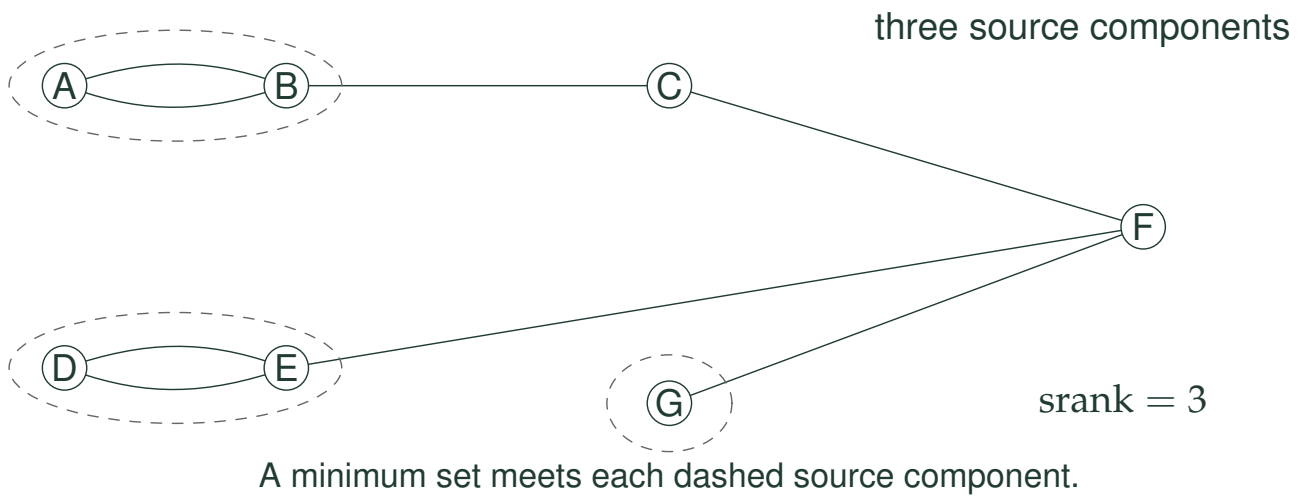
The arrows below are the entire supplied transport graph. Vertices joined by paths in both directions form strongly connected components. The components \(\{A,B\}\), \(\{D,E\}\), and \(\{G\}\) have no incoming edge from outside themselves.
Reading the drawing
Vertices are supplied residual objects and arrows are admissible directed transports. Strongly connected components group mutually reachable objects. A starting seed is needed in every source component. Direction matters; an edge does not automatically supply a reverse transport.
Drawing labels and data 10 labels
Read the original labels as selectable text. Tables preserve grid relationships; other short labels are grouped compactly.
- A
- B
- D
- E
- C
- F
- G
- three source components
- \(\operatorname{srank}=3\)
A minimum set meets each dashed source component.
A lower bound and a construction
Any seed set reaching every vertex must meet all three source components. Otherwise there is no path into the omitted source. Conversely, one representative from each source reaches \(C\) and \(F\) as well. The directed seed rank is therefore three.
There are precisely four minimum seed sets:
The example checks this by exhaustive enumeration of all \(2^7\) subsets, independently of the strongly connected component calculation. Adding an admissible edge cannot increase the required seed count. In particular, adding \(F\to G\) makes \(G\) reachable from the other sources, reducing the count to two.
The graph theorem is exact for the graph supplied. It does not establish that a proposed twist, induction, or arithmetic transfer preserves a determinant, local condition, or occupancy theorem. Those facts justify the arrows before graph optimization begins.
Read this as
Count source components, not all components and not all vertices. But do not add an arithmetic arrow merely because it would improve the count.