
10 Finite spectral occupancy
On this page · Permalink · Source line 1618
System completion produces arithmetic members. It does not prove that a desired packet occurs in a global carrier. In a fixed finite-dimensional semisimple carrier, however, occupancy is an exact projector question.
Let \(E\) be a field of characteristic zero and let \(T_1,\ldots,T_N\) be commuting operators on a finite-dimensional \(E\)-vector space \(A\), each diagonalizable over \(E\). Thus the selected spectra split over the coefficient field. Let \(a_i\in E\) be a selected target scalar for \(T_i\), possibly absent from its spectrum. Define
with \(e_i=0\) if \(a_i\) is absent.
Theorem 10.1: Exact finite occupancy trace
The operator \(e_T\) is the projector onto the joint eigenspace
Moreover,
The trace is identified with its unique nonnegative integer preimage under \({\mathbf Z}\hookrightarrow E\). Thus \({\operatorname{Tr}}(e_T)>0\) refers to that integer, not to an ordering of an arbitrary field \(E\). The finite packet is occupied exactly when this integer is positive. In positive characteristic the field-valued trace can vanish for a nonzero projector; the rank test, not a positive field trace, must then be used.
Read proof · Visual guide: Pairwise occupancy can still fail jointly · Visual guide: The hypotheses do real work · Read statement and proof side by side · Permalink · Source line 1633 · Claim record · Lean coverage · Code · Worked examples
Proof of Theorem 10.1
For each operator, its finite set of actual eigenvalues is used without multiplicity. The polynomial
is used when \(a\) occurs, and the zero polynomial otherwise. For an eigenvector \(T_i v=bv\), evaluation gives
Because the eigenspaces span \(A\), this proves that \(e_i=p_{i,a_i}(T_i)\) maps all of \(A\) into the selected eigenspace and fixes that eigenspace pointwise. It therefore proves the individual projector and image assertions, including an absent target.
Polynomials in commuting operators commute. If projections \(P,Q\) onto \(U,W\) commute, then \(PQ\) maps into both \(U\) and \(W\), and fixes every vector in \(U\cap W\). Induction proves that the actual ordered product \(e_T\) is a projection onto \(A_T\); commutation also makes the result independent of the ordering. An empty list of conditions gives the identity.
For a projection onto a subspace, the direct sum of its image and kernel identifies it with \(I\oplus0\). Thus its trace in \(E\) is the natural dimension of its image cast into \(E\). In characteristic zero this cast is injective, so there is a unique natural integer represented by the trace. That integer is positive exactly when the joint eigenspace contains a nonzero vector.
Back to statement · Read statement and proof side by side · Permalink · Source line 1649 · Claim record · Lean coverage · Code · Worked examples
Naturality and finite hypotheses.
On this page · Permalink · Source line 1679
If \(F T_i=U_i F\) and the source operators split, then \(F e_{T,a}=e_{U,a}F\). This follows first on source eigenvectors and then on their span. In particular, a change of basis conjugates the constructed projector and preserves its trace. Adding conditions decreases the actual joint eigenspace and cannot increase its dimension. These statements do not assume an orthonormal basis or a positive definite inner product.
A specified finite realization.
On this page · Permalink · Source line 1687
On \({\mathbf Q}^4\), take the diagonal operators with diagonal lists
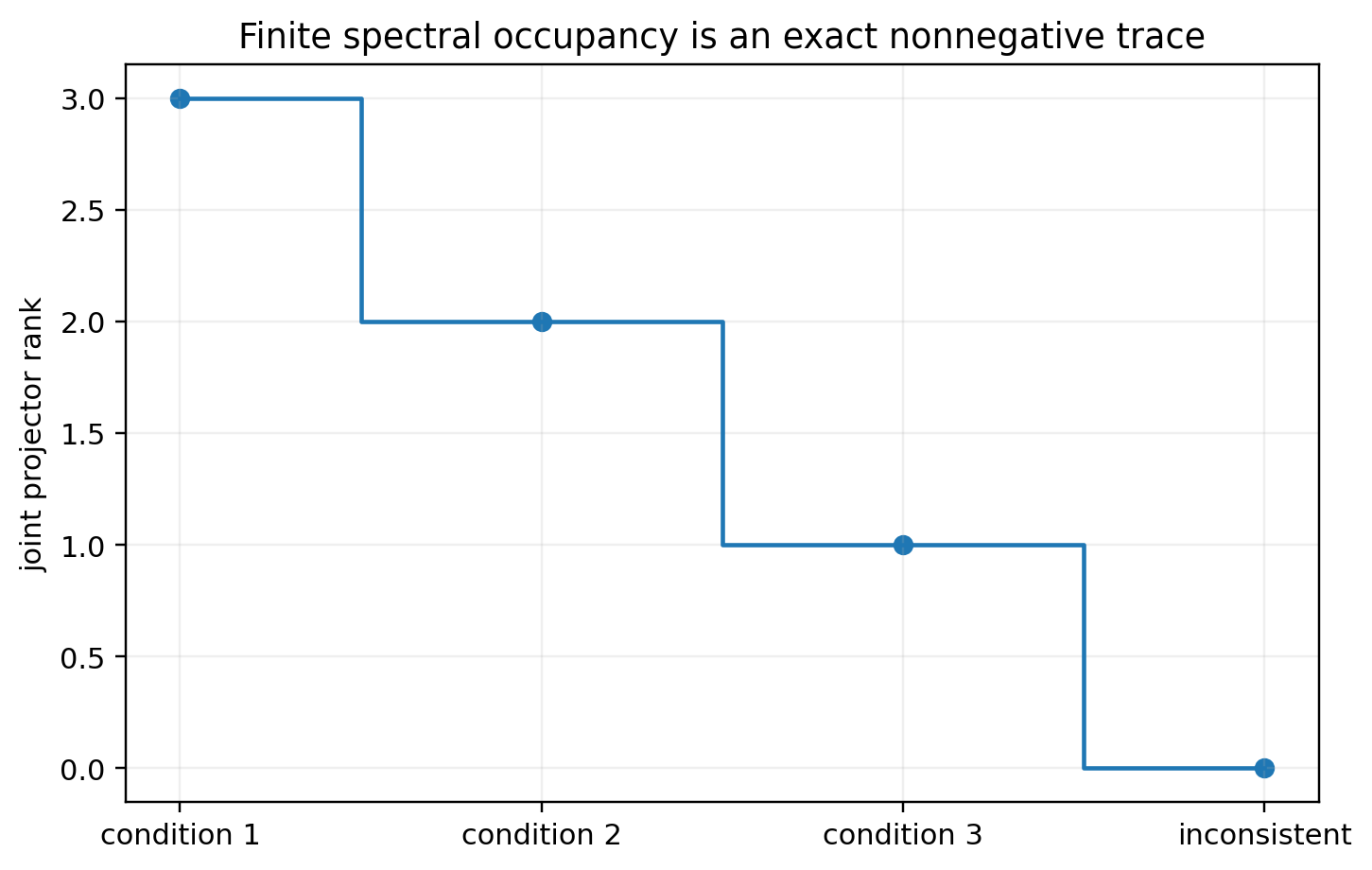
and target scalars \((1,2,3,4)\). All four targets occur individually. Imposing these conditions successively gives actual projector ranks \(3,2,1,0\). The last packet is empty despite individual feasibility. The formal code checks these operators, projector formulas, traces, and dimensions. This is a newly specified realization, not a claim to have recovered the original companion implementation.
Why the hypotheses cannot be omitted.
On this page · Permalink · Source line 1699
For
each operator is idempotent, but \(PQ\) is not idempotent and has trace \(1/2\). For the Jordan block \(J=\left(\begin{smallmatrix}1&1\\0&1\end{smallmatrix}\right)\), the singleton-spectrum Lagrange polynomial is \(1\), so the formula produces the identity although the eigenspace at \(1\) is only a line. Both failures are exact formal counterexamples to dropping the corresponding hypotheses, not counterexamples to the theorem with those hypotheses retained.
Conjecture 10.2: Universal occupancy
For every admissible finite arithmetic packet in the intended global class, there exists a finite-dimensional carrier in which the associated joint projector has positive trace.
Permalink · Source line 1719 · Claim record · Lean coverage · Code · Worked examples
This conjecture is not a consequence of the projector formula. The formula measures occupancy exactly once the carrier is fixed. It cannot force the trace to be positive.