3 Lift forests and inverse-limit reconstruction
On this page · Permalink · Source line 243
Fix \(\bar x\in\mathcal M(k)\). For \(m\ge1\), set
Reduction gives transition maps
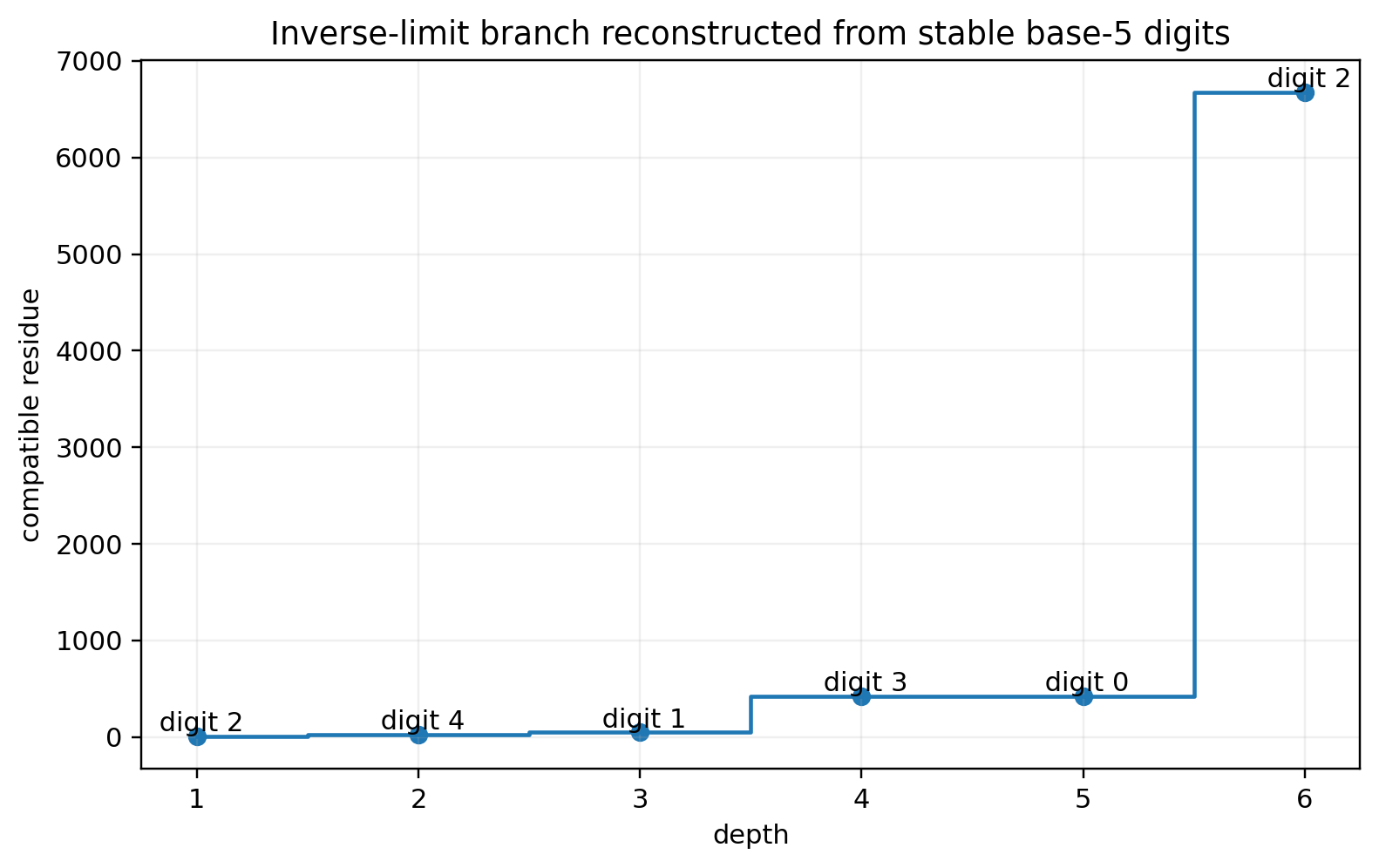
A compatible branch is a sequence \((x_m)_{m\ge1}\) satisfying
Classical input 3.1: Represented complete deformation problems
When a deformation functor is represented by a complete local ring \(R_{\bar x}\), its \({\mathcal O}\)-valued points are continuous local maps \(R_{\bar x}\to{\mathcal O}\). Completeness identifies such maps with compatible maps to every quotient \({\mathcal O}/\varpi^m\).
Permalink · Source line 258 · Claim record · Lean coverage · Code · Worked examples
Theorem 3.2: Formal inverse-limit reconstruction
Assume \(\mathcal M_{\bar x}\) is represented by a complete local \({\mathcal O}\)-algebra \(R_{\bar x}\). Then reduction induces a natural bijection
Read proof · Visual guide: A branch fixes digits permanently · Read statement and proof side by side · Permalink · Source line 262 · Claim record · Lean coverage · Code · Worked examples
Proof of Theorem 3.2
A continuous local homomorphism \(R_{\bar x}\to{\mathcal O}\) reduces to a compatible family of homomorphisms into \({\mathcal O}/\varpi^m\). Conversely, compatible finite-level maps determine a map
The two constructions are inverse because equality in a separated complete ring is detected modulo every power of its maximal ideal.
Back to statement · Read statement and proof side by side · Permalink · Source line 274 · Claim record · Lean coverage · Code · Worked examples
Theorem 3.3: Finite-branch compactness
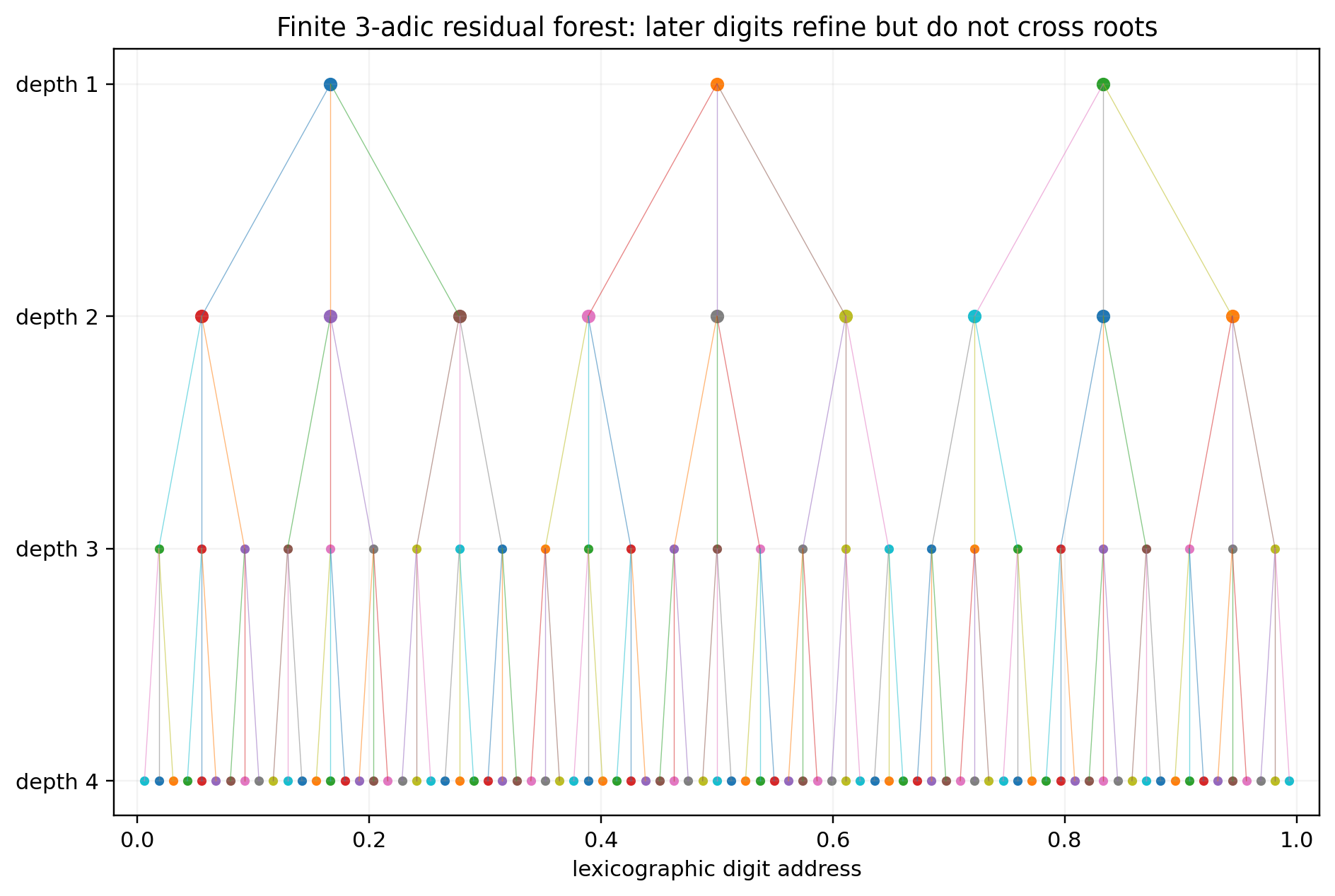
Suppose every \(X_m(\bar x)\) is finite and nonempty and every node has finitely many children. Then the lift tree above \(\bar x\) contains an infinite compatible branch.
Read proof · Visual guide: Why finiteness enters compactness · Read statement and proof side by side · Permalink · Source line 282 · Claim record · Lean coverage · Code · Worked examples
Proof of Theorem 3.3
The tree is infinite because it has a nonempty level at every depth, and it is finitely branching by hypothesis. König's lemma gives an infinite path. The edge relation is reduction, so that path is a compatible branch.
Back to statement · Read statement and proof side by side · Permalink · Source line 286 · Claim record · Lean coverage · Code · Worked examples
Surjectivity of every transition map is sufficient but not necessary. Finite branching and nonempty arbitrarily deep levels are the compactness mechanism.
Proposition 3.4: Smooth formal branch count
If
then
Fix a uniformizer and a section \(s:k\to{\mathcal O}\) of reduction, with \(s(0)=0\). Every \({\mathcal O}\)-valued branch is encoded by \(d\) positive-depth digit streams
Read proof · Visual guide: A smooth chart has independent choices · Read statement and proof side by side · Permalink · Source line 292 · Claim record · Lean coverage · Code · Worked examples
Proof of Proposition 3.4
A local map sends each parameter into the image of \((\varpi)\) in \({\mathcal O}/\varpi^m\). Conversely, every tuple in that image is nilpotent and defines a coefficient-preserving evaluation homomorphism. This homomorphism is local. To prove uniqueness without assuming continuity of an arbitrary competing homomorphism, observe in one variable that a homomorphism killing \(X^N\) only sees the finite polynomial truncation modulo \(X^N\). Induction over the finite number of variables gives uniqueness in all dimensions. The actual local maps are therefore in bijection with the full parameter tuple set. Its cardinality is \(q^{d(m-1)}\), including the zero-dimensional chart.
For integral maps, reduce an arbitrary tuple in \((\varpi){\mathcal O}\) at every precision, evaluate there, and use the represented-map reconstruction theorem. The finite evaluations are compatible, the reconstructed algebra map is local, and every competing local map has the same finite reductions. Separatedness gives uniqueness. Local maps are continuous in the maximal-ideal adic topologies. This establishes the integral parameter classification rather than assuming it from the finite count.
For the digit claim, subtract the chosen representative of the residue and divide the remainder by the uniformizer. Iterating gives unique digits. Conversely, the partial sums of any digit stream form a compatible Cauchy family and reconstruct uniquely by completeness and separatedness. More precisely, for each parameter there is a unique stream \((a_{i,j})_{j\ge1}\) such that
The section is a set-theoretic section of reduction, not an asserted embedding of residue fields into the coefficient ring. Finally, a supplied local \({\mathcal O}\)-algebra isomorphism from \(R_{\bar x}\) transports both the map classification and the count.
Back to statement · Read statement and proof side by side · Permalink · Source line 310 · Claim record · Lean coverage · Code · Worked examples