
Paper X · Visual guide
Explore the 30 visuals
Read all 30 visuals with 29 original drawings, selectable equations, descriptions, and transcripts of the drawing labels. Each worked example links to the manuscript passages it illustrates; evidence notes retain their source edition’s scope.
One of the 29 drawings belongs to the two opening scope sections below; the remaining 28 accompany the numbered plates.
The current reading contract
Permalink · Original opening source line 99
This guide preserves the Block 27 and scalar/Mellin worked examples. Their stated checkpoint limits belong to those source revisions. The later occupied-system endpoint is checked at its amended conditional scope: 20/20 internal claims. Actual completed source members, inverse-limit profile closure, compatible carrier presentations and constituent local comparisons remain supplied inputs.
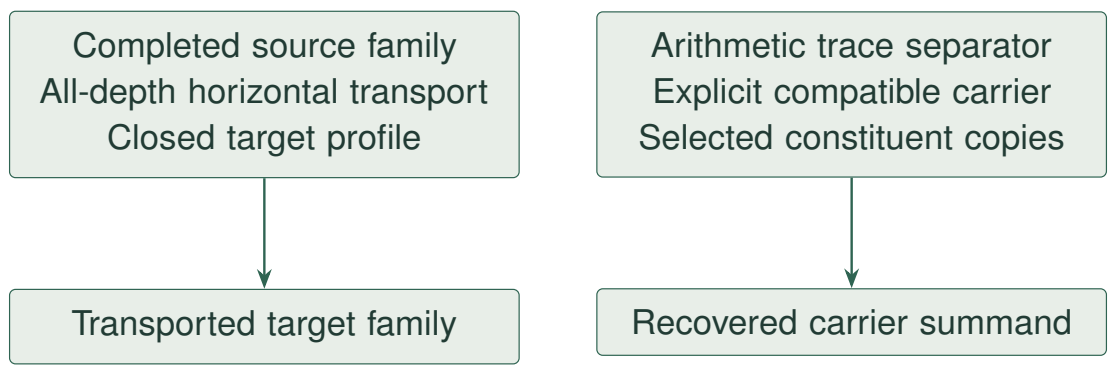
Reading the drawing
The left arrow starts with a completed source family, all-depth horizontal transport and a closed target profile, and produces a transported target family. The right arrow starts with an arithmetic trace separator, an explicit compatible carrier and selected constituent copies, and produces a recovered carrier summand. There is no arrow identifying the two outputs. The surrounding source text states the additional comparison and occupancy inputs.
Drawing labels and data 4 labels
Read the original labels as selectable text. Tables preserve grid relationships; other short labels are grouped compactly.
Completed source family
All-depth horizontal transport
Closed target profile
- Transported target family
Arithmetic trace separator
Explicit compatible carrier
Selected constituent copies
- Recovered carrier summand
The endpoint proves both outputs. It does not assert that their supplied local structures have been identified. Zero multiplicity is allowed; nonzero occupancy needs its own input. All-place carrier recovery needs the pointwise presentations at each place.
A checked scope and a later unpromoted scope
Permalink · Original opening source line 113
The final checked conditional release records two successful builds, matching proof objects, source and axiom checks, and negative controls. Its exact production source and saved records accompany this edition. A later stronger residual-system attempt records 19/20, no promoted endpoint, and an unavailable pinned Lean executable. The two records describe different input contracts.
The traditional edition gives the complete retained manuscript and the later conditional assembly. The Lean guide shows the source-exact endpoint, its proof structure and its evidence. The PDF build checks presentation. The separate October 20 production run freshly compiles the selected 122-module closure; its source selection and exact limits are recorded in the Lean guide.