
Paper II asks three different questions that can all sound like “increase the resolution.” This guide separates them, then follows small objects far enough that the distinctions can be computed rather than merely named.
Reading the drawing
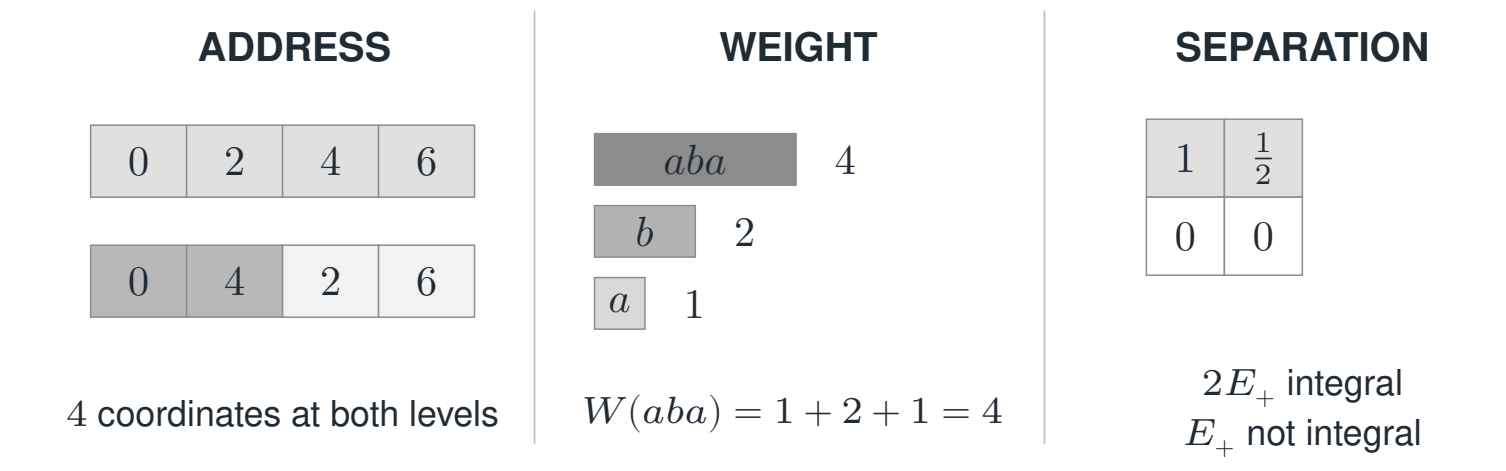
Three panels distinguish regrouping unchanged coordinates, adding the weights of operator letters, and clearing a rational projector denominator. The panel dividers do not represent maps between these operations.
Drawing labels and data 24 labels
Read the original labels as selectable text. Tables preserve grid relationships; other short labels are grouped compactly.
- ADDRESS
- WEIGHT
- SEPARATION
- \(0\)
- \(2\)
- \(4\)
- \(6\)
- \(0\)
- \(4\)
- \(2\)
- \(6\)
- \(4\text{ coordinates at both levels}\)
- \(a\)
- \(1\)
- \(b\)
- \(2\)
- \(aba\)
- \(4\)
- \(W(aba)=1+2+1=4\)
| Row / column | Column 1 | Column 2 |
|---|---|---|
| Row 1 | \(1\) | \(\frac{1}{2}\) |
| Row 2 | \(0\) | \(0\) |
\(2E_+\) integral
\(E_+\) not integral
Evidence note from the source edition
Three different operations. On the left, all coefficients survive a regrouping. In the middle, an integer weight controls which operator words can matter modulo a chosen power. On the right, a rational projector needs a denominator cleared before integral precision can be recovered.
Address resolution
A coefficient such as \(x_6\) can sit in the even packet, then the residue-\(2\) packet modulo \(4\), then the residue-\(6\) packet modulo \(8\). Its value does not become more accurate. Its address becomes more specific, while the full object remains exactly reconstructible.
Arithmetic precision
An operator word with total filtration weight at least \(L\) vanishes in the specified depth-\(L\) quotient. Increasing \(L\) can make additional words relevant. This is a change in the precision of the ring in which the answer is required, not a lossless rearrangement of one fixed list.
Separation precision
For the integral involution used later, \(E_+=(I+A)/2\) is an exact rational projector but not an integral one at \(2\). One extra input digit suffices to recover the projected difference to the requested precision. The packet is present over the fraction field even when its integral separation is delayed.
Read this as
Keep three quantities distinct: the packet address, the precision cutoff, and the denominator weight. Finer addresses do not automatically improve arithmetic precision or remove a spectral denominator.