
Let \(E_{ij}\) send the \(j\)th basis vector to the \(i\)th. In integral \(2\times2\) matrices set
Their certified dyadic weights are \(1\) and \(2\). At precision \(L=5\), every word of weight at least five vanishes modulo \(32\).
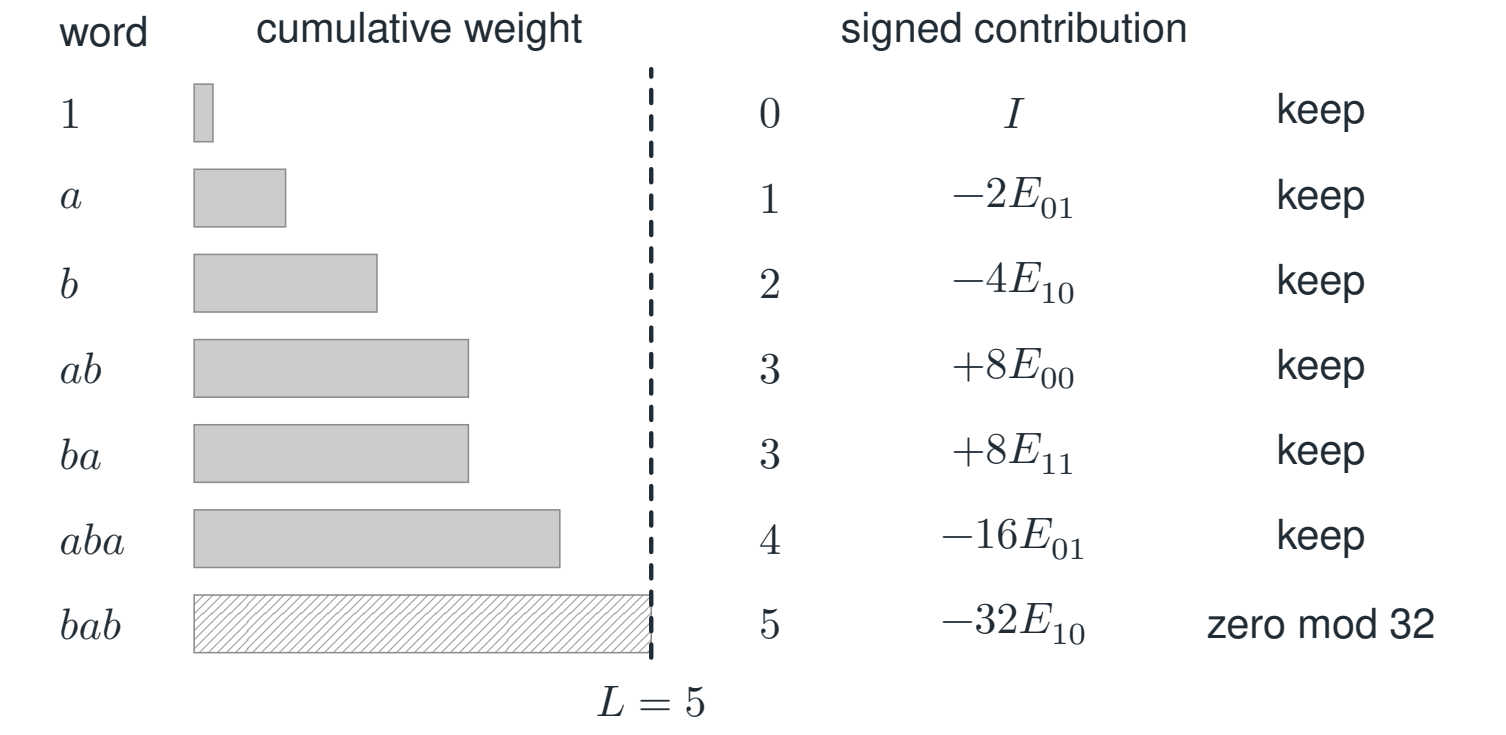
Reading the drawing
Rows give the displayed operator words, their total weights and signed matrix contributions. The first discarded nonzero word reaches the cutoff. A short word can still vanish algebraically.
Drawing labels and data 32 labels
Read the original labels as selectable text. Tables preserve grid relationships; other short labels are grouped compactly.
- \(L=5\)
| word | cumulative weight | signed contribution | Status |
|---|---|---|---|
| \(1\) | \(0\) | \(I\) | keep |
| \(a\) | \(1\) | \(-2E_{01}\) | keep |
| \(b\) | \(2\) | \(-4E_{10}\) | keep |
| \(ab\) | \(3\) | \(+8E_{00}\) | keep |
| \(ba\) | \(3\) | \(+8E_{11}\) | keep |
| \(aba\) | \(4\) | \(-16E_{01}\) | keep |
| \(bab\) | \(5\) | \(-32E_{10}\) | zero mod 32 |
Evidence note from the source edition
All nonzero retained terms of the signed inverse sum, followed by the first discarded nonzero word. The empty word contributes \(I\). Other words of weight below five can still be zero because \(a^2=b^2=0\).
The words are written matrix products: in \(ab\), the map \(b\) acts first. Therefore
The two products \(ab\) and \(ba\) cannot be identified merely because they have equal weight. Both their order and their source/target information matter.
The pruning rule supplies a sufficient reason for a term to vanish. It is not an assertion that every word below the threshold contributes nontrivially. Packet incompatibility and algebraic relations can remove additional words.
Read this as
Length controls the sign. Cumulative weight controls precision. The ordered matrix product controls the actual contribution. None of these three can replace the others.