
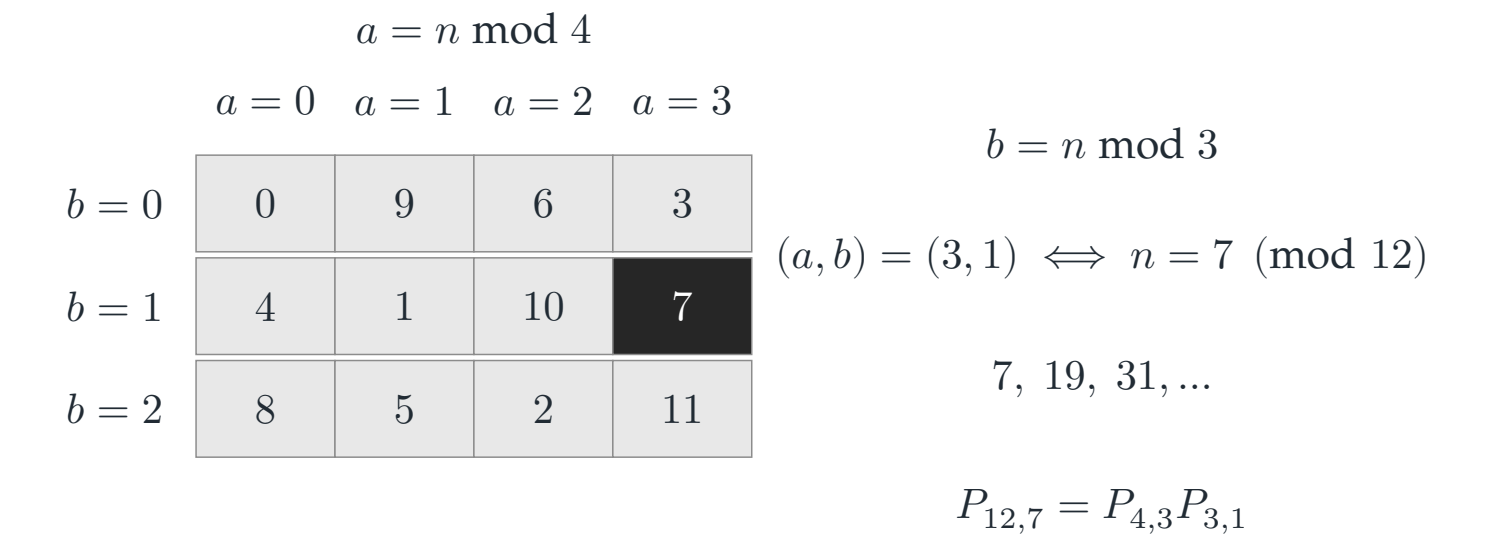
Because \(4\) and \(3\) are coprime, a residue modulo \(12\) is specified by a column \(a=n\bmod4\) and a row \(b=n\bmod3\). Each cell contains the unique combined address.
Reading the drawing
The rectangular grid lists the twelve residue addresses once. Row and column selectors identify a common cell; shading selects its congruence class.
Drawing labels and data 24 labels
Read the original labels as selectable text. Tables preserve grid relationships; other short labels are grouped compactly.
| Row / column | \(a=0\) | \(a=1\) | \(a=2\) | \(a=3\) |
|---|---|---|---|---|
| \(b=0\) | \(0\) | \(9\) | \(6\) | \(3\) |
| \(b=1\) | \(4\) | \(1\) | \(10\) | \(7\) |
| \(b=2\) | \(8\) | \(5\) | \(2\) | \(11\) |
- \(a=n\bmod4\)
- \(b=n\bmod3\)
- \((a,b)=(3,1)\ \Longleftrightarrow\ n=7\pmod{12}\)
- \(7,\ 19,\ 31,\ldots\)
- \(P_{12,7}=P_{4,3}P_{3,1}\)
Evidence note from the source edition
The twelve cells are a permutation of \(0,\ldots,11\), not twelve extra degrees of freedom. The selected cell contains every integer congruent to \(7\) modulo \(12\).
An explicit reconstruction formula is
because \(9\) is one modulo four and zero modulo three, while \(4\) has the opposite pair of residues. For \((a,b)=(3,1)\) this gives \(31\equiv7\).
Applying the two masks in either order gives
More generally, an address survives exactly when it satisfies both congruences. The coprime reconstruction identifies this intersection with one combined residue class.
The hypothesis can be seen failing
Replace \(4\) and \(3\) by \(4\) and \(6\). The requirements \(n\equiv0\pmod4\) and \(n\equiv1\pmod6\) are incompatible: the first makes \(n\) even and the second makes it odd. A full rectangular address product no longer exists. Compatible pairs must agree modulo the greatest common divisor.
Read this as
CRT separates address coordinates. It does not claim that dyadic and odd spectral projectors have the same denominator weights or the same lifting behavior.