
The projector acts by
Its factor \(1/2\) can consume one dyadic digit. The claim concerns differences: if the inputs agree modulo \(2^{m+1}\Lambda\), their projected differences lie in \(2^m\Lambda\).
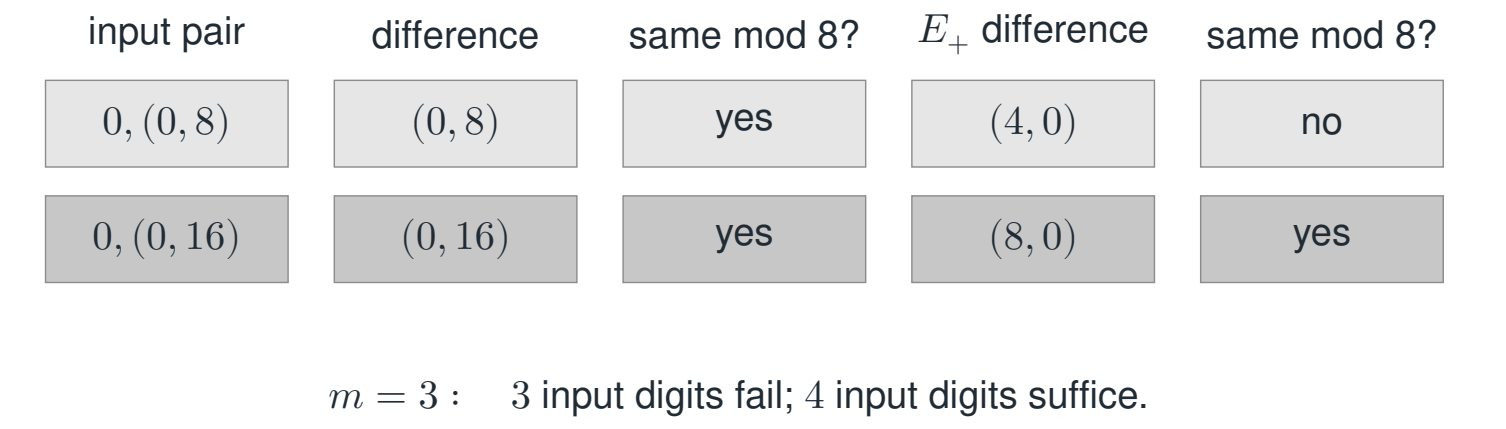
Reading the drawing
The two displayed inputs agree at one depth while their rationally projected differences require finer input precision. The labels give the exact example and denominator weight.
Drawing labels and data 16 labels
Read the original labels as selectable text. Tables preserve grid relationships; other short labels are grouped compactly.
| Row / column | input pair | difference |
|---|---|---|
| Row 1 | \(0,(0,8)\) | \((0,8)\) |
| Row 2 | \(0,(0,16)\) | \((0,16)\) |
- same mod 8?
- \(E_+\) difference
- same mod 8?
- yes
- \((4,0)\)
- no
- yes
- \((8,0)\)
- yes
Evidence note from the source edition
For \(m=3\), inputs differing by \((0,8)\) agree modulo eight, but their projected outputs differ by \((4,0)\) and do not. Raising the input agreement to modulo sixteen makes the projected outputs agree modulo eight.
The example works at every positive depth:
Thus a zero-delay promise fails, while one extra input digit is sufficient. This witnesses sharpness for the specified projector and lattice.
The general calculation is just as short
If \(\pi^sE\Lambda\subseteq\Lambda\) and \(x-y=\pi^{m+s}v\), then
No rounding procedure is hiding in this identity. Nor does it authorize reducing \(E\) modulo \(\pi\) when its entries are nonintegral. Individual projected points may lie in a fractional lattice. The theorem controls their difference at the stated integral scale.
Accuracy and branching are different views
The later Smith example records how many inputs share one output at finite depth. Here we ask how accurately an input must be known to determine a projected output difference. Both involve directional divisibility, but they are different questions.
Read this as
The phrase “one lost digit” has an exact meaning: both a sufficiency theorem and an explicit pair of inputs showing that a smaller delay fails.