
Use a finite periodic carrier \(X={\mathbb Q}^8\) for this example. Let \(Se_j=e_{j+1\bmod8}\) and let
This is a concrete cyclic model, not an unannounced boundary convention for the finitely supported signal on V20. Write \(R_N\) for the permutation that groups coordinates in increasing residue order modulo \(N\).
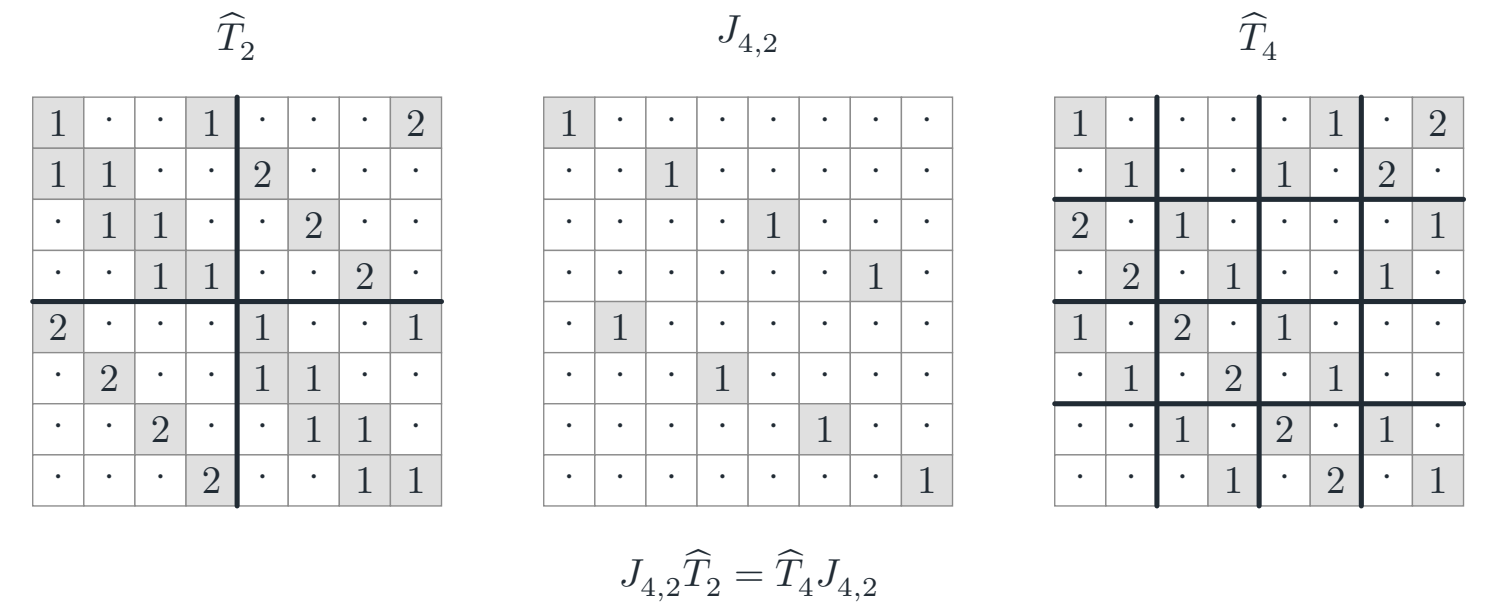
Reading the drawing
Rows are outputs and columns are inputs. Heavy rules mark packet blocks. The middle permutation changes the coordinate order, and the last matrix is the same operator in the new coordinates.
Drawing labels and data 196 labels
Read the original labels as selectable text. Tables preserve grid relationships; other short labels are grouped compactly.
- \(\widehat T_2\)
| Row / column | Column 1 | Column 2 | Column 3 | Column 4 | Column 5 | Column 6 | Column 7 | Column 8 |
|---|---|---|---|---|---|---|---|---|
| Row 1 | \(1\) | \(\cdot\) | \(\cdot\) | \(1\) | \(\cdot\) | \(\cdot\) | \(\cdot\) | \(2\) |
| Row 2 | \(1\) | \(1\) | \(\cdot\) | \(\cdot\) | \(2\) | \(\cdot\) | \(\cdot\) | \(\cdot\) |
| Row 3 | \(\cdot\) | \(1\) | \(1\) | \(\cdot\) | \(\cdot\) | \(2\) | \(\cdot\) | \(\cdot\) |
| Row 4 | \(\cdot\) | \(\cdot\) | \(1\) | \(1\) | \(\cdot\) | \(\cdot\) | \(2\) | \(\cdot\) |
| Row 5 | \(2\) | \(\cdot\) | \(\cdot\) | \(\cdot\) | \(1\) | \(\cdot\) | \(\cdot\) | \(1\) |
| Row 6 | \(\cdot\) | \(2\) | \(\cdot\) | \(\cdot\) | \(1\) | \(1\) | \(\cdot\) | \(\cdot\) |
| Row 7 | \(\cdot\) | \(\cdot\) | \(2\) | \(\cdot\) | \(\cdot\) | \(1\) | \(1\) | \(\cdot\) |
| Row 8 | \(\cdot\) | \(\cdot\) | \(\cdot\) | \(2\) | \(\cdot\) | \(\cdot\) | \(1\) | \(1\) |
- \(J_{4,2}\)
| Row / column | Column 1 | Column 2 | Column 3 | Column 4 | Column 5 | Column 6 | Column 7 | Column 8 |
|---|---|---|---|---|---|---|---|---|
| Row 1 | \(1\) | \(\cdot\) | \(\cdot\) | \(\cdot\) | \(\cdot\) | \(\cdot\) | \(\cdot\) | \(\cdot\) |
| Row 2 | \(\cdot\) | \(\cdot\) | \(1\) | \(\cdot\) | \(\cdot\) | \(\cdot\) | \(\cdot\) | \(\cdot\) |
| Row 3 | \(\cdot\) | \(\cdot\) | \(\cdot\) | \(\cdot\) | \(1\) | \(\cdot\) | \(\cdot\) | \(\cdot\) |
| Row 4 | \(\cdot\) | \(\cdot\) | \(\cdot\) | \(\cdot\) | \(\cdot\) | \(\cdot\) | \(1\) | \(\cdot\) |
| Row 5 | \(\cdot\) | \(1\) | \(\cdot\) | \(\cdot\) | \(\cdot\) | \(\cdot\) | \(\cdot\) | \(\cdot\) |
| Row 6 | \(\cdot\) | \(\cdot\) | \(\cdot\) | \(1\) | \(\cdot\) | \(\cdot\) | \(\cdot\) | \(\cdot\) |
| Row 7 | \(\cdot\) | \(\cdot\) | \(\cdot\) | \(\cdot\) | \(\cdot\) | \(1\) | \(\cdot\) | \(\cdot\) |
| Row 8 | \(\cdot\) | \(\cdot\) | \(\cdot\) | \(\cdot\) | \(\cdot\) | \(\cdot\) | \(\cdot\) | \(1\) |
- \(\widehat T_4\)
| Row / column | Column 1 | Column 2 | Column 3 | Column 4 | Column 5 | Column 6 | Column 7 | Column 8 |
|---|---|---|---|---|---|---|---|---|
| Row 1 | \(1\) | \(\cdot\) | \(\cdot\) | \(\cdot\) | \(\cdot\) | \(1\) | \(\cdot\) | \(2\) |
| Row 2 | \(\cdot\) | \(1\) | \(\cdot\) | \(\cdot\) | \(1\) | \(\cdot\) | \(2\) | \(\cdot\) |
| Row 3 | \(2\) | \(\cdot\) | \(1\) | \(\cdot\) | \(\cdot\) | \(\cdot\) | \(\cdot\) | \(1\) |
| Row 4 | \(\cdot\) | \(2\) | \(\cdot\) | \(1\) | \(\cdot\) | \(\cdot\) | \(1\) | \(\cdot\) |
| Row 5 | \(1\) | \(\cdot\) | \(2\) | \(\cdot\) | \(1\) | \(\cdot\) | \(\cdot\) | \(\cdot\) |
| Row 6 | \(\cdot\) | \(1\) | \(\cdot\) | \(2\) | \(\cdot\) | \(1\) | \(\cdot\) | \(\cdot\) |
| Row 7 | \(\cdot\) | \(\cdot\) | \(1\) | \(\cdot\) | \(2\) | \(\cdot\) | \(1\) | \(\cdot\) |
| Row 8 | \(\cdot\) | \(\cdot\) | \(\cdot\) | \(1\) | \(\cdot\) | \(2\) | \(\cdot\) | \(1\) |
- \(J_{4,2}\widehat T_2=\widehat T_4J_{4,2}\)
Evidence note from the source edition
Actual \(8\times8\) matrices. Dots are zero entries. The other entries are exact integers. Heavy lines mark the packet blocks: size four at level two and size two at level four.
The reordered operators and change of coordinates are
Multiplication cancels the intermediate coordinate maps:
Thus it makes no difference whether the operator is applied before or after a consistent coordinate change. One must transport the operator, not merely reuse the same numerical matrix under a new ordering.
Refined blocks still reconstruct the same map
A coarse block expands as
The terms are maps embedded in the original source and target spaces. Adding their norms, or adding their matrix entries after forgetting the embeddings, is not this operator identity.
Read this as
The fine matrix contains a different block organization of the same operator. An independently guessed coarse matrix is a separate approximation problem, measured later by a defect.