
Take \(N=3\) and work in \(\mathbb F_7\). Set
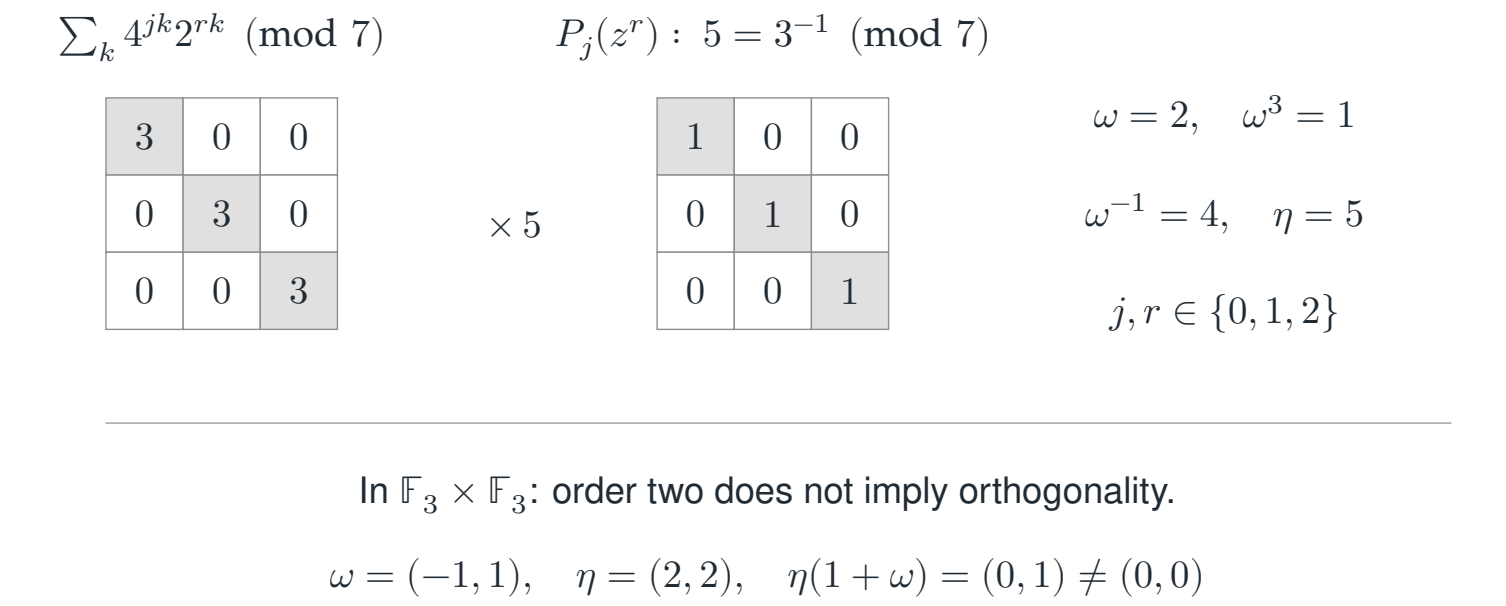
Here \(2^3=1\) and neither \(2\) nor \(2^2\) is one. The unnormalized geometric sums are the entries in the first matrix.
Reading the drawing
The entries are exact residues. The successful inverse normalization is compared with a failed certificate over a different ring; the lower failure is part of the example.
Drawing labels and data 26 labels
Read the original labels as selectable text. Tables preserve grid relationships; other short labels are grouped compactly.
- \(\sum_k4^{jk}2^{rk}\pmod7\)
| Row / column | Column 1 | Column 2 | Column 3 |
|---|---|---|---|
| Row 1 | \(3\) | \(0\) | \(0\) |
| Row 2 | \(0\) | \(3\) | \(0\) |
| Row 3 | \(0\) | \(0\) | \(3\) |
- \(\times\,5\)
- \(P_j(z^r):\ 5=3^{-1}\pmod7\)
| Row / column | Column 1 | Column 2 | Column 3 |
|---|---|---|---|
| Row 1 | \(1\) | \(0\) | \(0\) |
| Row 2 | \(0\) | \(1\) | \(0\) |
| Row 3 | \(0\) | \(0\) | \(1\) |
- \(\omega=2,\quad\omega^3=1\)
- \(\omega^{-1}=4,\quad\eta=5\)
- \(j,r\in\{0,1,2\}\)
In \(\mathbb F_3\times\mathbb F_3\): order two does not imply orthogonality.
Evidence note from the source edition
All entries are exact residues modulo seven. Multiplying the diagonal value \(3\) by \(5\) produces \(1\). The lower calculation is a genuine failed Fourier certificate in a different coefficient ring.
On the monomial \(z^n\), define \(UF(z)=F(2z)\). The proposed projector acts by
The identity \(2^3=1\) makes this depend only on \(n\bmod3\). The nine-entry table therefore establishes the formula for every exponent once periodicity is used, rather than requiring a separate test at every coefficient.
Order alone is not sufficient over every ring
In \(\mathbb F_3\times\mathbb F_3\), the element \((-1,1)\) has order two, but one component is a trivial character. Its nontrivial Fourier sum does not vanish in that component. Thus an element of order \(N\) in a ring with zero divisors is not, by itself, the full orthogonality certificate.
Read this as
The finite table is a checkable sufficient input. Over a field, a primitive root supplies it. Over a more general ring, inspect the actual table instead of inferring orthogonality from order alone.