
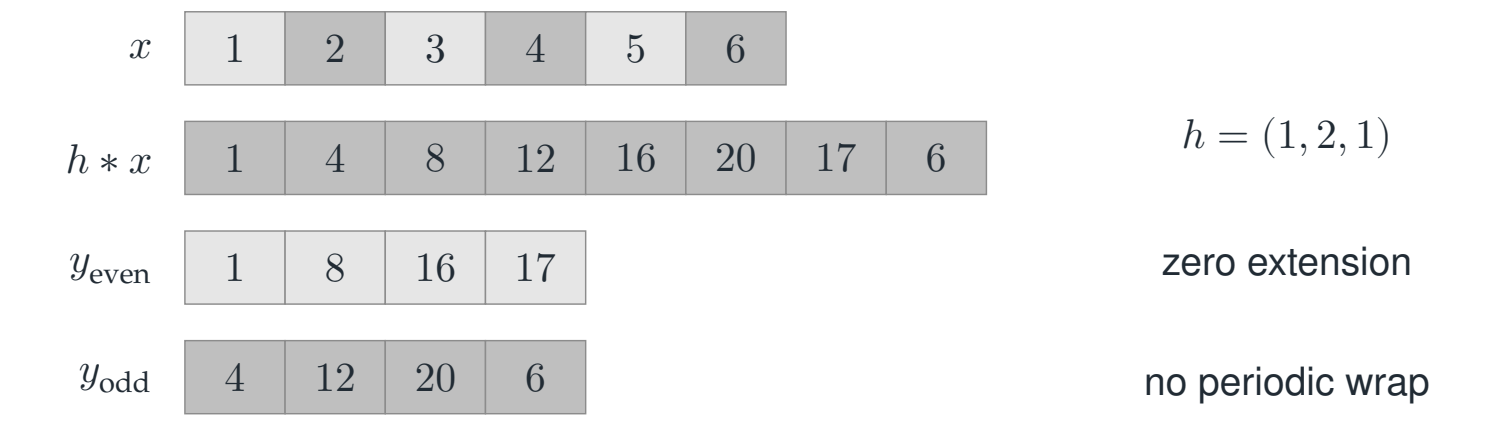
Use the finitely supported signal \(x=(1,2,3,4,5,6)\) and the filter \(h=(1,2,1)\). Outside the displayed support, the input is zero. Let \(e_m=x_{2m}\) and \(o_m=x_{2m+1}\).
Reading the drawing
The upper rows retain the signal and filter coefficients. The output includes both tail coefficients; interleaving its two phase rows recovers the complete convolution.
Drawing labels and data 29 labels
Read the original labels as selectable text. Tables preserve grid relationships; other short labels are grouped compactly.
- \(x\)
- \(1\)
- \(2\)
- \(3\)
- \(4\)
- \(5\)
- \(6\)
- \(h*x\)
- \(1\)
- \(4\)
- \(8\)
- \(12\)
- \(16\)
- \(20\)
- \(17\)
- \(6\)
- \(y_{\rm even}\)
- \(1\)
- \(8\)
- \(16\)
- \(17\)
- \(y_{\rm odd}\)
- \(4\)
- \(12\)
- \(20\)
- \(6\)
- \(h=(1,2,1)\)
- zero extension
- no periodic wrap
Evidence note from the source edition
Exact integer convolution, including both output tail coefficients. The two bottom rows are the even and odd output phases. Interleaving them reconstructs the full eight-term output.
If \(w\) denotes one delay on a phase sequence, the filter becomes
The cross-phase delay is not optional. A unit shift sends an odd sample to the next even position, while it sends an even sample to the odd position in the same phase block.
Here \(e=1+3w+5w^2\) and \(o=2+4w+6w^2\), so direct polynomial multiplication gives
This is the same result as ordinary convolution followed by residue extraction. No numerical transform or limiting argument is needed because every sequence is finitely supported.
Read this as
A phase matrix is not just a sparsity pattern. Its delay factors carry the quotient-and-remainder information needed when a shift crosses a phase boundary.