
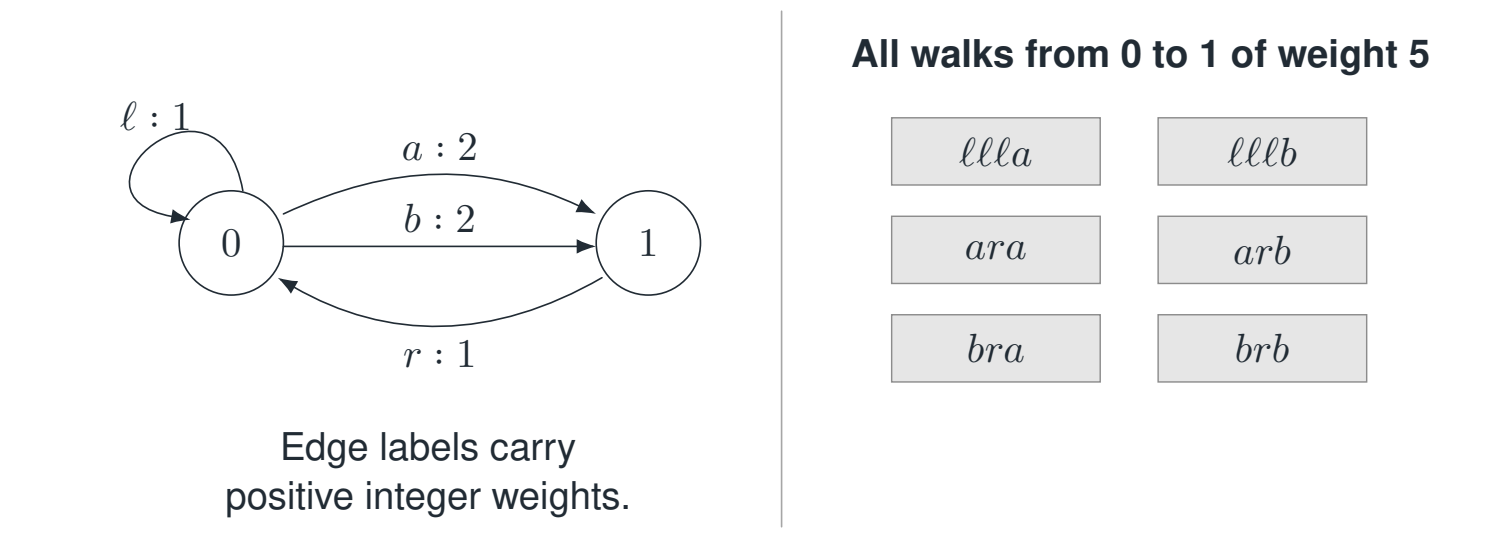
Consider the directed graph below. The loop \(\ell\) has weight one, the two distinct edges \(a,b\) from \(0\) to \(1\) each have weight two, and the return edge \(r\) has weight one.
Reading the drawing
Parallel edges remain separate choices. The word list reads traversals chronologically from left to right and permits repeated edges and vertices.
Drawing labels and data 14 labels
Read the original labels as selectable text. Tables preserve grid relationships; other short labels are grouped compactly.
- \(0\)
- \(1\)
- \(\ell:1\)
- \(a:2\)
- \(b:2\)
- \(r:1\)
Edge labels carry
positive integer weights.
- All walks from 0 to 1 of weight 5
| Row / column | Column 1 | Column 2 |
|---|---|---|
| Row 1 | \(\ell\ell\ell a\) | \(\ell\ell\ell b\) |
| Row 2 | \(ara\) | \(arb\) |
| Row 3 | \(bra\) | \(brb\) |
Evidence note from the source edition
Every word on the right is read chronologically from left to right as an edge traversal. This is intentionally different from the right-to-left action of a written operator product in V9.
A walk may revisit a vertex and reuse an edge. At total weight five there are six walks from \(0\) to \(1\). Two use three loops followed by either \(a\) or \(b\). Four travel to \(1\), return to \(0\), and travel to \(1\) again, with two independent choices of parallel edge.
Their multiplicities enter the polynomial adjacency matrix:
The coefficient \(2\) remembers the two distinct edges. Replacing it by \(1\) would count a different graph.
The first-edge decomposition
Let \(a_n(s,t)\) count walks of total weight \(n\) from \(s\) to \(t\). Removing the first edge gives
The empty walk is allowed precisely on the diagonal at weight zero. Positive weights ensure that every contributing walk has length at most \(n\), so enumeration at each fixed weight is finite.
Read this as
The graph series counts unsigned walks, including repetitions and parallel-edge multiplicity. It does not count simple paths, and it does not know whether an associated operator product vanishes or cancels.