
The word coarsening can suggest compression. In the exact coordinate theorem it means regrouping complete packet vectors. Replacing each packet by one scalar sum is a different operation and really does lose information.
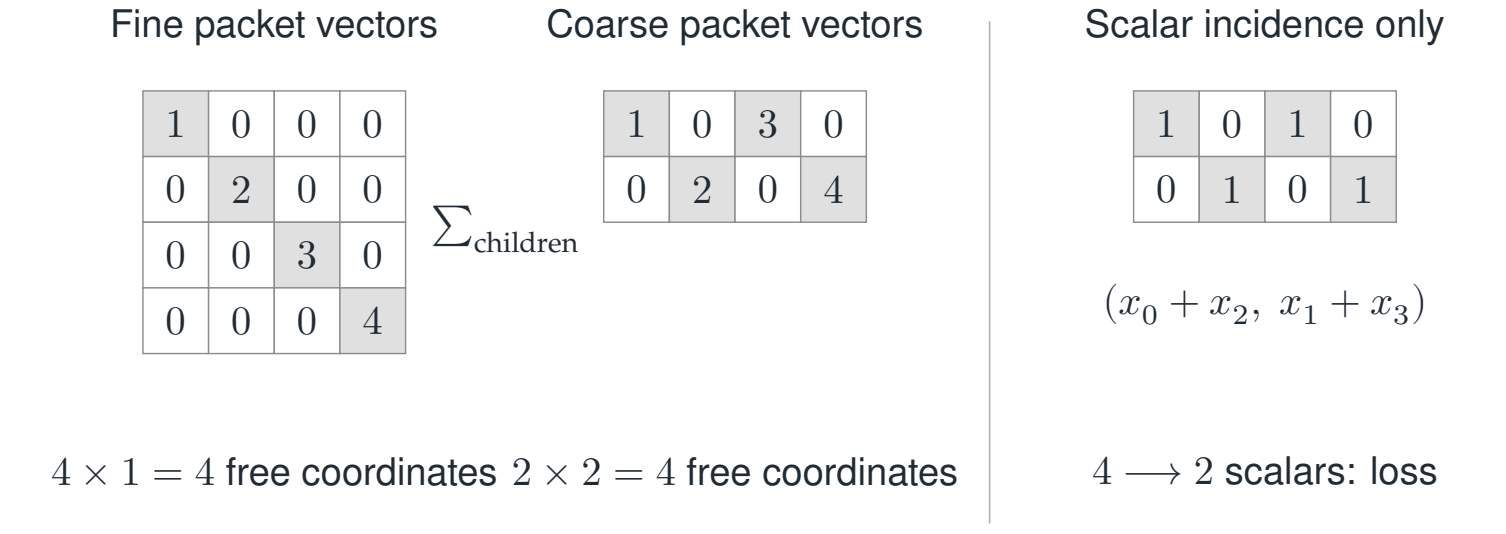
For \(x=(1,2,3,4)\), the fine packets are the four coordinate-supported vectors. Regrouping gives \((1,0,3,0)\) and \((0,2,0,4)\). Every original coordinate remains available in one of these two vectors.
Reading the drawing
The first two arrangements retain all four coordinate directions. The final matrix replaces the four coordinates with two scalar sums.
Drawing labels and data 40 labels
Read the original labels as selectable text. Tables preserve grid relationships; other short labels are grouped compactly.
- Fine packet vectors
| Row / column | Column 1 | Column 2 | Column 3 | Column 4 |
|---|---|---|---|---|
| Row 1 | \(1\) | \(0\) | \(0\) | \(0\) |
| Row 2 | \(0\) | \(2\) | \(0\) | \(0\) |
| Row 3 | \(0\) | \(0\) | \(3\) | \(0\) |
| Row 4 | \(0\) | \(0\) | \(0\) | \(4\) |
- Coarse packet vectors
| Row / column | Column 1 | Column 2 | Column 3 | Column 4 |
|---|---|---|---|---|
| Row 1 | \(1\) | \(0\) | \(3\) | \(0\) |
| Row 2 | \(0\) | \(2\) | \(0\) | \(4\) |
- \(\sum_{\rm children}\)
- \(4\times1=4\text{ free coordinates}\)
- \(2\times2=4\text{ free coordinates}\)
- Scalar incidence only
| Row / column | Column 1 | Column 2 | Column 3 | Column 4 |
|---|---|---|---|---|
| Row 1 | \(1\) | \(0\) | \(1\) | \(0\) |
| Row 2 | \(0\) | \(1\) | \(0\) | \(1\) |
- \((x_0+x_2,\ x_1+x_3)\)
- \(4\longrightarrow2\text{ scalars: loss}\)
Evidence note from the source edition
The left and middle panels store the same four independent coordinates. The right panel instead applies a \(2\times4\) numerical incidence matrix to four scalar entries. That is not the range-restricted exact coordinate map.
Define
Completeness and mutual annihilation give both inverse laws. Consequently,
The apparently larger list of fine packets simply has smaller individual packet spaces.
A kernel witnesses genuine information loss
For the scalar incidence matrix \(B\) drawn on the right,
The zero vector and \((1,0,-1,0)\) therefore have the same two scalar summaries. No inverse can recover the original four scalars from that output alone.
Read this as
Ask what each packet stores. A list of full packet vectors can be exactly invertible. A list of packet means or totals generally is not.