
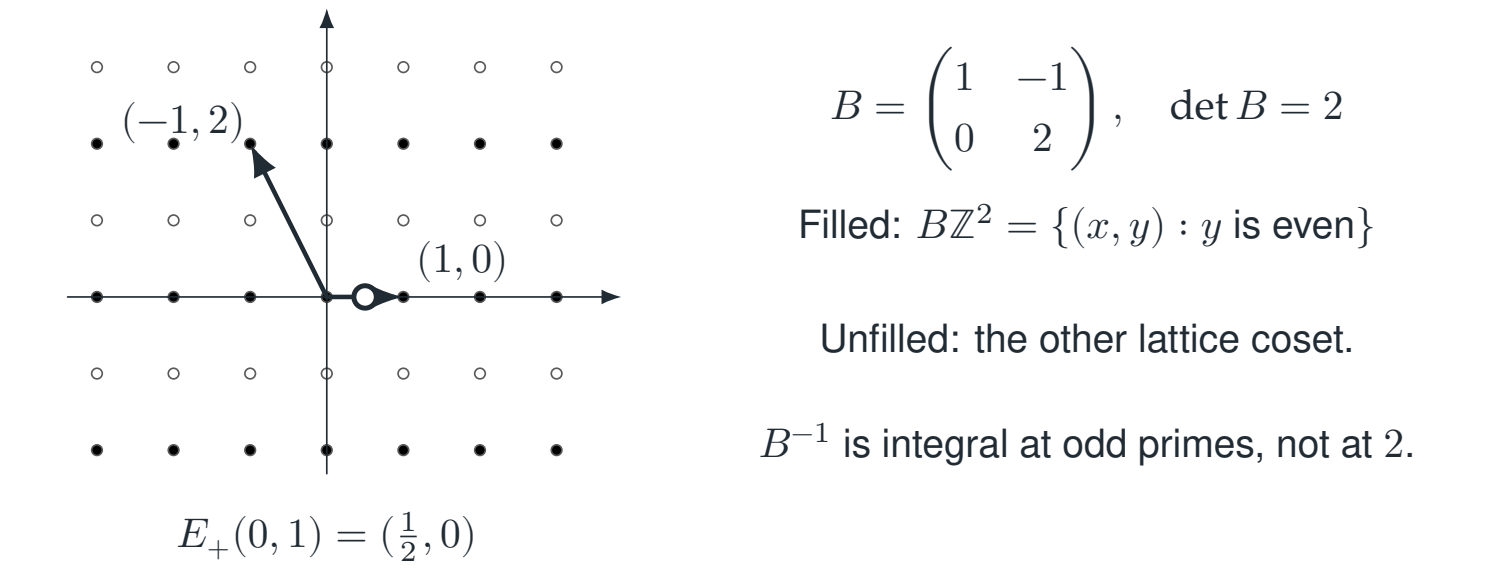
The eigenspaces are spanned by \((1,0)\) and \((-1,2)\). Their integral eigenvectors do not form an integral basis of \({\mathbb Z}^2\). The change-of-basis determinant is two.
Reading the drawing
The marked lattice points show the integral sublattice generated by the two eigenvectors. The ambient integer lattice contains additional points.
Drawing labels and data 7 labels
Read the original labels as selectable text. Tables preserve grid relationships; other short labels are grouped compactly.
- \((1,0)\)
- \((-1,2)\)
\(E_+(0,1)=(\frac12,0)\)
Filled: \(B\mathbb Z^2=\{(x,y):y\text{ is even}\}\)
- Unfilled: the other lattice coset.
- \(B^{-1}\) is integral at odd primes, not at \(2\).
Evidence note from the source edition
An ordinary integer-lattice picture, not a drawing of the topology of \({\mathbb Q}_2\). Filled dots have even second coordinate. Unfilled dots lie in the other coset. The hollow point at \((1/2,0)\) records the image of an integral vector under \(E_+\).
Write
The index-two eigenlattice explains the denominator in \(B^{-1}\) and in the projector. Over the localized lattice \(\Lambda_p={\mathbb Z}_{(p)}^2\), the number \(2\) is a unit for every odd prime \(p\). Hence the local denominator weight is zero there and one at \(p=2\).
This is a local assertion. Odd localization does not change the fact that the displayed eigenvectors span an index-two sublattice inside the ordinary integer lattice.
The special fiber does not retain the rational splitting
Modulo two, \(x-1=x+1\) and \(A\) becomes a nontrivial unipotent matrix. The entries \(1/2\) in \(E_\pm\) cannot be reduced modulo two. By contrast, the coefficient selectors on V6 use only zero and one and remain available.
Read this as
The obstruction is in integral separation, not in the existence of the two rational eigenspaces. The lattice is part of the question.