
Keep the matrices from V9 and choose
The six retained contributions sum to
The required inverse is \(K=SD^{-1}\) in the quotient, not \(D^{-1}S\).
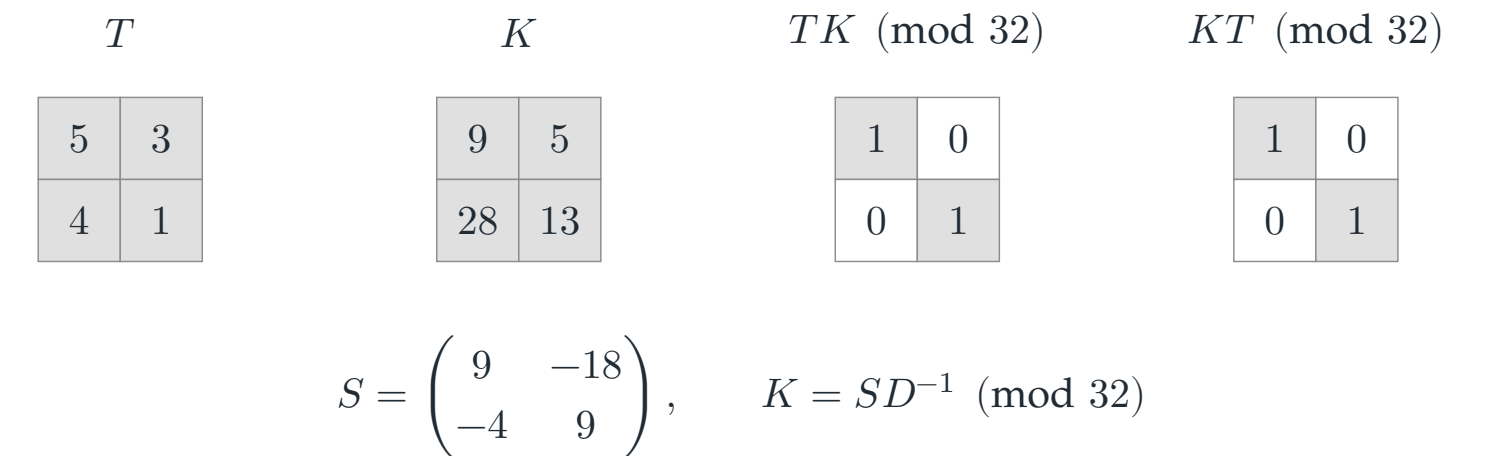
Reading the drawing
The matrices display the operator, its proposed inverse and both product orders. Entries are canonical residues; the identity products are exact modular statements.
Drawing labels and data 21 labels
Read the original labels as selectable text. Tables preserve grid relationships; other short labels are grouped compactly.
- \(T\)
| Row / column | Column 1 | Column 2 |
|---|---|---|
| Row 1 | \(5\) | \(3\) |
| Row 2 | \(4\) | \(1\) |
- \(K\)
| Row / column | Column 1 | Column 2 |
|---|---|---|
| Row 1 | \(9\) | \(5\) |
| Row 2 | \(28\) | \(13\) |
- \(TK\pmod{32}\)
| Row / column | Column 1 | Column 2 |
|---|---|---|
| Row 1 | \(1\) | \(0\) |
| Row 2 | \(0\) | \(1\) |
- \(KT\pmod{32}\)
| Row / column | Column 1 | Column 2 |
|---|---|---|
| Row 1 | \(1\) | \(0\) |
| Row 2 | \(0\) | \(1\) |
Evidence note from the source edition
The displayed \(K\) uses canonical residues from \(0\) to \(31\). Both left and right products are the identity modulo \(32\). These are exact modular equalities, not floating-point residuals.
One can verify the claim without trusting the word expansion:
The cancellation of the exterior factor \(D\) explains the order. Since \(T=D(I+A)\), multiply its inverse by \(D^{-1}\) on the right of the inverse of \(I+A\).
What the finite theorem does not require
There is no claim here that the same integer series converges in the ordinary real matrix norm. The quotient kills all sufficiently deep products, so a finite sum suffices. The complete normed-ring theorem is a separate result with its own strict contraction hypothesis.
Read this as
A correct noncommutative formula must work on both sides and preserve the order of its factors. Here the entire result can be checked by two integer matrix products.