
Choose an invertible coordinate shear but independently keep the same numerical operator at both levels:
Then \(\Delta=CT_f-T_cC=\varepsilon E_{01}\). Exact coordinate invertibility has not forced these independently selected operators to intertwine.
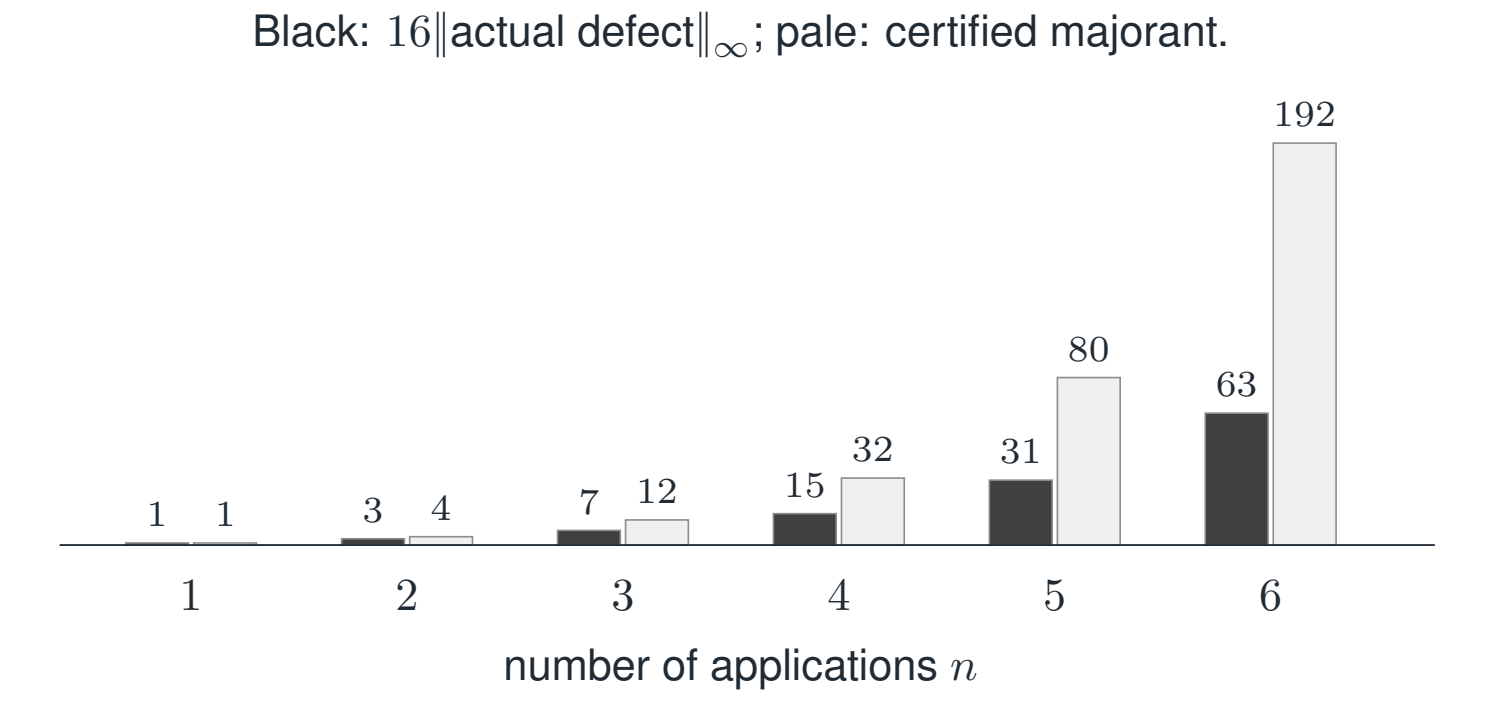
Reading the drawing
The plotted exact integer heights have the local defect coefficient divided out. The upper estimates can exceed the actual errors and do not imply a uniform bound in time.
Drawing labels and data 20 labels
Read the original labels as selectable text. Tables preserve grid relationships; other short labels are grouped compactly.
- \(1\)
- \(1\)
- \(1\)
- \(3\)
- \(4\)
- \(2\)
- \(7\)
- \(12\)
- \(3\)
- \(15\)
- \(32\)
- \(4\)
- \(31\)
- \(80\)
- \(5\)
- \(63\)
- \(192\)
- \(6\)
- number of applications \(n\)
Black: \(16\|\text{actual defect}\|_\infty\); pale: certified majorant.
Evidence note from the source edition
Actual defects and certified upper bounds in the induced infinity norm, both divided by \(\varepsilon\). All heights are exact integers. The upper estimate is valid but need not be tight.
Direct multiplication gives
The general telescoping formula explains every contribution:
Since both operator norms are two, the source theorem bounds the error by \(n2^{n-1}\varepsilon\). It does not promise a uniform-in-\(n\) small error merely because \(\varepsilon\) is small.
Had we chosen the transported operator \(T_c'=CT_fC^{-1}\), the defect would be zero and every polynomial action would intertwine exactly. That is a different choice of coarse operator, not a stronger conclusion from the faulty one.
Read this as
Separate coordinate coherence from operator consistency. A defect from one step is propagated by the dynamics on both sides. The telescoping identity tells you exactly how.