
For the same model, take \(z\notin\{1,2\}\) and form the actual inverse matrices
Their off-diagonal intertwining error is
Both inverse hypotheses matter. Neither resolvent is asserted at a pole.
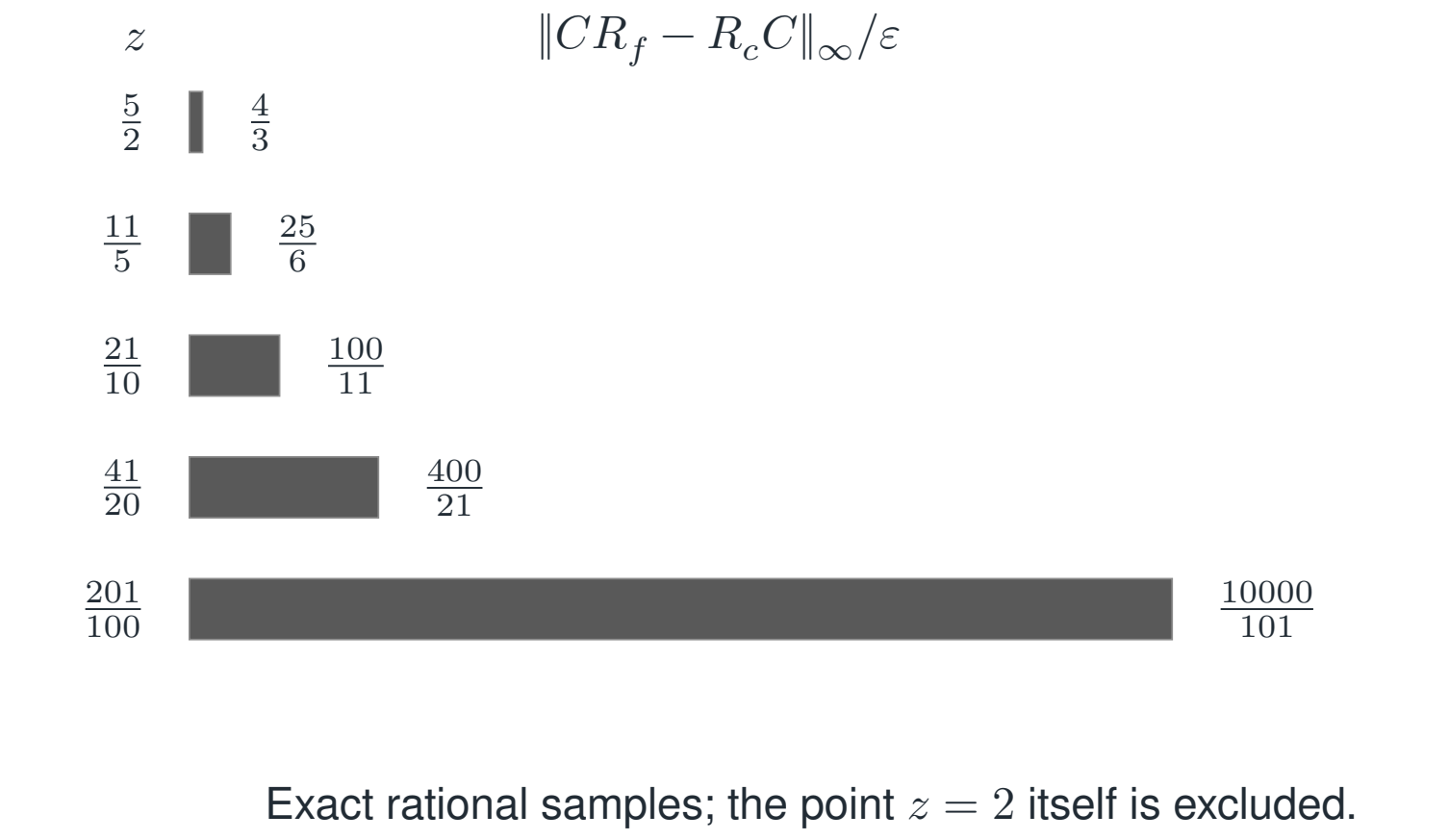
Reading the drawing
Each bar corresponds to its labeled rational spectral parameter. The rows are separate samples rather than equally spaced axis values; the local defect coefficient is divided out.
Drawing labels and data 13 labels
Read the original labels as selectable text. Tables preserve grid relationships; other short labels are grouped compactly.
\(\frac{5}{2}\)
\(\frac{4}{3}\)
\(\frac{11}{5}\)
\(\frac{25}{6}\)
\(\frac{21}{10}\)
\(\frac{100}{11}\)
\(\frac{41}{20}\)
\(\frac{400}{21}\)
\(\frac{201}{100}\)
\(\frac{10000}{101}\)
- \(z\)
- \(\|C R_f-R_c C\|_\infty/\varepsilon\)
Exact rational samples; the point \(z=2\) itself is excluded.
Evidence note from the source edition
The bars show exact amplification factors for five rational choices \(z>2\). Rows are separate samples, not equally spaced positions on the \(z\) axis. The coefficient \(\varepsilon=1/16\) has been divided out.
At \(z=3\) the amplification factor is only \(1/2\). At \(z=201/100\), it is \(10000/101\), so a small one-step defect can create a much larger resolvent defect. This follows from the exact formula rather than from unstable floating-point subtraction of two nearly singular inverses.
The certified general norm estimate is
The paper also proves a one-sided-witness version: a left inverse for the coarse shift and a right inverse for the fine shift suffice for the algebraic identity. That does not turn arbitrary one-sided witnesses into a claim of two-sided resolvent existence.
Read this as
A small local defect is meaningful only together with control of the surrounding operators or inverses. Near a pole, the domain and amplification factors are part of the theorem, not technical decoration.