
For \(S_N=\sum_{k=0}^{N-1}(-A)^k\), telescoping gives
Thus the exact residual is known. To certify precision \(L\), it is enough to show that every residual entry is divisible by \(2^L\).
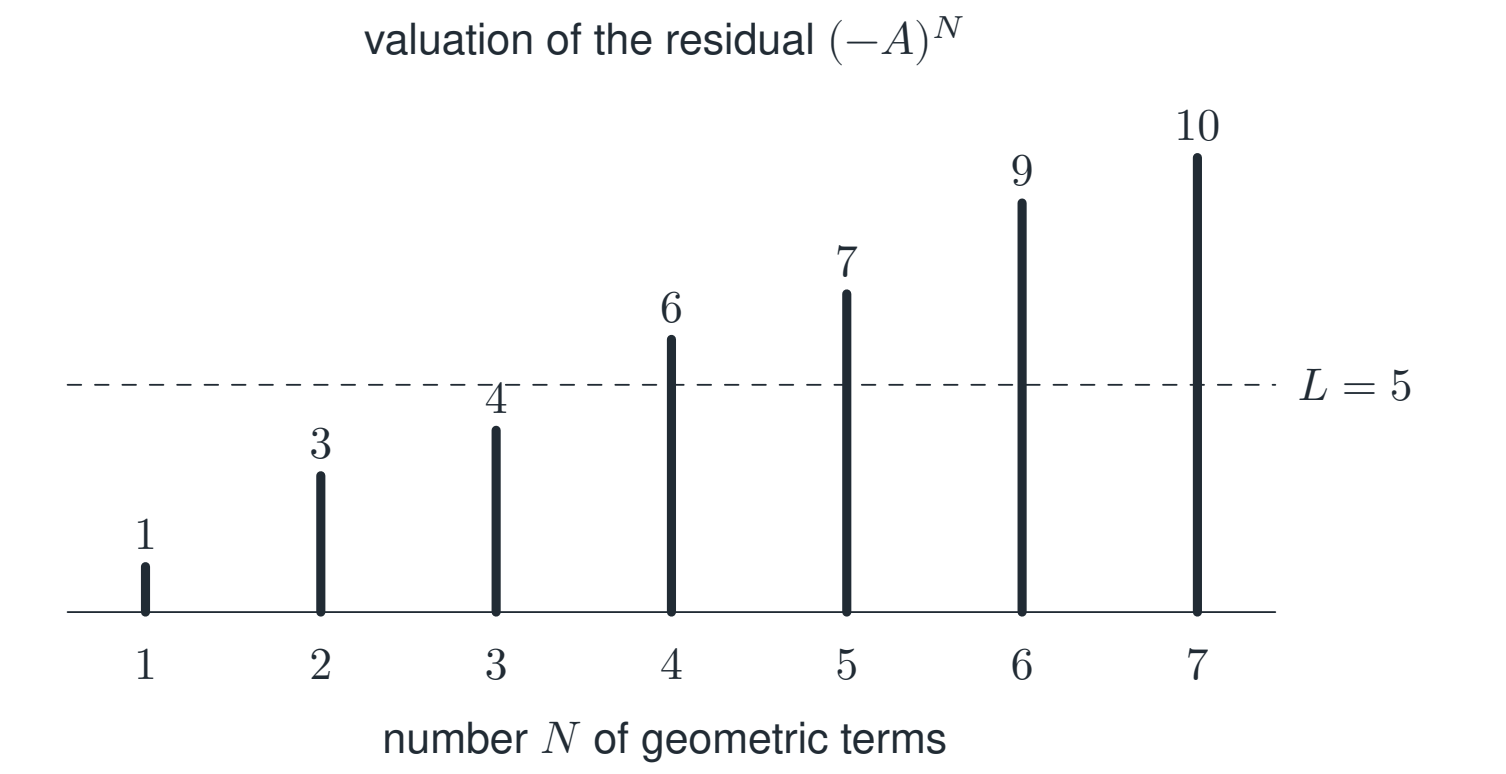
Reading the drawing
The plotted minimum entry valuations are compared with the horizontal requested precision. The points describe exact dyadic arithmetic rather than measured floating-point convergence.
Drawing labels and data 17 labels
Read the original labels as selectable text. Tables preserve grid relationships; other short labels are grouped compactly.
- \(1\)
- \(1\)
- \(3\)
- \(2\)
- \(4\)
- \(3\)
- \(6\)
- \(4\)
- \(7\)
- \(5\)
- \(9\)
- \(6\)
- \(10\)
- \(7\)
- \(L=5\)
- number \(N\) of geometric terms
- valuation of the residual \((-A)^N\)
Evidence note from the source edition
The plotted values are the minimum dyadic valuations of the nonzero entries of \((-A)^N\). The dashed line is the requested cutoff \(L=5\). This is an exact valuation profile, not a measured numerical convergence curve.
In this particular model, \(A^2=8I\). Therefore
where the matrix valuation means the minimum entry valuation. Three geometric terms leave a residual of valuation four and do not suffice modulo \(32\). Four terms leave valuation six and do suffice.
The generic positive-weight estimate is more conservative. If every edge weight is at least \(m>0\), a word of length \(N\) has weight at least \(mN\). Hence the cutoff
is sufficient. Here the certified minimum weight is \(m=1\), so the generic choice is five. The extra identity \(A^2=8I\) justifies stopping at four in this example.
Read this as
A structural identity may improve a cutoff. An observed small real norm or an arbitrarily larger claimed minimum edge weight does not supply that certificate.