
The preceding diagonal system is connected to a nondiagonal one by the unimodular change of variables
Since \(\det V=1\), \(x=Vy\) is bijective modulo eight. Thus \(Mx=b\) is equivalent to \(Dy=b\).
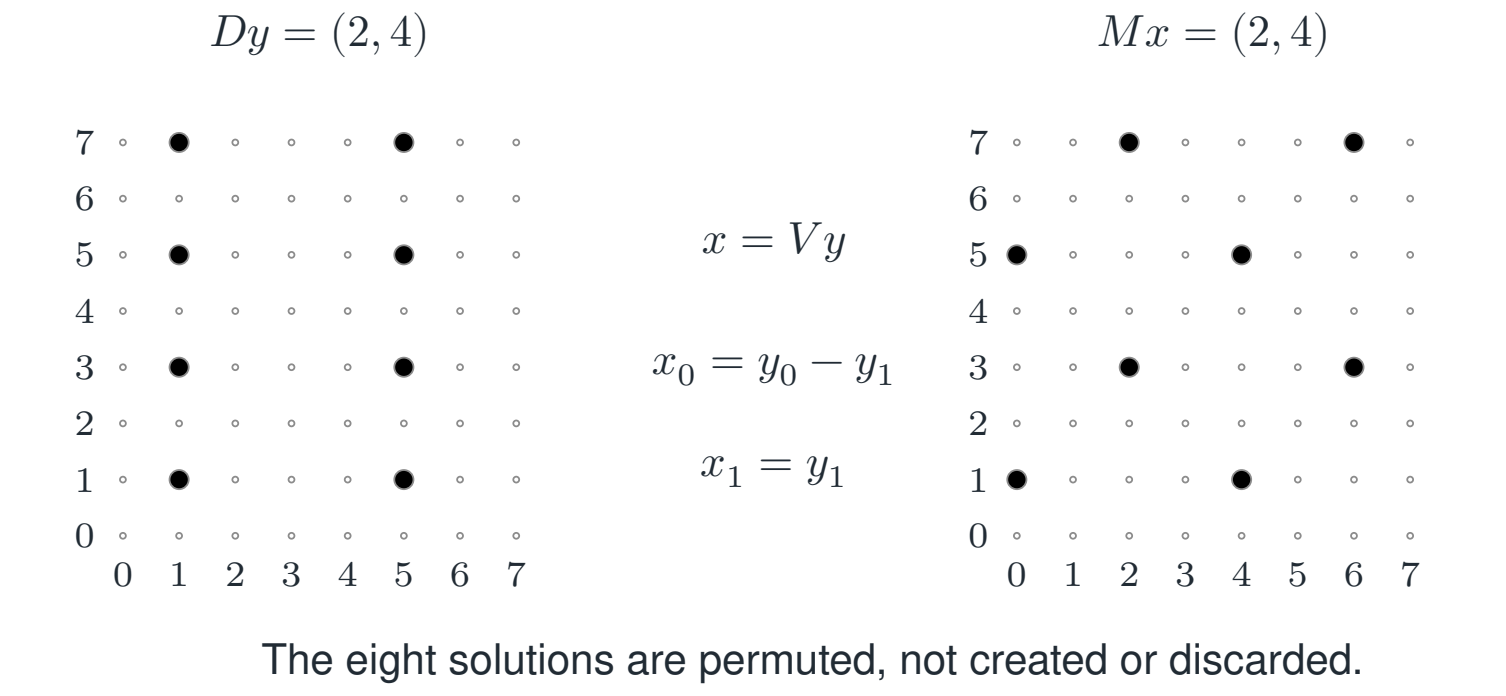
Reading the drawing
Matching point labels identify corresponding members of the same solution fiber. The coordinates are residues modulo eight and the grid is discrete.
Drawing labels and data 38 labels
Read the original labels as selectable text. Tables preserve grid relationships; other short labels are grouped compactly.
- \(Dy=(2,4)\)
- \(0\)
- \(1\)
- \(2\)
- \(3\)
- \(4\)
- \(5\)
- \(6\)
- \(7\)
- \(0\)
- \(1\)
- \(2\)
- \(3\)
- \(4\)
- \(5\)
- \(6\)
- \(7\)
- \(Mx=(2,4)\)
- \(0\)
- \(1\)
- \(2\)
- \(3\)
- \(4\)
- \(5\)
- \(6\)
- \(7\)
- \(0\)
- \(1\)
- \(2\)
- \(3\)
- \(4\)
- \(5\)
- \(6\)
- \(7\)
- \(x=Vy\)
- \(x_0=y_0-y_1\)
- \(x_1=y_1\)
The eight solutions are permuted, not created or discarded.
Evidence note from the source edition
The eight solutions for the target \((2,4)\), before and after the coordinate shear. Coordinates are residues in \(\{0,\ldots,7\}\). No interpolation on this modular grid is intended.
For example, the diagonal solution \(y=(1,3)\) corresponds to
and \(M(6,3)^\mathsf T=(18,12)^\mathsf T\equiv(2,4)^\mathsf T\). Applying the inverse shear recovers the original solution.
Two boundary cases worth keeping visible
A unit diagonal coordinate has exactly one solution for every target. A literal zero coordinate has all eight possible inputs when its target is zero, and no input when the target is nonzero. A zero coordinate is not inverted or silently omitted.
The displayed diagonalization is verified by multiplication. The theorem takes diagonal data as input. A Smith normal form for an arbitrary matrix or general DVR requires a separate structure theorem.
Read this as
An invertible change of coordinates transports existence, every solution, and the fiber count. The target must be transformed as prescribed when checking admissibility.