
Use the integral involution
With \(F=A-I\) and \(G=A+I\), the identities
are an explicit evaluated Bézout certificate. Here all the required commutations follow because these operators are polynomials in the same matrix.
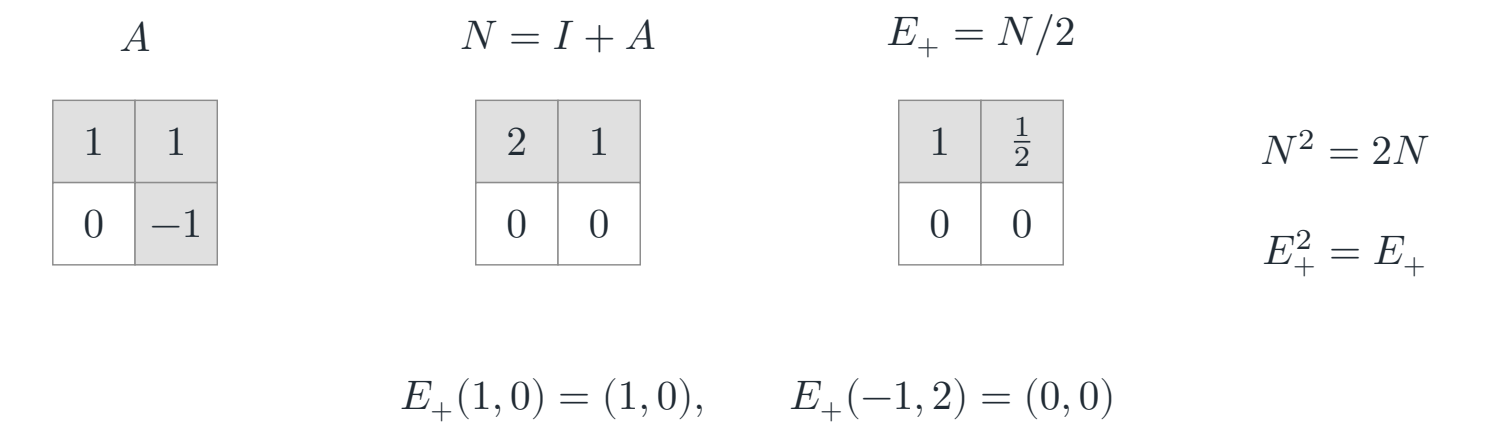
Reading the drawing
The displayed matrices separate the integral numerator calculation from division by the normalization factor. Clearing the denominator is a separate arithmetic step.
Drawing labels and data 18 labels
Read the original labels as selectable text. Tables preserve grid relationships; other short labels are grouped compactly.
- \(A\)
| Row / column | Column 1 | Column 2 |
|---|---|---|
| Row 1 | \(1\) | \(1\) |
| Row 2 | \(0\) | \(-1\) |
- \(N=I+A\)
| Row / column | Column 1 | Column 2 |
|---|---|---|
| Row 1 | \(2\) | \(1\) |
| Row 2 | \(0\) | \(0\) |
- \(E_+=N/2\)
| Row / column | Column 1 | Column 2 |
|---|---|---|
| Row 1 | \(1\) | \(\frac{1}{2}\) |
| Row 2 | \(0\) | \(0\) |
- \(N^2=2N\)
- \(E_+^2=E_+\)
- \(E_+(1,0)=(1,0),\qquad E_+(-1,2)=(0,0)\)
Evidence note from the source edition
The denominator-free numerator is quasi-idempotent: \(N^2=2N\). Division by the nonzero scalar \(2\) gives an idempotent over the fraction field. It does not yet make the projector integral on the selected lattice.
The numerator \(N=G\) acts by \(2\) on \(\ker(A-I)\) and by zero on \(\ker(A+I)\). Thus
is the required separator. The complementary projector is \(E_-=I-E_+\).
A denominator bound need not be minimal
The same projector can be presented with the inflated certificate \(-2F+2G=4I\). Its numerator is \(2G\) and its normalization is still \(E_+\). This supplies a two-digit clearing bound at \(2\), although one digit is enough. Thus the valuation of a supplied certificate gives an upper bound, not automatically the least possible weight.
For the original sign factors the concrete resultant is \(\operatorname{Res}(x-1,x+1)=2\) and the bound is sharp. That equality is special to this displayed calculation, not a universal minimality theorem for every resultant certificate.
Read this as
First check the evaluated identities and the numerator. Then normalize in the fraction field. Finally ask what denominator is needed on the particular lattice.