
For the graph on V12, compute the determinant and adjugate rather than guessing a recurrence:
Since \(Q(0)=1\), its inverse exists as a formal power series with integer coefficients.
Reading the drawing
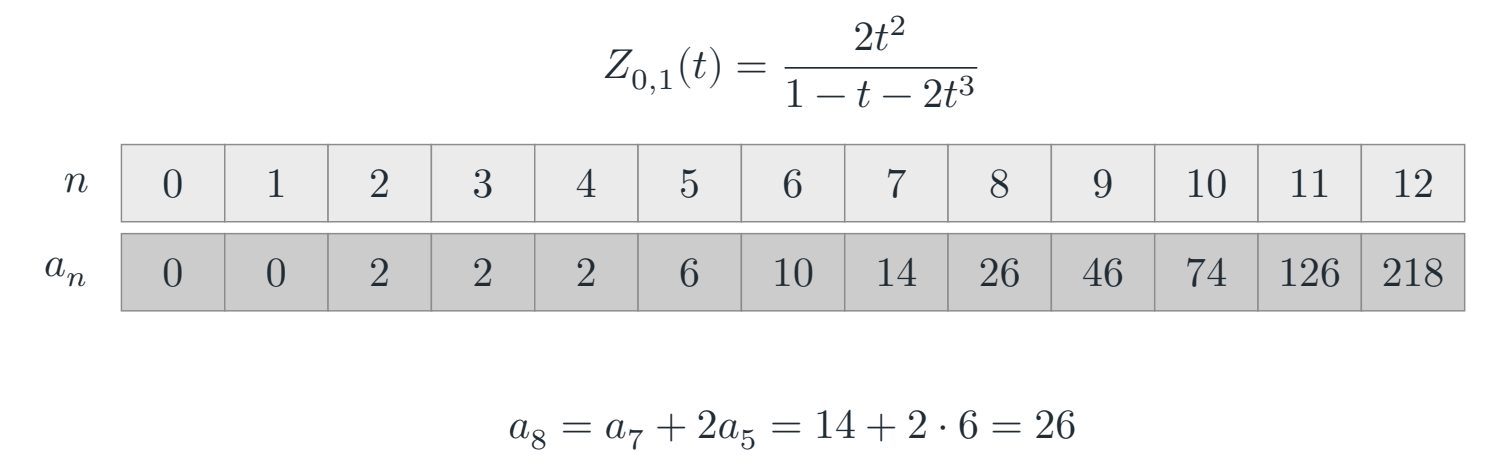
The displayed coefficient rows compare the graph recurrence and rational generating series. These are unsigned counts with the finite checking ranges retained in the source note.
Drawing labels and data 30 labels
Read the original labels as selectable text. Tables preserve grid relationships; other short labels are grouped compactly.
| Row / column | Column 1 | Column 2 | Column 3 | Column 4 | Column 5 | Column 6 | Column 7 | Column 8 | Column 9 | Column 10 | Column 11 | Column 12 | Column 13 |
|---|---|---|---|---|---|---|---|---|---|---|---|---|---|
| \(n\) | \(0\) | \(1\) | \(2\) | \(3\) | \(4\) | \(5\) | \(6\) | \(7\) | \(8\) | \(9\) | \(10\) | \(11\) | \(12\) |
| \(a_n\) | \(0\) | \(0\) | \(2\) | \(2\) | \(2\) | \(6\) | \(10\) | \(14\) | \(26\) | \(46\) | \(74\) | \(126\) | \(218\) |
- \(Z_{0,1}(t)=\dfrac{2t^2}{1-t-2t^3}\)
- \(a_8=a_7+2a_5=14+2\cdot6=26\)
Evidence note from the source edition
The coefficients are independently computed by the first-edge recurrence and checked against the rational series through weight \(24\). Literal edge-walk enumeration supplies a third check through weight \(10\).
From \(QZ_{0,1}=2t^2\) one obtains
The numerator is responsible for the initial exception. Omitting it would incorrectly force the entire series to vanish.
Three boundaries of this calculation
This is a formal series identity. No analytic convergence at a chosen real or complex value of \(t\) is needed. The canonical determinant need not be the minimal denominator after cancellation. Finally, positive weights prevent infinitely many walks at a fixed weight: a single weight-zero loop would already give the infinitely many distinct walks \(1,\ell,\ell^2,\ldots\) at weight zero.
Read this as
Finite positive-weight graph data determine a rational series and an eventual recurrence. The proof does not begin by assuming a certificate \(QZ=P\) that already contains that conclusion.