
Consider the actual map of finite sets
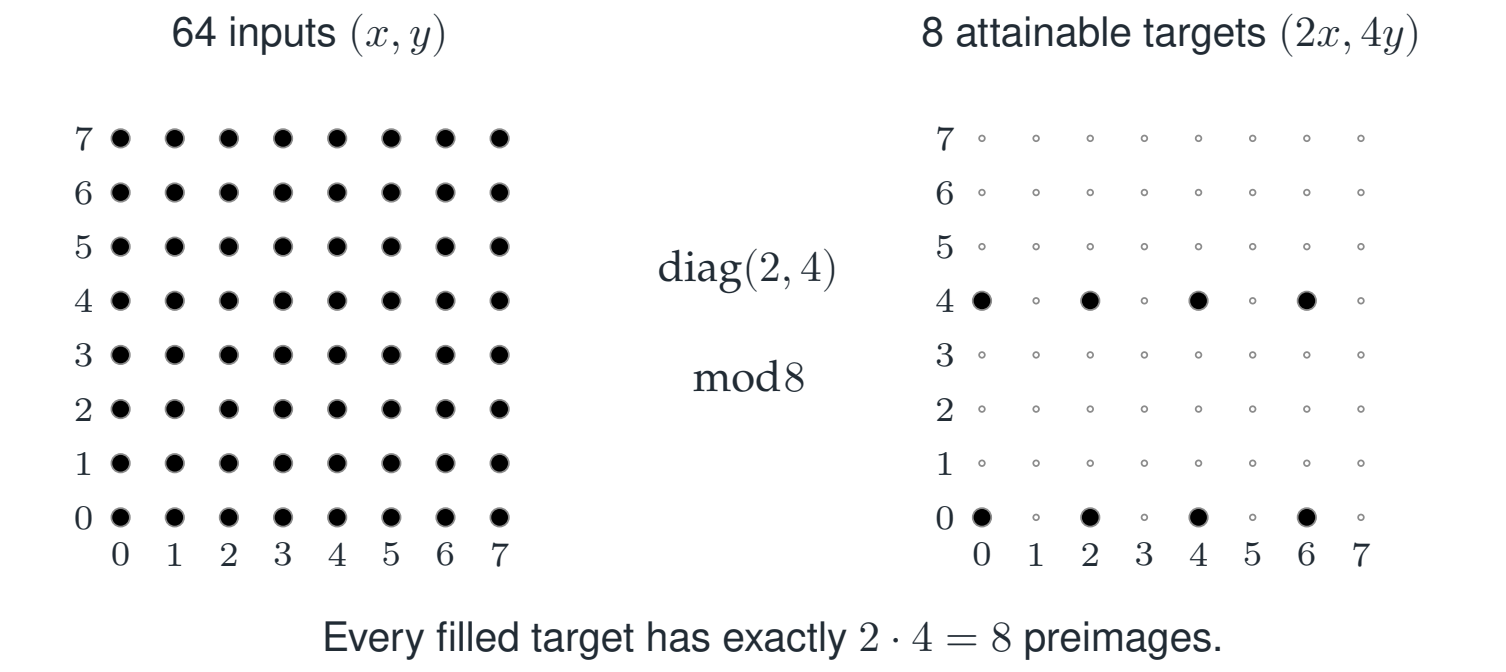
The first coordinate of the output must be even. The second must be zero or four. Those are precisely the attainable targets in the right panel.
Reading the drawing
Both grids show all sixty-four residue pairs. Only eight target points are attained; each attained target has eight preimages.
Drawing labels and data 37 labels
Read the original labels as selectable text. Tables preserve grid relationships; other short labels are grouped compactly.
- 64 inputs \((x,y)\)
- \(0\)
- \(1\)
- \(2\)
- \(3\)
- \(4\)
- \(5\)
- \(6\)
- \(7\)
- \(0\)
- \(1\)
- \(2\)
- \(3\)
- \(4\)
- \(5\)
- \(6\)
- \(7\)
- 8 attainable targets \((2x,4y)\)
- \(0\)
- \(1\)
- \(2\)
- \(3\)
- \(4\)
- \(5\)
- \(6\)
- \(7\)
- \(0\)
- \(1\)
- \(2\)
- \(3\)
- \(4\)
- \(5\)
- \(6\)
- \(7\)
- \({\operatorname{diag}}(2,4)\)
- \(\bmod 8\)
Every filled target has exactly \(2\cdot4=8\) preimages.
Evidence note from the source edition
All sixty-four input points and all sixty-four possible target addresses are shown. The eight filled target points are the image. Every attainable target has exactly eight preimages. The other fifty-six targets have none.
For a specific attainable target \((2,4)\),
The coordinate choices are independent, giving \(2\cdot4=8\) solutions. The entire carrier is partitioned consistently:
For an inadmissible target, such as \((1,4)\) or \((2,2)\), the fiber is empty. The same nonzero cardinality formula must not be applied to it.
The arithmetic behind the picture
Multiplication by \(p^s\) modulo \(p^L\) has kernel size \(p^{\min(s,L)}\). Its image consists exactly of residues whose canonical representatives are divisible by that same power. The displayed model has \(p=2\), \(L=3\) and weights \((1,2)\).
Read this as
A directional weight has two consequences: a divisibility condition on the target and a conditional multiplicity of inputs. Solvability comes before counting.