
Take a vector \(x=(x_0,\ldots,x_{15})\). A packet is not a single summary number: it retains every coefficient at its selected addresses. For example,
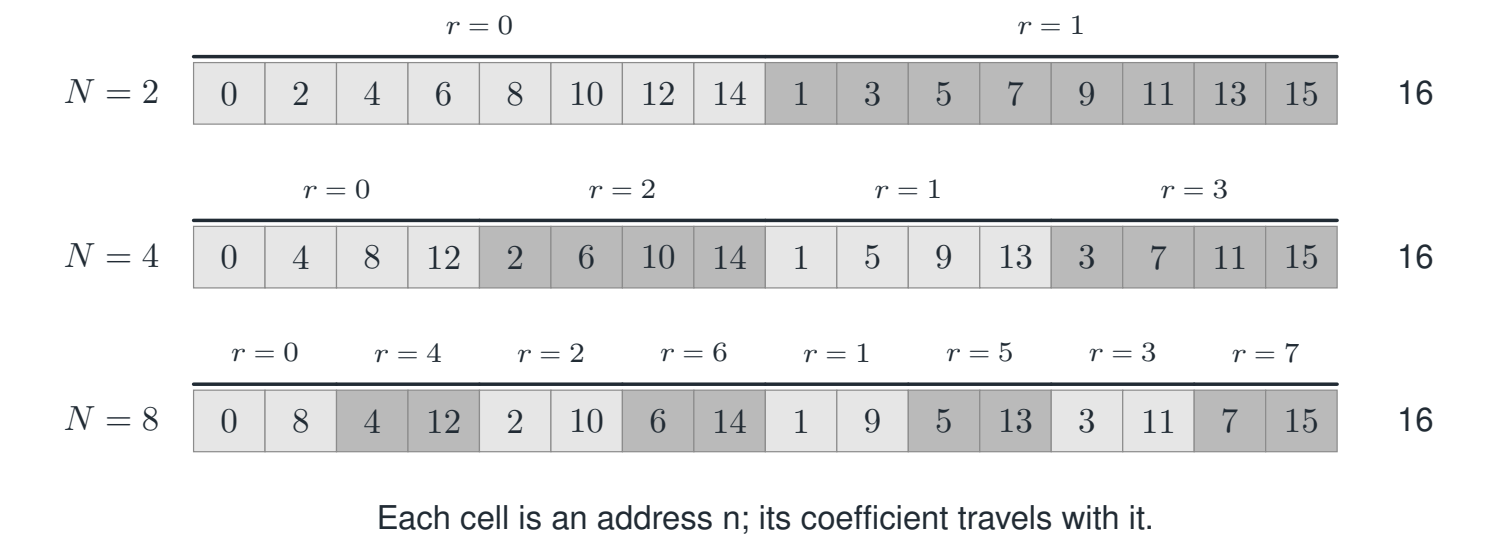
The rail below lists the addresses in each packet. Its display order groups descendants under their parents. The matrix example on V5 instead uses increasing residue order.
Reading the drawing
Each arrangement contains all sixteen addresses once. The heavier boundaries in the drawing group the residues into packets; the coefficient values are unchanged. The label tables list the residue groups in the displayed order.
Drawing labels and data 69 labels
Read the original labels as selectable text. Tables preserve grid relationships; other short labels are grouped compactly.
| Residue group | Address 1 | Address 2 | Address 3 | Address 4 | Address 5 | Address 6 | Address 7 | Address 8 |
|---|---|---|---|---|---|---|---|---|
| \(r=0\) | \(0\) | \(2\) | \(4\) | \(6\) | \(8\) | \(10\) | \(12\) | \(14\) |
| \(r=1\) | \(1\) | \(3\) | \(5\) | \(7\) | \(9\) | \(11\) | \(13\) | \(15\) |
Total addresses
- 16
| Residue group | Address 1 | Address 2 | Address 3 | Address 4 |
|---|---|---|---|---|
| \(r=0\) | \(0\) | \(4\) | \(8\) | \(12\) |
| \(r=2\) | \(2\) | \(6\) | \(10\) | \(14\) |
| \(r=1\) | \(1\) | \(5\) | \(9\) | \(13\) |
| \(r=3\) | \(3\) | \(7\) | \(11\) | \(15\) |
Total addresses
- 16
| Residue group | Address 1 | Address 2 |
|---|---|---|
| \(r=0\) | \(0\) | \(8\) |
| \(r=4\) | \(4\) | \(12\) |
| \(r=2\) | \(2\) | \(10\) |
| \(r=6\) | \(6\) | \(14\) |
| \(r=1\) | \(1\) | \(9\) |
| \(r=5\) | \(5\) | \(13\) |
| \(r=3\) | \(3\) | \(11\) |
| \(r=7\) | \(7\) | \(15\) |
Total addresses
- 16
Each cell is an address n; its coefficient travels with it.
Evidence note from the source edition
Every row contains all sixteen addresses exactly once. A heavier boundary separates packet ranges. The numbers are coefficient addresses, not new coefficient values. There is no interpolation, averaging, or omitted high-frequency tail.
The address \(6\) is even, is \(2\) modulo \(4\), and is \(6\) modulo \(8\). Its coefficient therefore lies in the successive ranges
The corresponding identities hold as operators:
Applying either composite parent selector to \(P_{8,6}x\) leaves it unchanged. Applying the odd selector kills it. This is absorption between a parent and a child, rather than an approximate resemblance between nearby scales.
Why the reconstruction is unique
If a vector is a sum of components in disjoint packet ranges, apply the projector for one range. All other components vanish and the selected component remains. Thus every child component is recovered uniquely from the sum.
Read this as
Refinement is a sharper address book for the same coefficients. The total number of free coordinates does not change.