
Work first in \(\mathbb F_2\), where \(1+1=0\). The eight coefficients below are just a finite display of a coefficient sequence. The even and odd projectors are diagonal masks with entries zero and one.
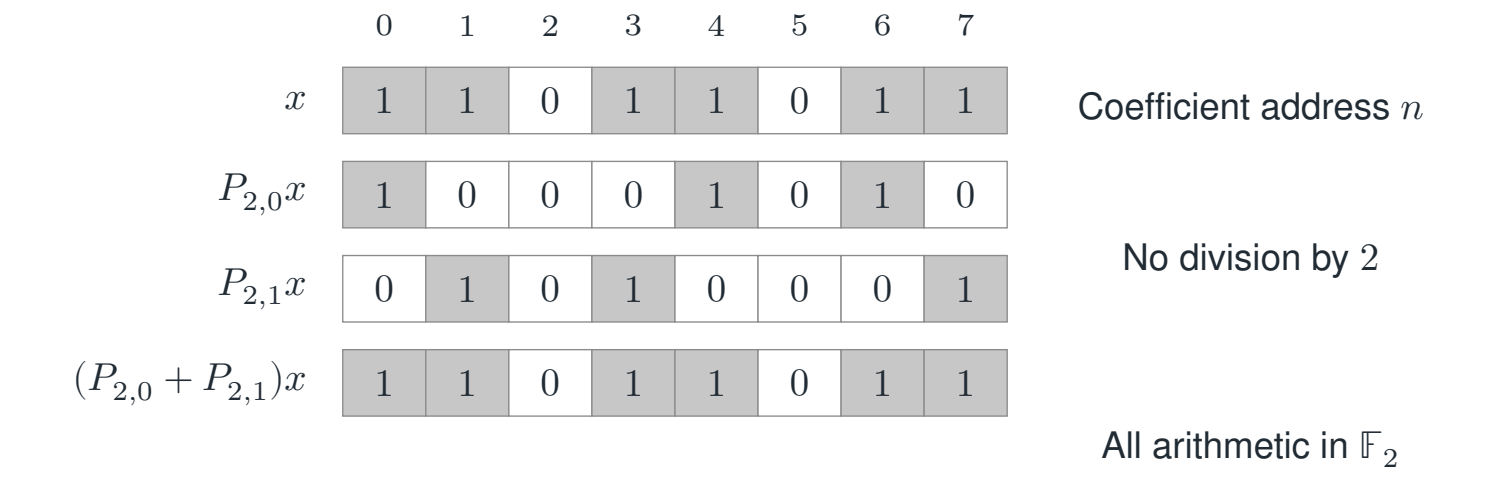
Reading the drawing
The first row is the input over the field with two elements. The next two rows retain disjoint address classes, and the last row reconstructs their sum without division.
Drawing labels and data 47 labels
Read the original labels as selectable text. Tables preserve grid relationships; other short labels are grouped compactly.
| Row / column | \(0\) | \(1\) | \(2\) | \(3\) | \(4\) | \(5\) | \(6\) | \(7\) |
|---|---|---|---|---|---|---|---|---|
| \(x\) | \(1\) | \(1\) | \(0\) | \(1\) | \(1\) | \(0\) | \(1\) | \(1\) |
| \(P_{2,0}x\) | \(1\) | \(0\) | \(0\) | \(0\) | \(1\) | \(0\) | \(1\) | \(0\) |
| \(P_{2,1}x\) | \(0\) | \(1\) | \(0\) | \(1\) | \(0\) | \(0\) | \(0\) | \(1\) |
| \((P_{2,0}+P_{2,1})x\) | \(1\) | \(1\) | \(0\) | \(1\) | \(1\) | \(0\) | \(1\) | \(1\) |
- \(\text{Coefficient address }n\)
- \(\text{No division by }2\)
\(\text{All arithmetic in }\mathbb F_2\)
Evidence note from the source edition
Each nonzero input coefficient is retained by exactly one mask. Reconstruction is exact over \(\mathbb F_2\). No average and no root of unity is used.
For a general coefficient ring and a positive integer \(N\), the definition is
An address belongs to one residue class, so applying two masks either keeps that same coefficient or kills it. This proves
The argument is coordinatewise and does not require the coefficients to form a field.
Why the usual even/odd average is a different formula
Over a field of characteristic not two, parity extraction can be represented using \(F(z)\) and \(F(-z)\) and division by \(2\). In characteristic two, \(-z=z\) and \(2=0\), so that formula cannot be used. The coefficient mask, however, still distinguishes even from odd exponents.
This distinction also explains the later involution example. Failure to reduce a rational spectral projector containing \(1/2\) does not make every integral coefficient-address selector disappear.
Read this as
The basic object is the address selector. A Fourier average is one possible realization of it and has additional algebraic hypotheses.