E7 Singular packets and exact reconstruction
On this page · Permalink · Source line 2503
Trace data identify the singular part
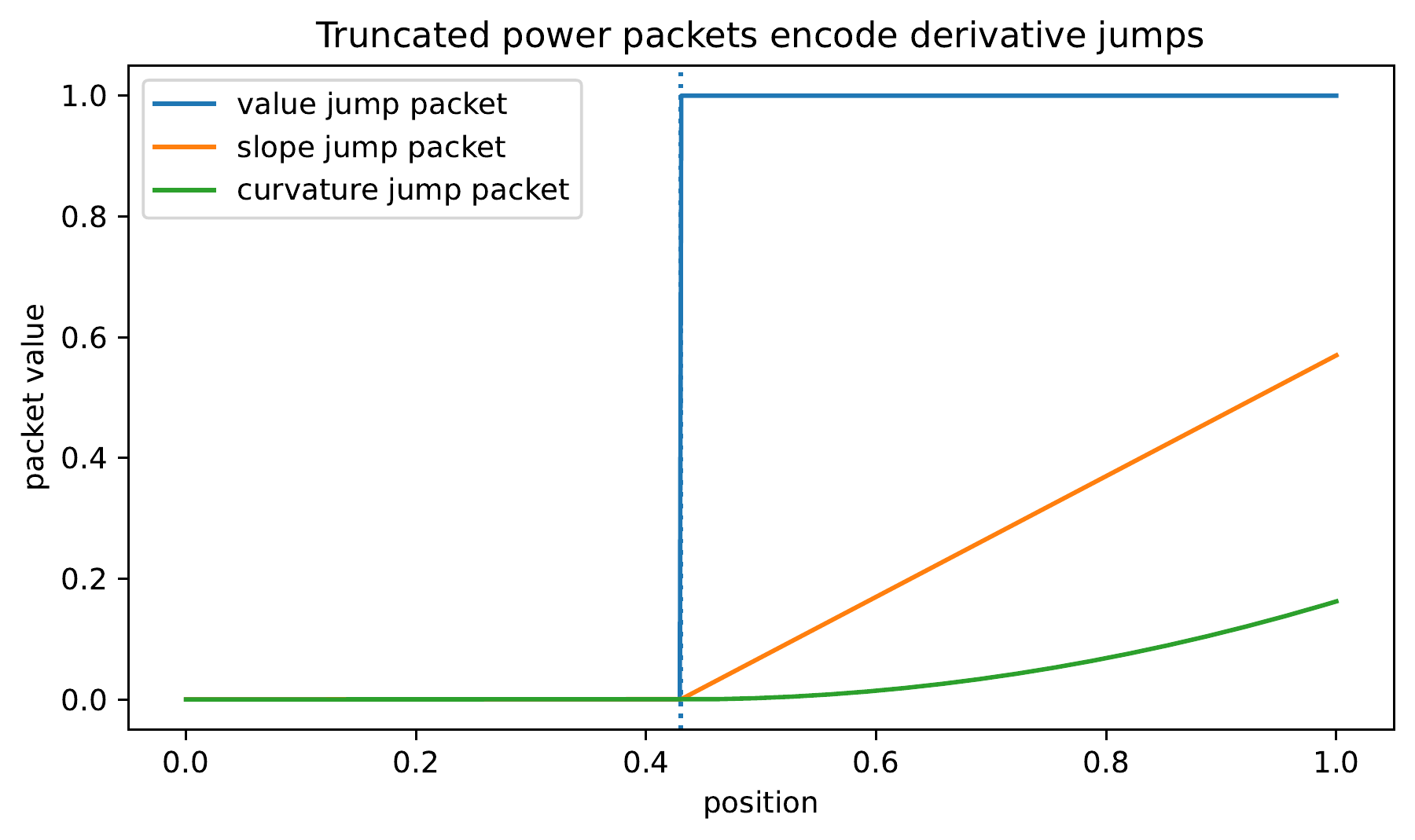
A value jump needs a step packet. A jump in a derivative needs a truncated power of the corresponding order. Subtracting these finite packets matches the one sided traces and leaves the regular remainder covered by the theorem's Sobolev assumptions. The packet construction and the approximation operator play separate roles.
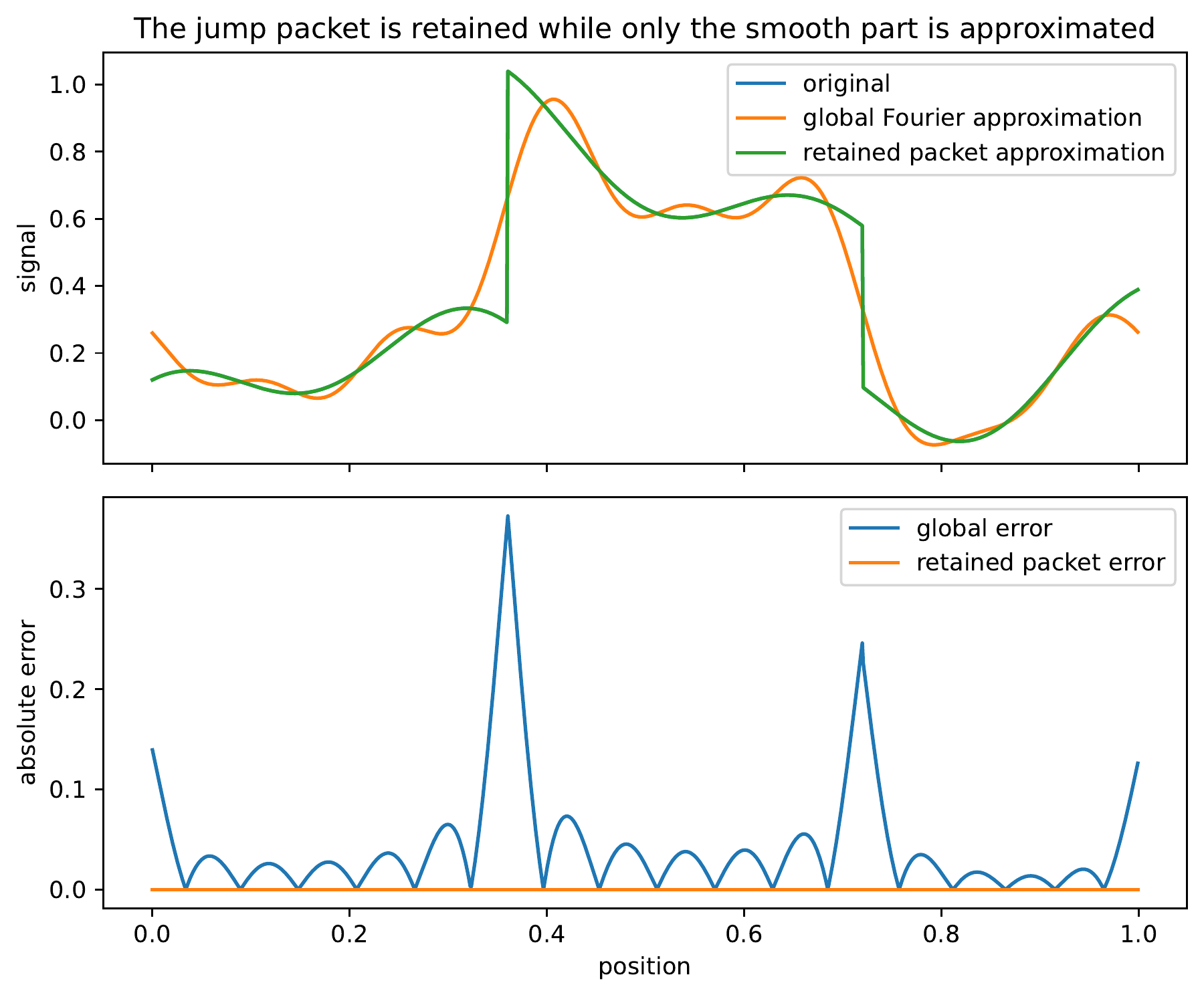
A packet decomposition becomes useful for approximation when it separates a component that should be retained from a component that should be compressed. The simplest singular packets are steps. Higher order packets record jumps in derivatives.
For \(m\geq0\) and \(0<\tau<1\), define
Thus \(\phi_{0,\tau}={\mathbf 1}_{[\tau,1]}\). On each side of \(\tau\), the packet is a polynomial. Its derivative of order \(m\) has a unit jump at \(\tau\).
Definition E7.1: Sobolev step packet class
Fix \(r\geq1\), \(1\leq p\leq\infty\), and an integer \(Q\geq0\). The class \({\mathcal F}_{r,p}(Q)\) consists of functions
with \(s\in W^{r,p}(0,1)\) and
No lower bound on the jump amplitudes is required for representation. Recovery results later impose such a bound.
Permalink · Source line 2519 · Claim record · Lean coverage · Code · Worked examples
Theorem E7.2: Higher order singular packet decomposition
Let
Suppose the restriction of \(f\) to every interval \((\tau_q,\tau_{q+1})\) belongs to \(W^{r,p}\), and choose the one dimensional Sobolev representatives whose derivatives through order \(r-1\) have one sided traces at the endpoints. Define
and
Then
has matching one sided derivatives through order \(r-1\) at every breakpoint and belongs to \(W^{r,p}(0,1)\). Its weak derivative of order \(r\) equals the piecewise classical derivative \(f^{(r)}\) almost everywhere.
Read proof · Visual guide: Derivative jumps have their own packets · Read statement and proof side by side · Permalink · Source line 2531 · Claim record · Lean coverage · Code · Worked examples
Proof of Theorem E7.2
For \(0\leq \ell\leq m\), the classical derivative of \(\phi_{m,\tau}\) on the two open sides is
This derivative has zero jump when \(\ell<m\) and a unit jump when \(\ell=m\). Derivatives of order larger than \(m\) vanish on both open sides. It follows that subtracting the term \(a_{q,m}\phi_{m,\tau_q}\) removes exactly the jump in the derivative of order \(m\) without changing the other classical trace jumps. Hence \(s_f\) has matching traces through order \(r-1\).
On each partition interval, \(j_f\) is a polynomial of degree at most \(r-1\), so its weak derivative of order \(r\) is zero there. A piecewise \(W^{r,p}\) function whose traces through order \(r-1\) match across every breakpoint belongs to \(W^{r,p}(0,1)\). Repeated integration by parts on the partition intervals shows that all boundary terms cancel. Thus the weak derivative of order \(r\) is the piecewise weak derivative of \(f\).
Back to statement · Read statement and proof side by side · Permalink · Source line 2557 · Claim record · Lean coverage · Code · Worked examples
Corollary E7.3: Uniqueness of the trace packet
Fix the breakpoints \(\tau_q\). If
with \(s\in W^{r,p}(0,1)\), then
The finite truncated power packet is therefore the unique packet supported at the declared breakpoints that removes all trace jumps through order \(r-1\).
Read proof · Visual guide: Derivative jumps have their own packets · Read statement and proof side by side · Permalink · Source line 2569 · Claim record · Lean coverage · Code · Worked examples
Proof of Corollary E7.3
Every representative in \(W^{r,p}(0,1)\) has derivatives through order \(r-1\) that admit absolutely continuous representatives on compact subintervals, with matching one sided traces at each interior point. Taking the jump of the derivative of order \(m\) therefore removes the contribution of \(s\). The packet \(\phi_{m,\tau_q}\) has unit jump in its derivative of order \(m\), while all other declared packets have zero jump at that derivative order and breakpoint. Hence the remaining jump is exactly \(b_{q,m}\).
Back to statement · Read statement and proof side by side · Permalink · Source line 2581 · Claim record · Lean coverage · Code · Worked examples
Remark E7.4
The theorem isolates only finitely many trace jumps. More general free discontinuity models may contain jump sets, Cantor parts, or singular derivatives that are not represented by a finite truncated power sum. The natural ambient theory is related to bounded variation and free discontinuity spaces [AmbrosioFuscoPallara2000].
Let \(X\) be a normed linear space and let \(Q:X\to X\) be bounded and linear. The next identity is elementary, but it is the central separation principle.
Theorem E7.5: Exact retained packet identity
Let \(f=s+j\) in \(X\). Define
Then
Consequently,
Read proof · Read statement and proof side by side · Permalink · Source line 2598 · Claim record · Lean coverage · Code · Worked examples
Proof of Theorem E7.5
Subtract:
Back to statement · Read statement and proof side by side · Permalink · Source line 2615 · Claim record · Lean coverage · Code · Worked examples
Remark E7.6
The theorem assumes that the packet \(j\) is known. It does not supply a detector. It also does not say that every representation of \(f\) as \(s+j\) is useful. The point is that once a meaningful packet has been identified, its approximation error can be removed from the smooth approximation problem exactly.
Corollary E7.7: Sobolev rate after packet separation
Suppose \(Q_m\) satisfies
for every \(s\in W^{r,p}(0,1)\). If \(f=s+j\) and \(j\) is retained, then
The same conclusion applies to the higher order decomposition in Theorem E7.2.
Read proof · Read statement and proof side by side · Permalink · Source line 2628 · Claim record · Lean coverage · Code · Worked examples
Proof of Corollary E7.7
Use Theorem E7.5 and the assumed approximation estimate.
Back to statement · Read statement and proof side by side · Permalink · Source line 2644 · Claim record · Lean coverage · Code · Worked examples
Theorem E7.8: Reconstruction with an estimated packet
Let \(Q_m:X\to X\) be linear, let \(f=s+j\), let \(\widehat j\) be an estimated packet, and define
Then
If \(Q_m\) is bounded, then
Read proof · Visual guide: The approximation operator also acts on packet error · Read statement and proof side by side · Permalink · Source line 2648 · Claim record · Lean coverage · Code · Worked examples
Proof of Theorem E7.8
Since \(f-\widehat j=s+(j-\widehat j)\),
Subtract this expression from \(s+j\). The norm bound follows from
Back to statement · Read statement and proof side by side · Permalink · Source line 2673 · Claim record · Lean coverage · Code · Worked examples