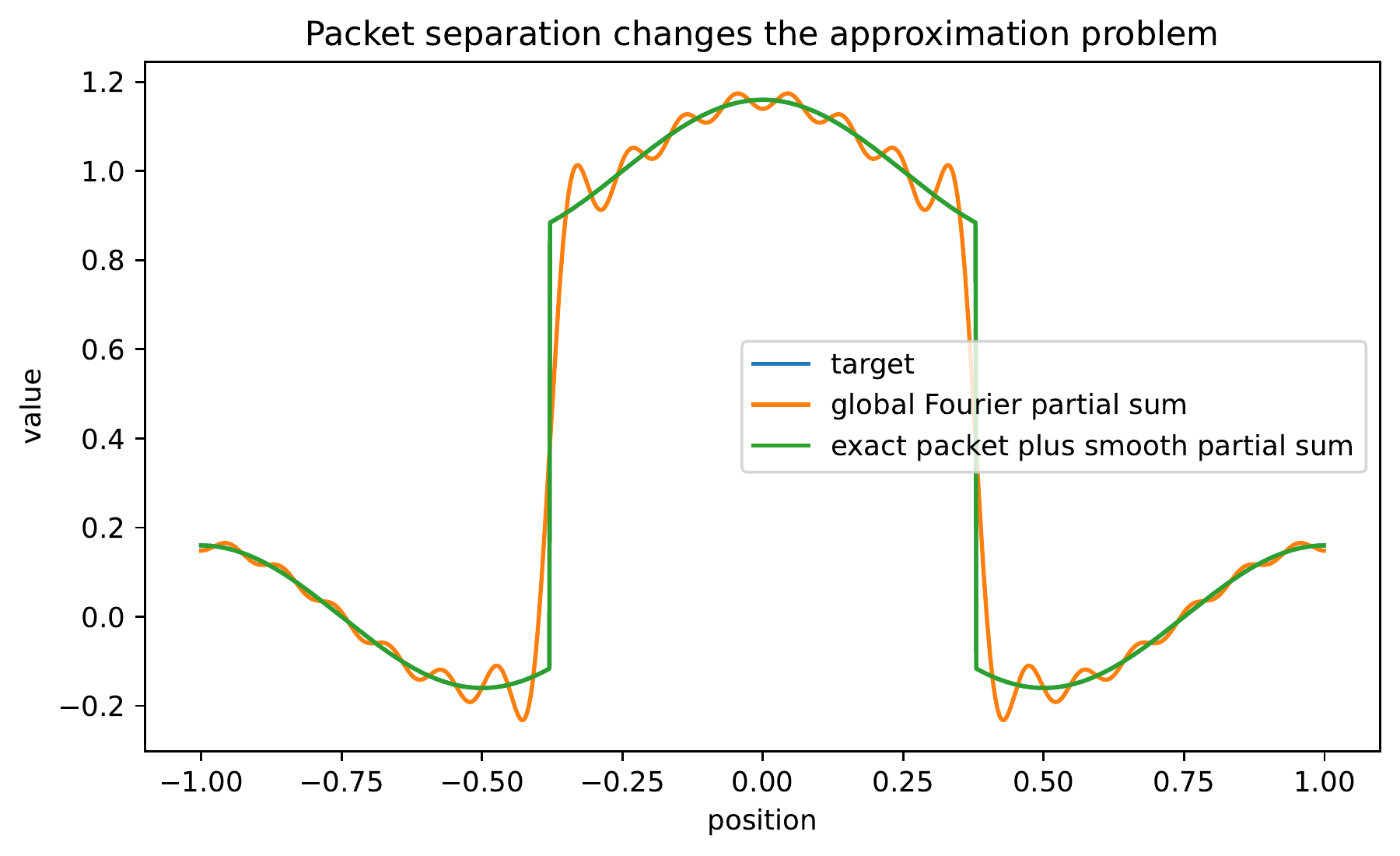
E11 Packet separation and the Gibbs phenomenon
On this page · Permalink · Source line 3376
A Fourier partial sum is global. When the target has a jump, the partial sum must approximate that jump using continuous trigonometric polynomials. This creates the classical Gibbs oscillation. Standard accounts and recovery methods appear in [Zygmund2002], [GottliebShu1997].
Standard fact E11.1: Classical square-wave Gibbs behavior
Let \(q(x)=\tfrac12\operatorname{sign}(\sin x)\), whose jump at zero has size one. For \(n\geq1\), its partial sum through the first \(n\) positive odd frequencies is
At \(x_n=\pi/(2n)\),
where \(\operatorname{Si}(z)=\int_0^z\sin(t)/t\,dt\) and \(G=\operatorname{Si}(\pi)/\pi-1/2>0\). Thus a nonzero overshoot persists along points approaching the jump. Scaling by a real amplitude \(a\) gives an overshoot or undershoot of magnitude \(|a|G\).
For the limit, put \(u_k=(k+\tfrac12)/n\). The identity
is a midpoint Riemann sum, since the integrand has continuous value \(\pi\) at zero. This is the normalized classical example in [DLMFGibbs], Section 6.16(i), equations 6.16.1–6.16.4.
Permalink · Source line 3380 · Claim record · Lean coverage · Code · Worked examples
The square-wave example supplies a classical comparison. The following retained-packet identities do not require a general overshoot theorem. They change the approximation problem because the discontinuity is no longer represented by the Fourier partial sum.
Theorem E11.2: Uniform convergence with exact jump packets
Let \(f=s+j\) on a compact domain, where \(j\) is any bounded singular packet. Suppose \(Q_ms\to s\) uniformly. Then
converges uniformly to \(f\), even when \(f\) is discontinuous:
There is no error proportional to the jump size because the jump is shared exactly by \(f\) and \(\widetilde f_m\).
Read proof · Visual guide: Conditional Gibbs control closes the reconstruction estimate · Read statement and proof side by side · Permalink · Source line 3404 · Claim record · Lean coverage · Code · Worked examples
Proof of Theorem E11.2
Apply Theorem E7.5 in the supremum norm.
Back to statement · Read statement and proof side by side · Permalink · Source line 3419 · Claim record · Lean coverage · Code · Worked examples
Theorem E11.3: Estimated packet Gibbs bound
Let \(Q_m\) be linear and uniformly bounded on \(L^p\), with
For \(f=s+j\) and an estimated packet \(\widehat j_m\), define
Then
Consequently, smooth approximation and packet recovery may be improved independently. No claim of Gibbs removal is justified unless both terms are controlled in the norm under consideration.
Read proof · Visual guide: Conditional Gibbs control closes the reconstruction estimate · Read statement and proof side by side · Permalink · Source line 3424 · Claim record · Lean coverage · Code · Worked examples
Proof of Theorem E11.3
This is Theorem E7.8 with the uniform operator bound.
Back to statement · Read statement and proof side by side · Permalink · Source line 3444 · Claim record · Lean coverage · Code · Worked examples
Corollary E11.4: Boundary band error
Let \(\Gamma\) be the singular boundary and assume
for small \(\delta\). For finite \(p\),
Read proof · Read statement and proof side by side · Permalink · Source line 3448 · Claim record · Lean coverage · Code · Worked examples
Proof of Corollary E11.4
The error equals \(s-Q_ms\). Bound it by its supremum and multiply by the measure of the boundary tube.
Back to statement · Read statement and proof side by side · Permalink · Source line 3462 · Claim record · Lean coverage · Code · Worked examples
Example E11.5: Square wave Fourier tail
Let
on the circle and let \(s\) be smooth. If \(Q_m\) is a Fourier partial sum, then \(Q_m(s+j)\) has the ordinary oscillatory boundary layer. In contrast,
has error exactly \(s-Q_ms\). The visual comparison in Figure illustrates this change in approximation target. It is not a new Fourier summability theorem.