Paper VReading edition

Boundary-localized error and claim control

Reading tools
Reading libraryFind statementsInspect Lean
Switch work

Saved reading

Read side by side

Start reading

Resources & source

Original TeX with line links · Download TeX

The wording and mathematics follow the retained manuscript. This reading format does not add a proof review or extend Lean coverage.

Skip contents and start reading

15 Boundary-localized error and claim control

The strongest visual distinction between global Fourier reconstruction and exact packet retention is seen in a band around the discontinuity.
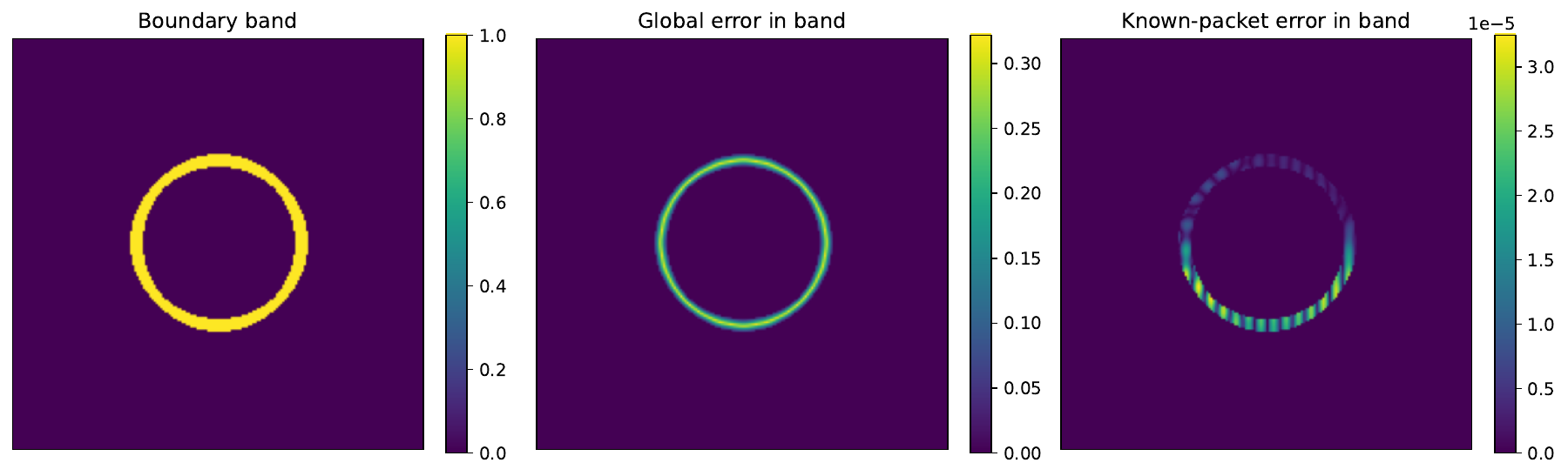
Boundary-band errors for global truncation and retained known-packet reconstruction.
Error restricted to a narrow boundary band. Global truncation concentrates large error on the jump. The known-packet reconstruction has only the small smooth-packet error in the same band.

View full-size figure (new tab)

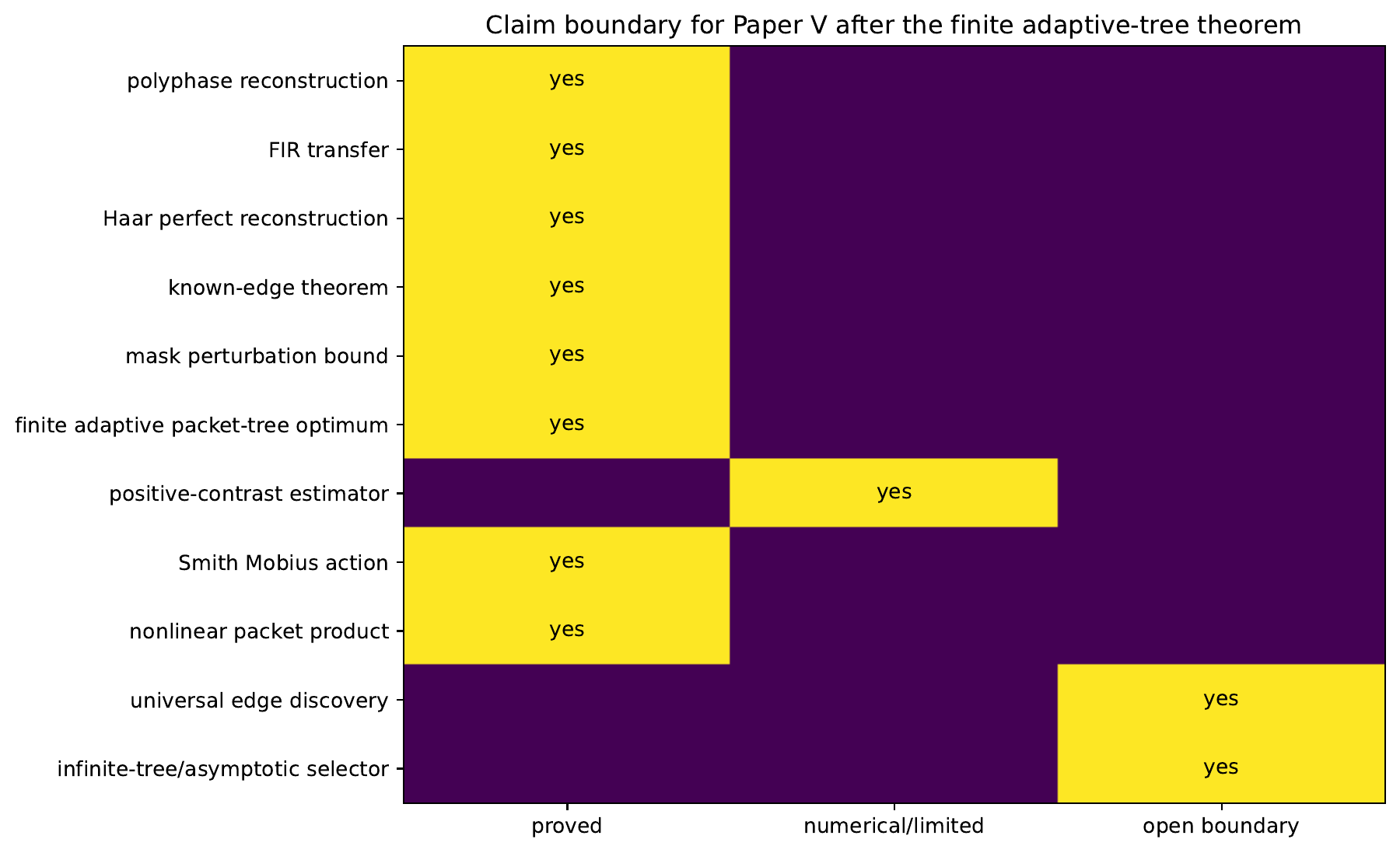
A chart separating the finite adaptive-tree result from remaining recovery and asymptotic questions.
Proof and claim boundary. Finite adaptive-tree selection is now proved; the remaining open rows concern universal recovery and infinite-tree or asymptotic selection.

View full-size figure (new tab)

Conjecture 15.1: Edge-packet approximation class

There should exist natural function spaces in which a signal is represented as

\[ f=s+\sum_q a_q\mathbf1_{\Omega_q}, \]

with separate norms for smooth approximation, boundary geometry, packet amplitude, and packet identification. A projector-resolved approximation theory on such spaces should yield rates that do not mix smooth truncation error with discontinuity-location error.

Source and conversion record

Source SHA-256: 5d3c6b2e5709c37ea551eb8fd1d823e5249c5fbc411d36b806241af4df888f36

Unsupported prose commands stop the build. The mathematical expression sequence is checked against the source, with manuscript macros expanded for display.

Conversion records

Notation in Paper V

Look up a symbol without leaving this chapter. Select text before opening help to search for it.

Search this work’s notation.

    Symbols can have different meanings in different passages. Read each result in its own context.

    Open the full notation index