E4 Convolution as a packet transfer matrix
On this page · Permalink · Source line 1902
Let \(h\in\ell^1({\mathbb Z}^d)\) and \(x\in\ell^p({\mathbb Z}^d)\), with \(1\leq p\leq\infty\), and define
Young's inequality gives
for every \(1\leq p\leq\infty\).
Definition E4.1: Packet transfer kernel
For output residue \(r\in R\) and input residue \(s\in R\), define a kernel on \(L\) by
Permalink · Source line 1916 · Claim record · Lean coverage · Code · Worked examples
Theorem E4.2: Exact convolution transfer law
Let \(y=h*x\). Then
Equivalently,
where \(H_{rs}\) is convolution on \(L\) by \(h_{rs}\).
Read proof · Read statement and proof side by side · Permalink · Source line 1925 · Claim record · Lean coverage · Code · Worked examples
Proof of Theorem E4.2
Evaluate the output at \(r+\ell\). Write every input address as \(s+\ell'\). The convolution offset is
Setting \(m=\ell-\ell'\) gives the formula.
Back to statement · Read statement and proof side by side · Permalink · Source line 1941 · Claim record · Lean coverage · Code · Worked examples
Proposition E4.3: Transfer norm control
For every output residue \(r\),
The packet transfer matrix acts on the polyphase direct sum with norm at most \(\|h\|_1\) on every \(\ell^p\) space.
Read proof · Read statement and proof side by side · Permalink · Source line 1950 · Claim record · Lean coverage · Code · Worked examples
Proof of Proposition E4.3
For fixed \(r\), every \(q\in{\mathbb Z}^d\) has a unique representation \(q=r-s+m\) with \(s\in R\) and \(m\in L\). This proves the equality of the absolute sums. The operator norm bound also follows by conjugating Young's inequality through the isometric analysis map.
Back to statement · Read statement and proof side by side · Permalink · Source line 1960 · Claim record · Lean coverage · Code · Worked examples
Proposition E4.4: Composition of transfer matrices
If \(G\) and \(H\) are convolution operators with packet matrices \((G_{rs})\) and \((H_{rs})\), then the packet matrix of \(GH\) is
In one dimensional transform notation, the corresponding matrix symbols multiply pointwise.
Read proof · Read statement and proof side by side · Permalink · Source line 1964 · Claim record · Lean coverage · Code · Worked examples
Proof of Proposition E4.4
Conjugation by \({\mathcal A}_L\) preserves composition:
Reading the \((r,t)\) block gives the formula.
Back to statement · Read statement and proof side by side · Permalink · Source line 1974 · Claim record · Lean coverage · Code · Worked examples
E4.1 The one dimensional symbol
On this page · Permalink · Source line 1984
For \(L=N{\mathbb Z}\) with \(N\geq1\), first take \(|z|=1\). The assumption \(h\in\ell^1({\mathbb Z})\) makes the following symbol series absolutely convergent. Define
For \(x\in\ell^1({\mathbb Z})\), the channel transforms converge absolutely on the unit circle and satisfy
For \(x\in\ell^2({\mathbb Z})\), the same identity holds almost everywhere in the \(L^2\) Fourier sense. For finite impulse-response kernels it also holds at nonzero \(z\) wherever the input channel transforms are weighted absolutely summable. This is the classical polyphase matrix. It is the exact block matrix of the original convolution operator.
Corollary E4.5: Finite impulse response closure
If \(h\) has finite support, every packet kernel \(h_{ks}\) has finite support. Matrix multiplication of polyphase symbols agrees with composition of the original finite impulse response operators.
Read proof · Read statement and proof side by side · Permalink · Source line 1996 · Claim record · Lean coverage · Code · Worked examples
Proof of Corollary E4.5
Finite support is preserved by taking residue subsequences. The composition statement is Proposition E4.4.
Back to statement · Read statement and proof side by side · Permalink · Source line 2000 · Claim record · Lean coverage · Code · Worked examples
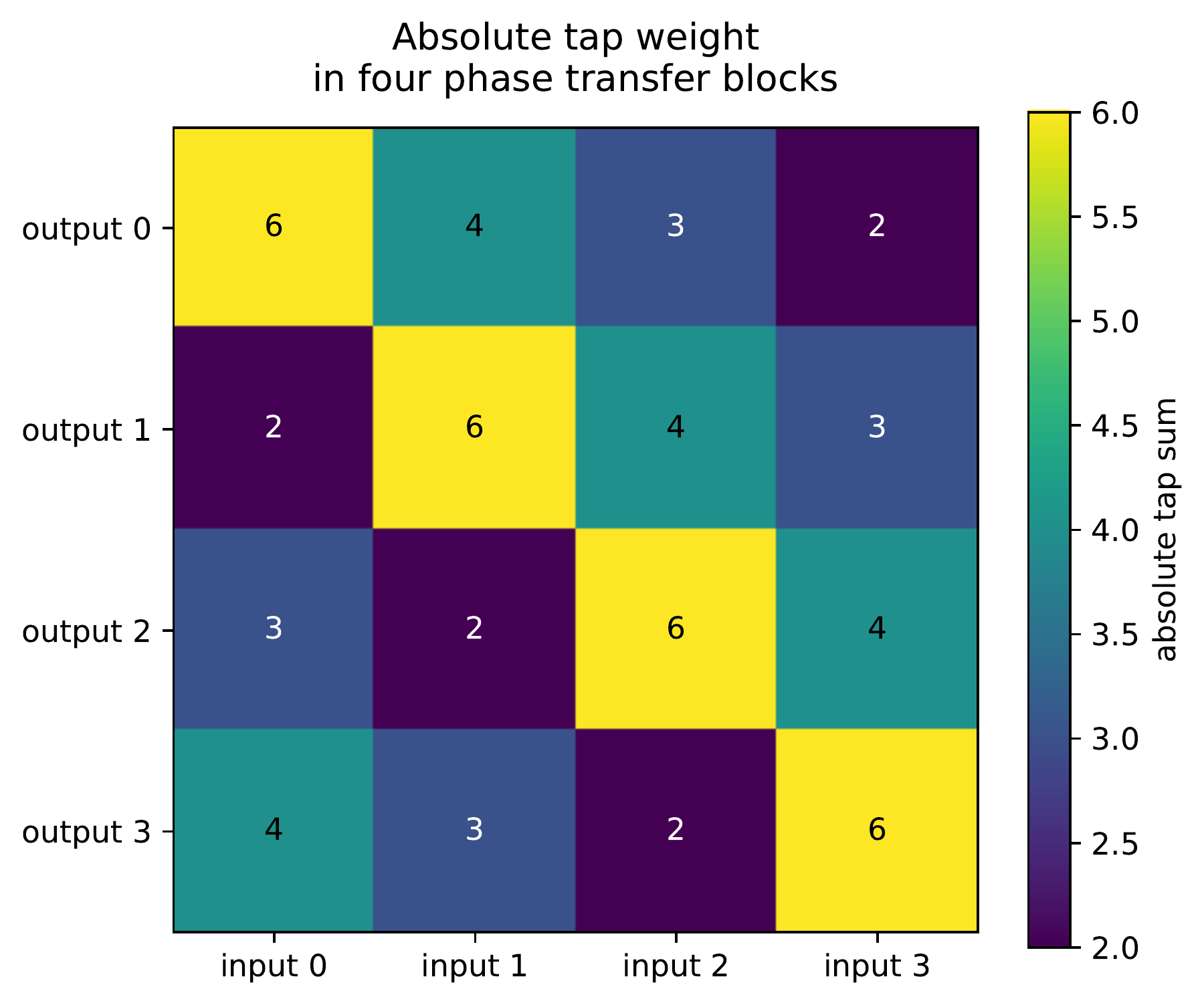
Example E4.6: A four phase finite impulse response operator
Let
with all other taps zero. For four residue channels, the transfer symbol is
The delay term records the tap that crosses a coarse cell boundary. No approximation is introduced by the matrix representation.