E14 Cyclic Cayley coordinates
On this page · Permalink · Source line 3639
Keep the rotation and its chart separate
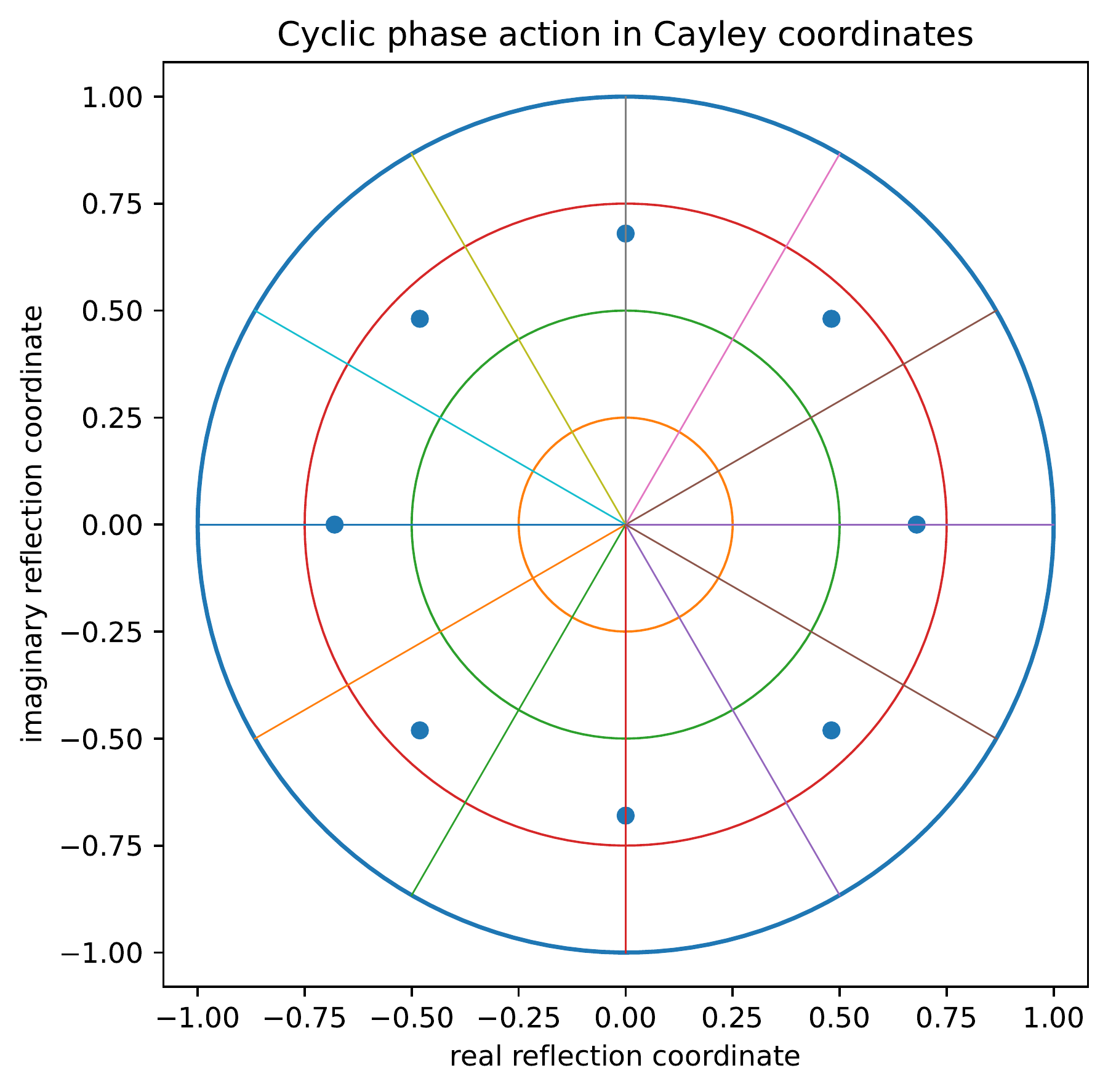
For the phase factorization below, \(M\) and \(N\) are positive phase orders. The reflection coordinate rotates in the unit disk. The Cayley map expresses that same motion as a fractional linear impedance action. A pole of the chart does not mean that the projective action fails. This realization is independent of the separated jump detector.
This section records a secondary realization from the original signal manuscript. It is logically independent of the recovery theorems. The classical Smith chart uses the Cayley transform between normalized impedance and a reflection coordinate [Smith1969].
Let
and define
It maps \(\mathbb H\) conformally onto the unit disk \(\mathbb D\), with inverse
For \(\theta\in{\mathbb R}\), let
Theorem E14.1: Cyclic Mobius action
The pullback
is the fractional linear map
It preserves \(\mathbb H\) and satisfies
For an integer \(N\geq1\) and \(\theta=2\pi/N\), the map has order \(N\).
Read proof · Read statement and proof side by side · Permalink · Source line 3666 · Claim record · Lean coverage · Code · Worked examples
Proof of Theorem E14.1
Substitute \({\mathrm e}^{{\mathrm i}\theta}(z-1)/(z+1)\) into \(C^{-1}\) and simplify. Preservation of \(\mathbb H\) follows because \(C\) maps it to \(\mathbb D\), rotation preserves \(\mathbb D\), and \(C^{-1}\) maps back. The group law follows by conjugating the rotation group law. When \(\theta=2\pi/N\), the \(N\)th power is the identity. Conversely, if its \(k\)th power is the identity, conjugation by \(C\) and evaluation at \(w=1/2\) give \({\mathrm e}^{2\pi{\mathrm i} k/N}=1\), so \(N\) divides \(k\). Hence the order is exactly \(N\).
Back to statement · Read statement and proof side by side · Permalink · Source line 3690 · Claim record · Lean coverage · Code · Worked examples
Corollary E14.2: Impedance and admittance
For \(N=2\), \(\theta=\pi\) and
Thus the two phase action is normalized impedance and admittance inversion.
Read proof · Read statement and proof side by side · Permalink · Source line 3694 · Claim record · Lean coverage · Code · Worked examples
Proof of Corollary E14.2
Insert \({\mathrm e}^{{\mathrm i}\pi}=-1\) in the formula of Theorem E14.1.
Back to statement · Read statement and proof side by side · Permalink · Source line 3702 · Claim record · Lean coverage · Code · Worked examples
Proposition E14.3: Radial and phase coordinates
Write
Then
The radial mismatch \(\rho\) is invariant and the phase coordinate advances by \(\theta\).
Read proof · Read statement and proof side by side · Permalink · Source line 3706 · Claim record · Lean coverage · Code · Worked examples
Proof of Proposition E14.3
This is the defining conjugacy \(C\Phi_\theta=R_\theta C\).
Back to statement · Read statement and proof side by side · Permalink · Source line 3722 · Claim record · Lean coverage · Code · Worked examples
Proposition E14.4: Coprime phase factorization
Let \(M\) and \(N\) be coprime. The cyclic phase labels modulo \(MN\) are equivalent to pairs of labels modulo \(M\) and modulo \(N\):
Under this identification, the rotation by \(2\pi/(MN)\) is determined by its two projected cyclic actions.
Read proof · Read statement and proof side by side · Permalink · Source line 3726 · Claim record · Lean coverage · Code · Worked examples
Proof of Proposition E14.4
This is the Chinese remainder theorem applied to the additive phase label. A label modulo \(MN\) is uniquely determined by its two residues, and addition of labels is preserved.
Back to statement · Read statement and proof side by side · Permalink · Source line 3736 · Claim record · Lean coverage · Code · Worked examples