
Reduced zeros grow like \(m^N\). Their absolute zero-zeta series therefore has half-plane of absolute convergence \(\Re s>1/N\). The absolute zero zeta in the original variable instead requires \(\Re s>1\).
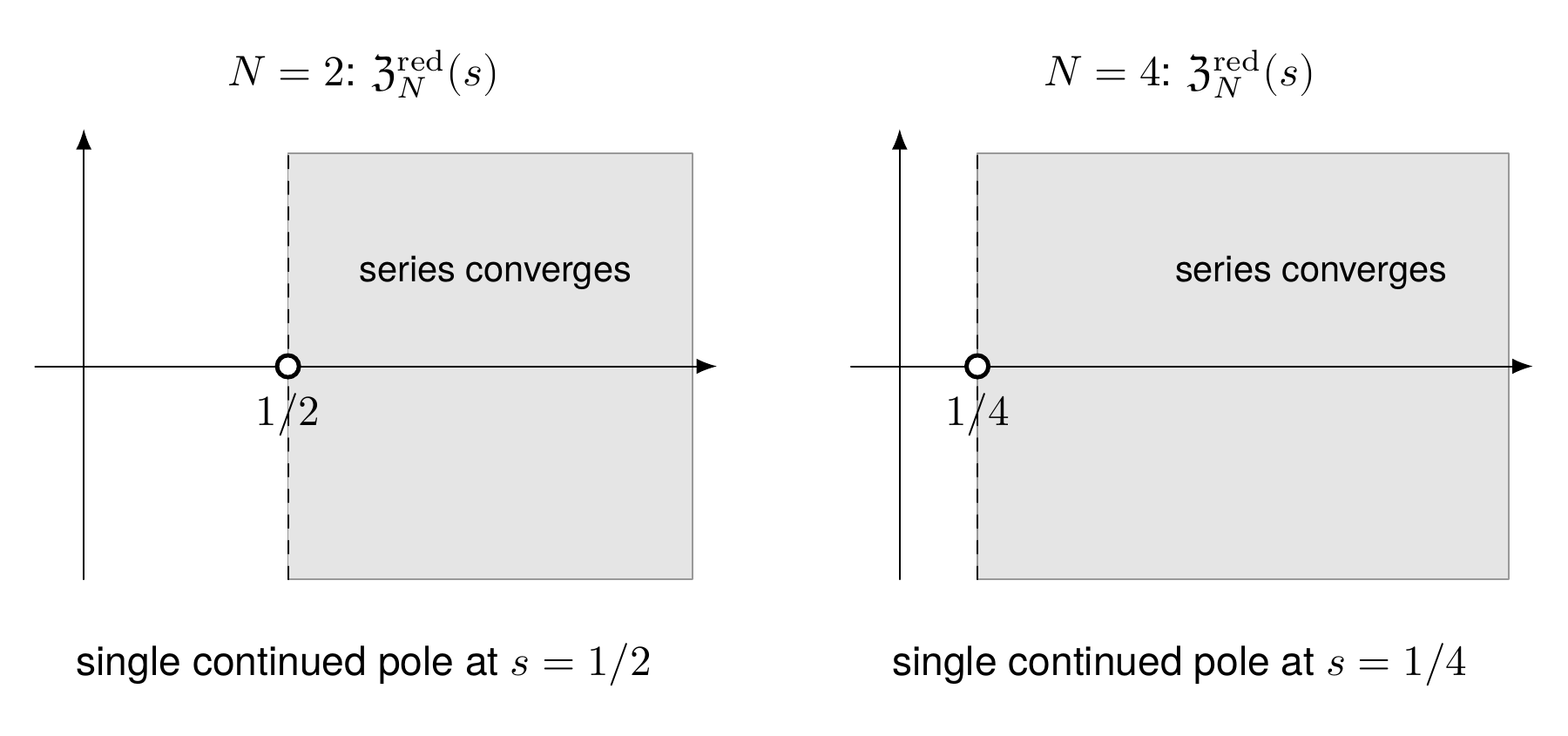
Reading the drawing
In each panel the shaded region lies strictly to the right of the stated real-part threshold. An open circle on the boundary marks the single pole of the meromorphic continuation. The open circles are poles, not zeros. The two different boundaries reflect the different growth rates of the reduced zero sequences.
Drawing labels and data 8 labels
Read the original labels as selectable text. Tables preserve grid relationships; other short labels are grouped compactly.
| Case | Real-part boundary | Shaded region | Pole label |
|---|---|---|---|
| \(N=2\): \(\mathfrak Z_N^{\rm red}(s)\) | \(1/2\) | series converges | single continued pole at \(s=1/2\) |
| \(N=4\): \(\mathfrak Z_N^{\rm red}(s)\) | \(1/4\) | series converges | single continued pole at \(s=1/4\) |
For \(N=2\) and \(N=4\), the lattices are exact:
Each identity first holds where its defining series converges. The right side supplies its meromorphic continuation. There is a single pole, at \(1/2\) or \(1/4\), with residue \(1/(2\pi)\) or \(1/(4\sqrt2\pi)\) respectively.
The factor \(N\) matters twice
For every order in the paper,
For general \(N\), exponentially accurate zero locations leave an entire correction to the Hurwitz model. A finite exceptional zero set also contributes entire terms. This reasoning establishes continuation, not a zeta functional equation.
Read this as
An analytic continuation can exist at points where the original infinite sum diverges. It must not be evaluated there by naively summing that series.
Evidence note from the source edition
The shaded regions show convergence, and the open circles mark poles of the continued functions. They are not zeros of the zeta functions. Branch-dependent orbit zetas and derivative-weighted zetas retain their separately stated conventions.