
For \(C_{2,0}(z)={\operatorname{sech}} z\), define \(E_m(x)\) by \({\operatorname{sech}} z\,e^{xz}=\sum E_m(x)z^m/m!\). The formal differential-operator formula is
Although the symbol is an infinite series, derivatives above degree \(m\) vanish.
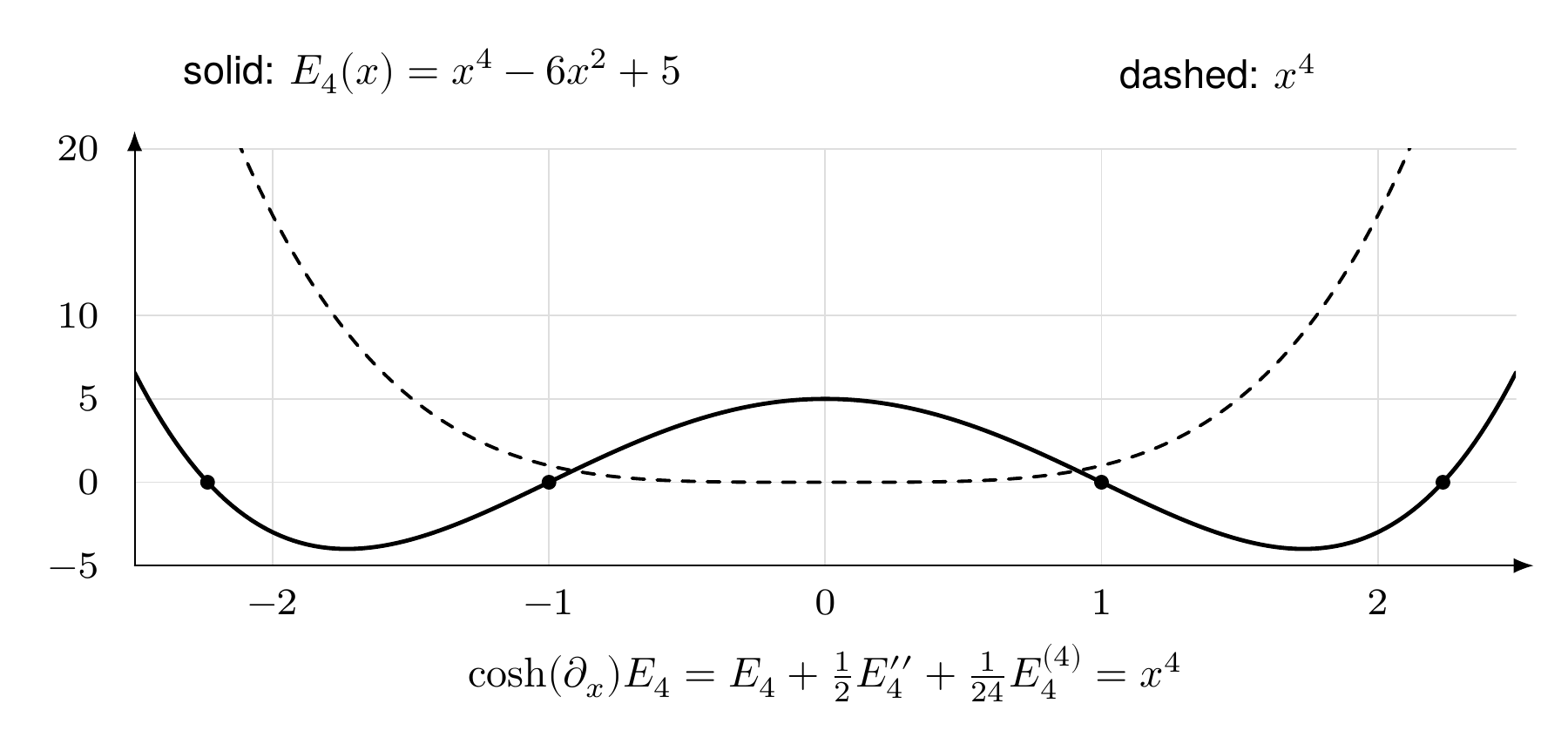
Reading the drawing
The horizontal axis is the polynomial variable and the vertical axis is the polynomial value. The solid output crosses the axis four times, at the roots stated in the plate, while the dashed input touches it at the origin. These are polynomial roots, not zeros of the analytic denominator. The formula below the graph gives the exact finite inverse operation.
Drawing labels and data 13 labels
Read the original labels as selectable text. Tables preserve grid relationships; other short labels are grouped compactly.
Horizontal-axis ticks
\(-2\), \(-1\), \(0\), \(1\), \(2\)
Vertical-axis ticks
\(-5\), \(0\), \(5\), \(10\), \(20\)
Curve labels
- solid: \(E_4(x)=x^4-6x^2+5\)
- dashed: \(x^4\)
Inverse operation
For \(m=4\), only three terms survive:
The four real roots of this polynomial are \(\pm1,\pm\sqrt5\). They are not the zeros of the original analytic denominator. The plot distinguishes the input polynomial and its transformed output.
An inverse operation, not a truncation error
Applying \(\cosh(\partial_x)\) returns \(x^4\) exactly. The general inverse uses the reciprocal formal symbol. The lowering and translation identities are
Both follow from the generating function. No operator-series convergence assumption on an infinite-dimensional function space is needed for this polynomial calculation.
Read this as
Formal substitution into the derivative is safe here because every polynomial sees only finitely many derivatives. That is a domain statement.
Evidence note from the source edition
The polynomial, its inverse image, and the Appell identities are checked symbolically through degree eight in four normalized-section families. The displayed curves are samples of exact polynomials.