
For \(N=4\) the factorization is exact:
Set \(A_4=\sqrt2\pi\). All the zeros are \(A_4(m+1/2)i^k\), with \(m\ge0\) and \(0\le k<4\). Each zero is simple.
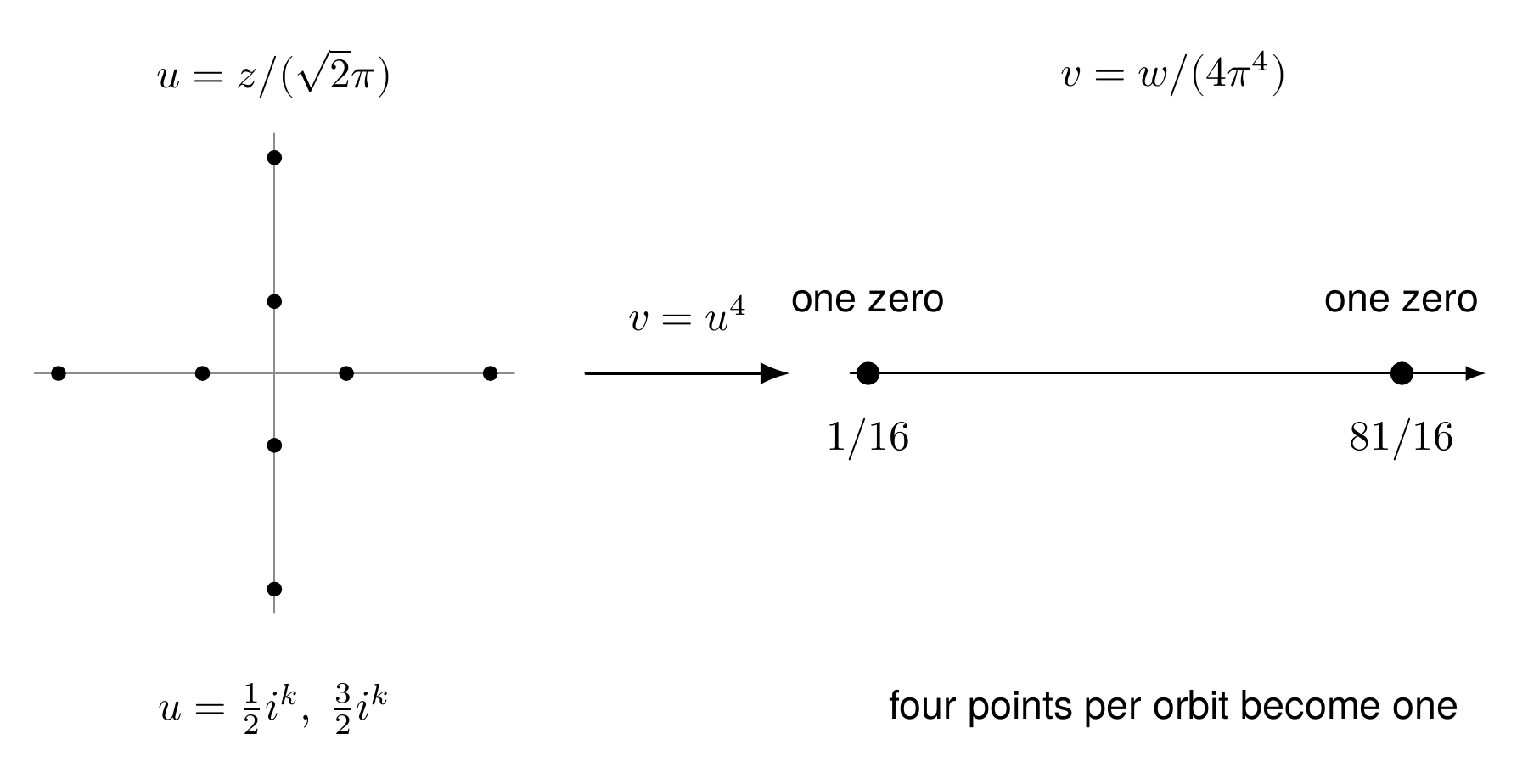
Reading the drawing
The left panel marks two radial levels on each of the four coordinate rays. The fourth-power arrow identifies all four members of each orbit with one point on the positive reduced axis. The two reduced points are labeled separately as one zero each. The map changes the radius scale and removes repeated orbit members; it does not multiply local multiplicity.
Drawing labels and data 9 labels
Read the original labels as selectable text. Tables preserve grid relationships; other short labels are grouped compactly.
Original normalized plane
- \(u=z/(\sqrt2\pi)\)
- \(u=\tfrac12 i^k,\ \tfrac32 i^k\)
Power map
- \(v=u^4\)
| Position | Multiplicity label |
|---|---|
| \(1/16\) | one zero |
| \(81/16\) | one zero |
- \(v=w/(4\pi^4)\)
- four points per orbit become one
The drawing uses \(u=z/A_4\) and \(v=w/A_4^4\), so its marked coordinates are rational. The first four-point orbit has fourth power \(1/16\). The second has fourth power \(81/16\).
Multiplicity is not multiplied in the reduced function
At a nonzero point, \(z\mapsto z^4\) has nonzero derivative. It preserves the local multiplicity of a zero. Four distinct simple zeros of \(D_4\) therefore correspond to one simple zero of \(\Delta_4\), not one zero of multiplicity four. The reduced zeros are
This is why an orbit factor in the \(z\) plane is \(1-z^4/\lambda_m\). It is the product of the four corresponding linear factors, with their phases included.
Read this as
Orbit reduction removes repetition. It changes growth and counting exponents, while preserving each nonzero zero's local multiplicity.
Evidence note from the source edition
The quartic factorization, its differential equation, and the displayed orbit powers are checked independently. Here the complete zero set is known exactly. A finite numerical root search is not being used to establish it.