
Start in the reduced variable with
Write \(1/\Delta_2(w)=\sum b_nw^n\). Matching the product with \(1\) gives a unit lower-triangular system. At each row there is exactly one new unknown.
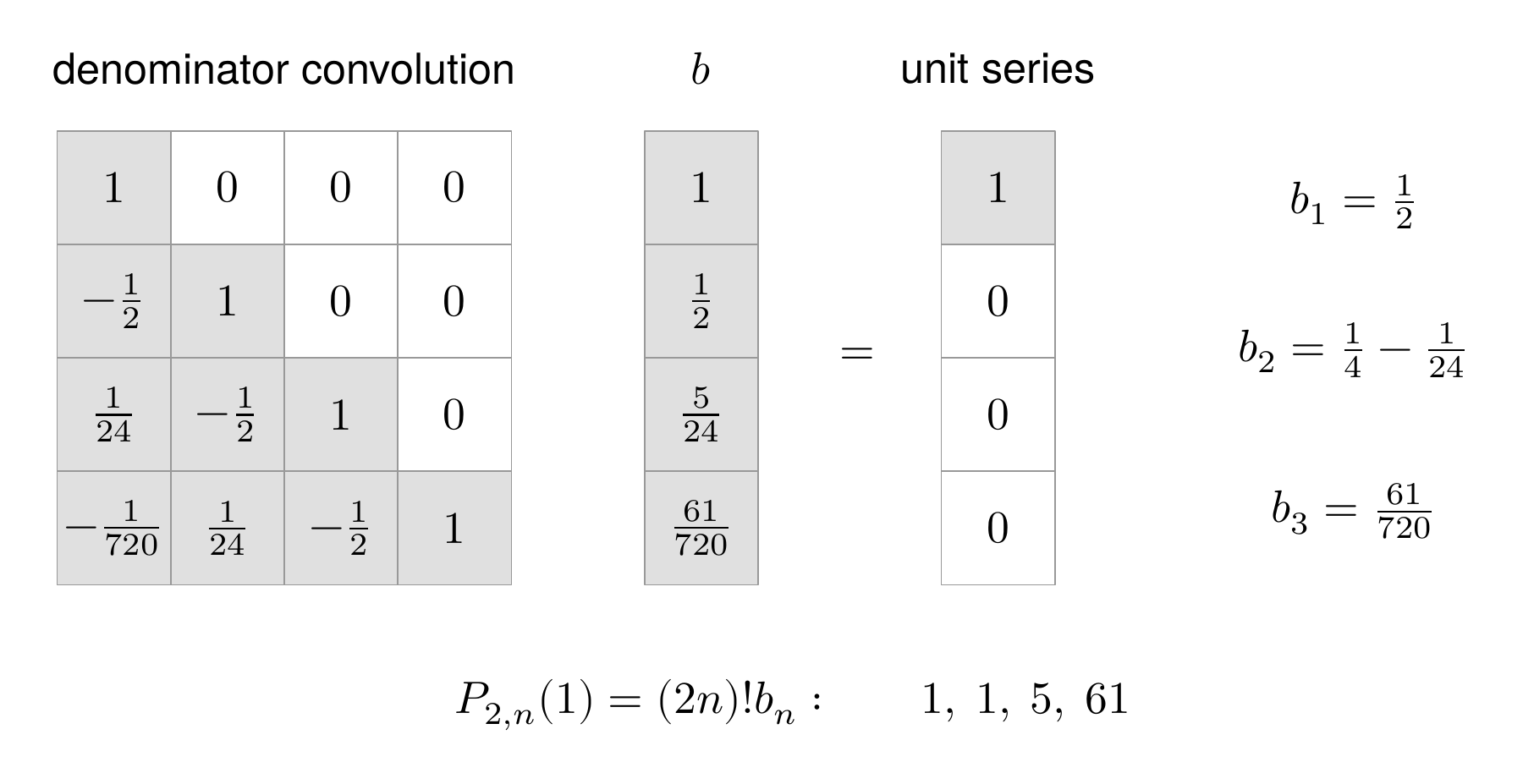
Reading the drawing
Read the matrix equation from left to right: denominator convolution, the unknown coefficient vector, and the unit series. Each matrix row introduces one new coefficient. The values shown are ordinary reduced-variable coefficients. The final line separately converts them to block exponential-generating-function coefficients.
Drawing labels and data 32 labels
Read the original labels as selectable text. Tables preserve grid relationships; other short labels are grouped compactly.
| Row / column | Column 0 | Column 1 | Column 2 | Column 3 |
|---|---|---|---|---|
| Row 0 | \(1\) | \(0\) | \(0\) | \(0\) |
| Row 1 | \(- \frac{1}{2}\) | \(1\) | \(0\) | \(0\) |
| Row 2 | \(\frac{1}{24}\) | \(- \frac{1}{2}\) | \(1\) | \(0\) |
| Row 3 | \(- \frac{1}{720}\) | \(\frac{1}{24}\) | \(- \frac{1}{2}\) | \(1\) |
| Index | Coefficient |
|---|---|
| 0 | \(1\) |
| 1 | \(\frac{1}{2}\) |
| 2 | \(\frac{5}{24}\) |
| 3 | \(\frac{61}{720}\) |
- \(=\)
| Index | Coefficient |
|---|---|
| 0 | \(1\) |
| 1 | \(0\) |
| 2 | \(0\) |
| 3 | \(0\) |
\(b_1=\frac12\)
\(b_2=\frac14-\frac1{24}\)
\(b_3=\frac{61}{720}\)
- \(P_{2,n}(1)=(2n)!b_n:\qquad 1,\ 1,\ 5,\ 61\)
The first three equations are
They yield \(b_1=1/2\), \(b_2=5/24\), and \(b_3=61/720\). Multiplication by \((2n)!\) produces the secant coefficients \(1,5,61\).
Why this is an exact finite calculation
To compute the coefficient of \(w^n\), only denominator coefficients through \(w^n\) are needed. Later terms of the entire series cannot affect it. A finite series inverse is therefore exact at its declared truncation order, even though evaluating that truncated series is only an approximation to the full analytic function away from the origin.
Read this as
A unit constant term makes coefficient recovery triangular. It does not by itself specify the radius of analytic convergence.
Evidence note from the source edition
The checks compare an independent binomial-series expansion, the parameter recurrence, and the logarithmic Newton recurrence through block index six. The table uses ordinary coefficients, with factorial conversion shown separately.