
This guide follows a concrete analytic family through three descriptions: selected Taylor coefficients, a finite differential system, and the zeros of an entire function. The formulas are linked, but the evidence needed for each description is different.
Reading the drawing
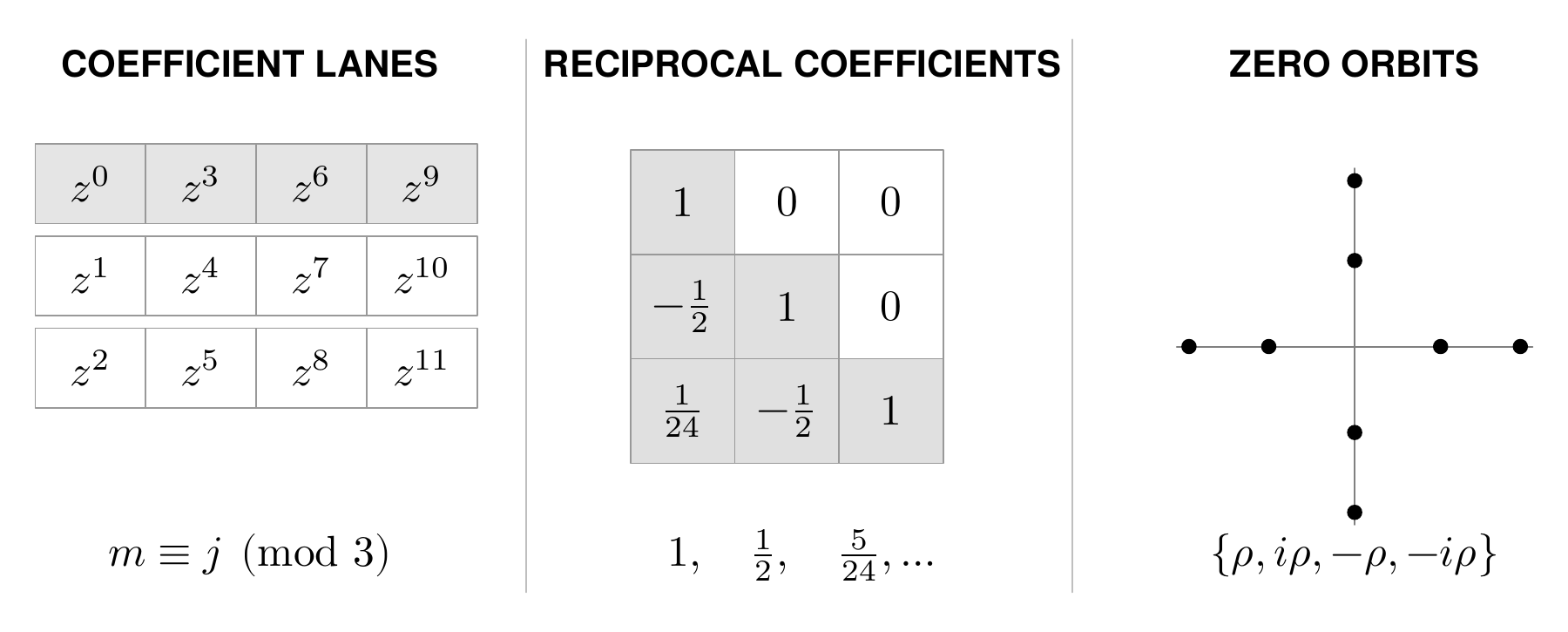
Read left to right. The first panel groups monomials into three residue lanes. The middle panel shows a lower-triangular coefficient matrix and the beginning of its reciprocal solution. The right panel places two four-point orbits on the coordinate axes. These are different small-order models, as explained in the plate; they are not one diagram at a single common order or scale.
Drawing labels and data 27 labels
Read the original labels as selectable text. Tables preserve grid relationships; other short labels are grouped compactly.
| Lane | First term | Second term | Third term | Fourth term |
|---|---|---|---|---|
| Residue 0 | \(z^{0}\) | \(z^{3}\) | \(z^{6}\) | \(z^{9}\) |
| Residue 1 | \(z^{1}\) | \(z^{4}\) | \(z^{7}\) | \(z^{10}\) |
| Residue 2 | \(z^{2}\) | \(z^{5}\) | \(z^{8}\) | \(z^{11}\) |
- \(m\equiv j\pmod 3\)
| Row / column | Column 0 | Column 1 | Column 2 |
|---|---|---|---|
| Row 0 | \(1\) | \(0\) | \(0\) |
| Row 1 | \(- \frac{1}{2}\) | \(1\) | \(0\) |
| Row 2 | \(\frac{1}{24}\) | \(- \frac{1}{2}\) | \(1\) |
\(1,\quad\frac12,\quad\frac5{24},\ldots\)
Rotational picture
- ZERO ORBITS
- \(\{\rho,i\rho,-\rho,-i\rho\}\)
Keep three small models in view
For \(N=2\), the signed denominator is \(D_2(z)=\cos z\). Its reciprocal is the familiar secant series. For \(N=3\), a third exponential perturbs the zeros of a dominant cosine. For \(N=4\), an exact factorization gives a complete zero picture:
The examples move between these orders deliberately. Order two makes the coefficient arithmetic transparent. Order three shows a genuine displacement. Order four makes orbit reduction completely explicit.
Three routes through the guide
| Route | Pages and question |
|---|---|
| Algebra first | Visual 3 to Visual 16: how do selection, signs, reciprocals, and finite differential operators work? |
| Zeros first | Visual 17 to Visual 24: where can cancellation happen, and how does it determine coefficients? |
| One full calculation | Visual 25: derive the same number, \(69\), from denominator coefficients and from zero moments. |
Read this as
The pictures carry computable objects. They do not replace the global analytic arguments or extend the inherited Lean contract.
Evidence note from the source edition
Exact identities and rational certificates are distinguished from sampled curves. All plates are reproducible vector drawings. The source package preserves the original proofread manuscript.