
Work in \({\mathbb C}[\xi]/(\xi^3+1)\). Every element has coordinates in \(1,\xi,\xi^2\). The entire exponential has the finite-coordinate form
The multiplication table makes the carry sign unavoidable.
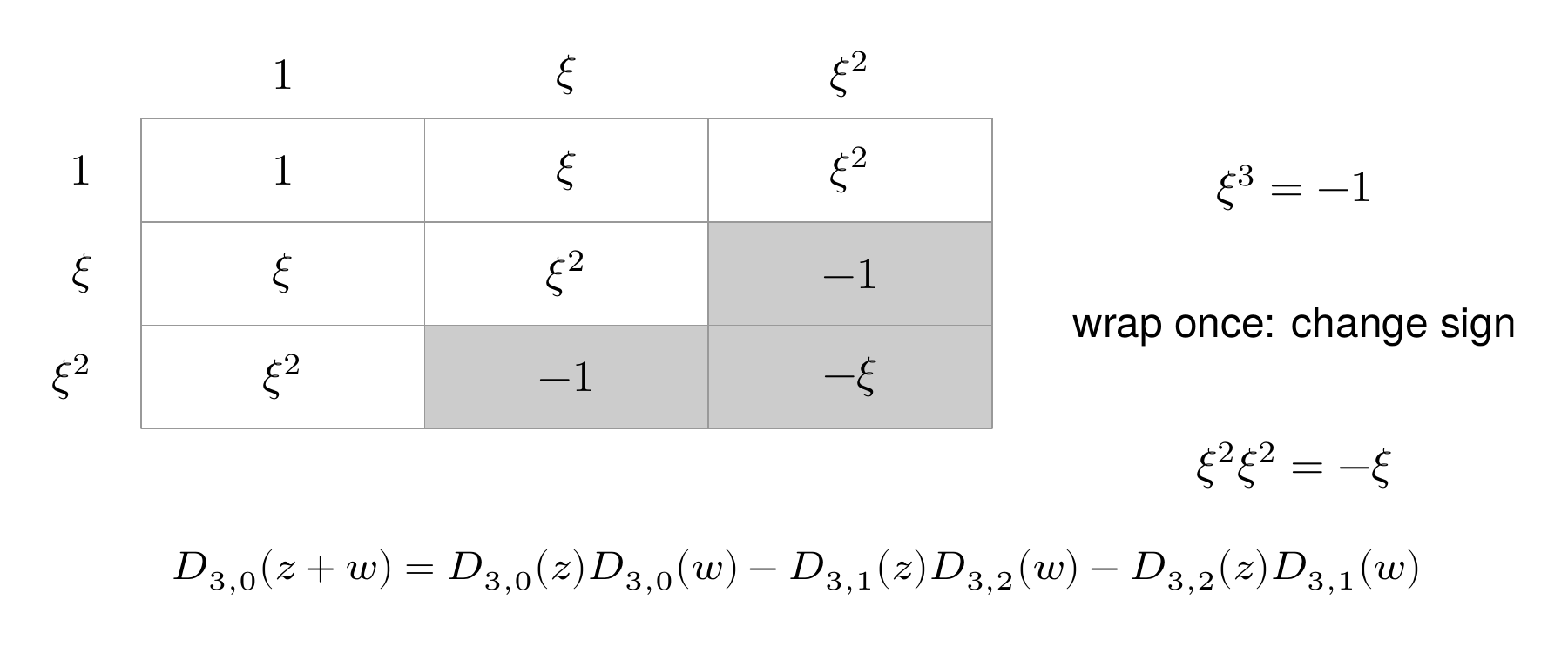
Reading the drawing
The row and column labels are the three basis elements. Products crossing the cubic relation acquire a minus sign. The addition formula below the table reads the constant-coordinate contributions: one has no wrap and two have a wrap.
Drawing labels and data 19 labels
Read the original labels as selectable text. Tables preserve grid relationships; other short labels are grouped compactly.
| Row factor / column factor | \(1\) | \(\xi\) | \(\xi^2\) |
|---|---|---|---|
| \(1\) | \(1\) | \(\xi\) | \(\xi^2\) |
| \(\xi\) | \(\xi\) | \(\xi^2\) | \(-1\) |
| \(\xi^2\) | \(\xi^2\) | \(-1\) | \(-\xi\) |
- \(\xi^3=-1\)
- wrap once: change sign
- \(\xi^2\xi^2=-\xi\)
Multiply the coordinate forms of \(e^{z\xi}\) and \(e^{w\xi}\). Their product is \(e^{(z+w)\xi}\). The coefficient of \(1\) receives one contribution without a wrap and two contributions with a wrap. Reading that coefficient gives the displayed addition law.
Compare the unsigned model
In \({\mathbb C}[\xi]/(\xi^3-1)\), the same table has no minus signs. Its exponential coordinates are the unsigned sections \(E_{3,j}\). Thus the difference between the two differential systems is a single algebraic relation, not a change in how coefficients are grouped. For general \(N\), the carry factor is
Only zero or one wrap is possible in a product of two coordinate basis elements.
Read this as
The twisted addition law is the ordinary exponential group law expressed in a signed cyclic algebra.
Evidence note from the source edition
Bivariate Taylor identities are checked through total degree ten in every section for \(N=2,3,4\). Omitting the carry sign is one of the deliberately rejected controls.