
For \(N\ge2\), the reduced entire function has order \(1/N<1\). Its multiplicity-sensitive genus-zero product is
Putting \(K_Ne_\lambda=\lambda^{-1}e_\lambda\) on \(\ell^2(\Lambda_N)\) gives the corresponding diagonal Fredholm determinant. Repeated zeros require repeated diagonal entries.
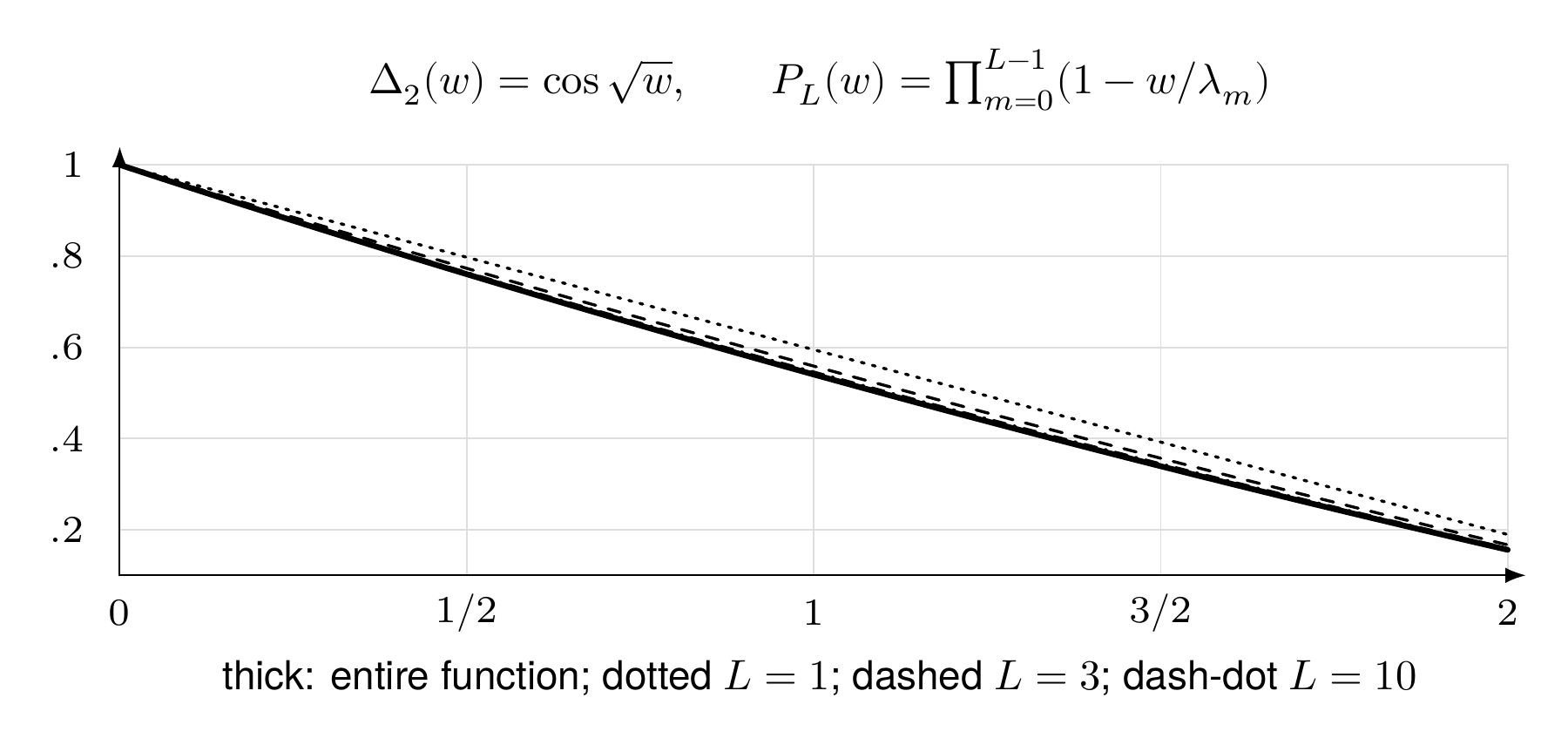
Reading the drawing
The horizontal axis is the reduced variable and the vertical axis is the function or product value. All curves start at one. The thick curve is the entire function; three line styles identify products with increasing numbers of factors. Their agreement improves with the truncation size, while the plate states a separate quantitative tail bound and its range.
Drawing labels and data 12 labels
Read the original labels as selectable text. Tables preserve grid relationships; other short labels are grouped compactly.
Reduced-variable ticks
\(0\), \(1/2\), \(1\), \(3/2\), \(2\)
Value-axis ticks
\(.2\), \(.4\), \(.6\), \(.8\), \(1\)
Function and product
Line-style key
thick: entire function; dotted \(L=1\); dashed \(L=3\); dash-dot \(L=10\)
Finite compression is an approximation
For \(N=2\), \(\lambda_m=\pi^2(m+1/2)^2\). The finite determinant \(P_L\) is exactly the displayed finite product, but it is not exactly \(\Delta_2\). For \(0\le w\le1\) and \(L\ge1\), an elementary tail estimate gives
The last bound uses \(\pi>3\) and integral comparison. Thus truncation has an explicit error mechanism.
Read this as
The infinite product is justified by the analytic theorem. Finite determinants provide controlled approximations, not substitutes for that theorem.
Evidence note from the source edition
The exact finite determinant test includes a repeated eigenvalue and rejects deduplication. The curves use known cosine zeros. Order one is excluded: \(\Delta_1(w)=e^{-w}\) has no zeros, so its empty product would be \(1\), not the function.