
Let \(H_N(z)=E_{N,0}(z)\). The theta family uses the same parameter \(u\) twice, but in two different roles:
Argument scaling contributes \(u^{Nm}\) at logarithmic block \(m\). Reciprocal order contributes \(u\).
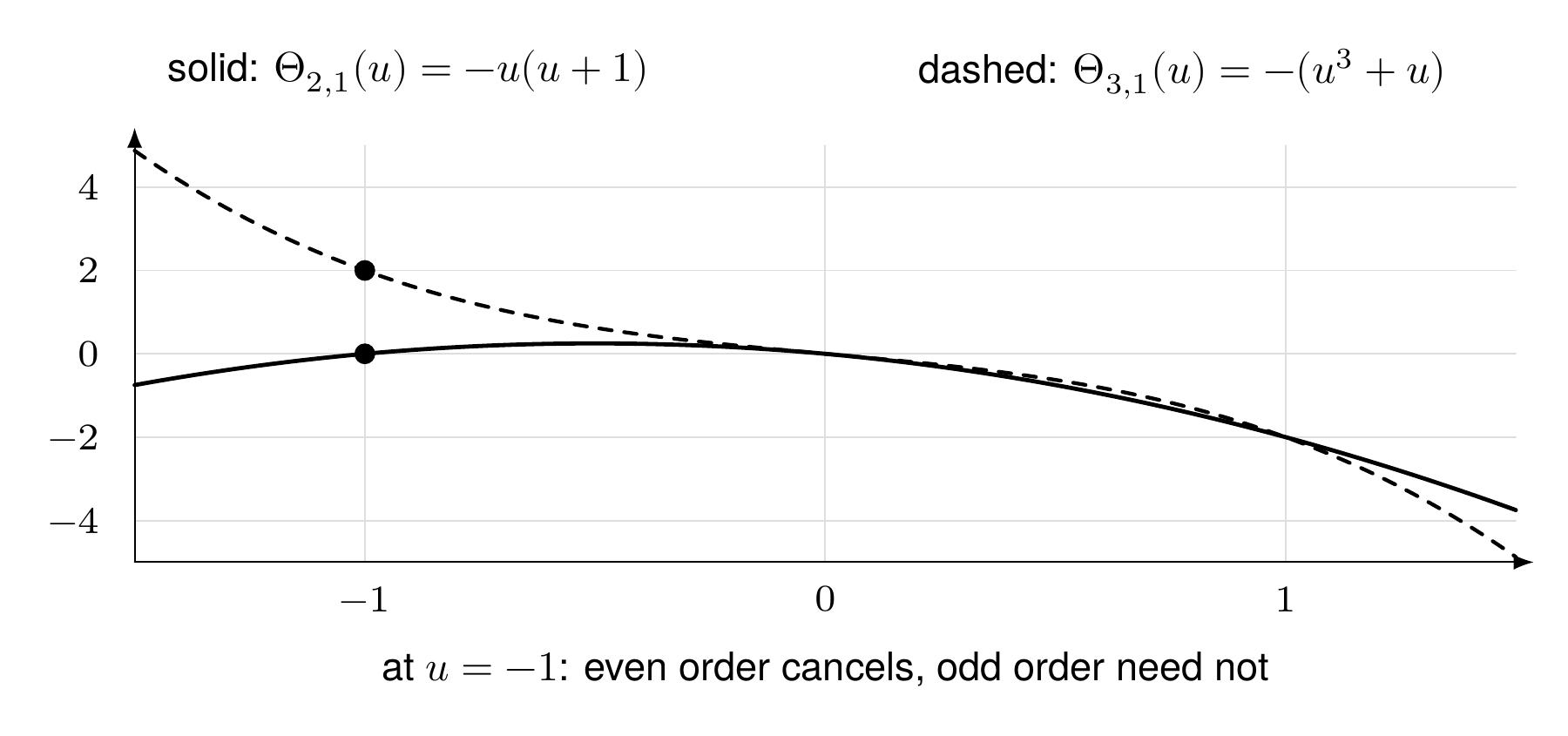
Reading the drawing
The horizontal axis is the common parameter and the vertical axis is the first theta coefficient. Both displayed curves pass through zero at the origin. At minus one the solid even-order curve also vanishes, whereas the dashed odd-order curve does not. The distinction illustrates the boundary stated in the accompanying text.
Drawing labels and data 11 labels
Read the original labels as selectable text. Tables preserve grid relationships; other short labels are grouped compactly.
Horizontal-axis ticks
\(-1\), \(0\), \(1\)
Vertical-axis ticks
\(-4\), \(-2\), \(0\), \(2\), \(4\)
Curve labels
- solid: \(\Theta_{2,1}(u)=-u(u+1)\)
- dashed: \(\Theta_{3,1}(u)=-(u^3+u)\)
at \(u=-1\): even order cancels, odd order need not
Their combined logarithm has coefficient
At the first block this gives \(\Theta_{N,1}(u)=-(u^N+u)\). Every positive-index theta polynomial vanishes at \(u=0\). For even \(N\), \(H_N(-z)=H_N(z)\), so the defining product is also \(1\) at \(u=-1\).
The odd-order boundary is visible
For \(N=3\), \(\Theta_{3,1}(-1)=2\), not zero. The factor \(u+1\) is not a uniform law across orders. In contrast,
The two guaranteed factors follow from the whole generating function, not from guessing the first few polynomial roots.
Read this as
A common parameter does not make argument scaling and reciprocal order interchangeable. Their powers must be tracked separately.
Evidence note from the source edition
The exact checker compares theta convolution with its logarithmic Newton recurrence through block index four. The odd-order factor claim is explicitly rejected as an invalid control.