
The root finder is used only to suggest intervals. Each displayed interval is accepted by exact rational arithmetic: opposite endpoint signs prove existence, and an interval bound for \(D_3'\) excludes zero throughout the interval, proving uniqueness inside it.
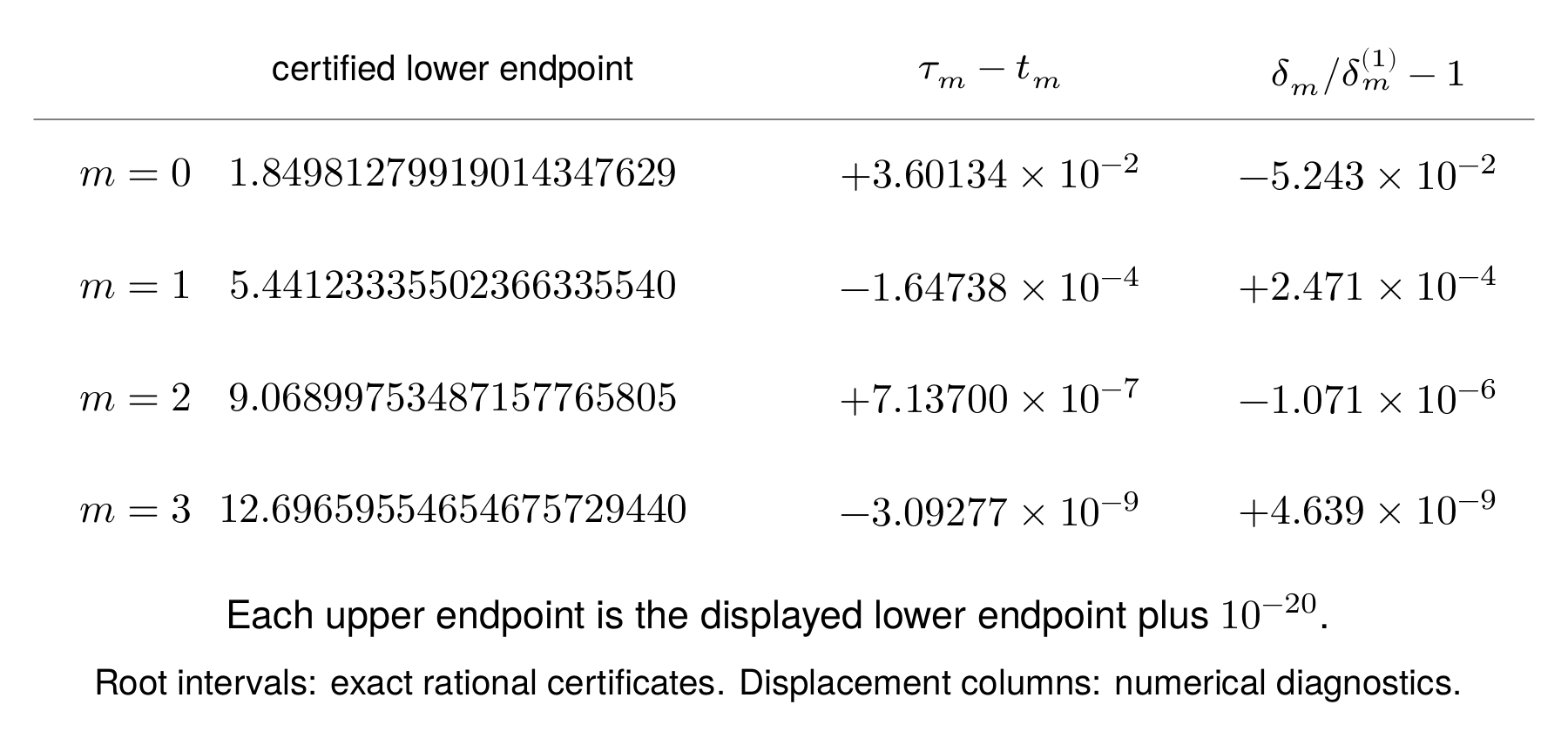
Reading the drawing
Each row identifies one local root interval. The first numeric column is its certified lower endpoint; the upper endpoint is obtained by the exact increment stated below the table. The remaining columns describe displacement and relative discrepancy numerically. They are diagnostics, distinct from the rational interval certificates. This table does not enumerate every zero.
Drawing labels and data 21 labels
Read the original labels as selectable text. Tables preserve grid relationships; other short labels are grouped compactly.
| Index | certified lower endpoint | \(\tau_m-t_m\) | \(\delta_m/\delta_m^{(1)}-1\) |
|---|---|---|---|
| \(m=0\) | \(1.84981279919014347629\) | \(+3.60134\times10^{-2}\) | \(-5.243\times10^{-2}\) |
| \(m=1\) | \(5.44123335502366335540\) | \(-1.64738\times10^{-4}\) | \(+2.471\times10^{-4}\) |
| \(m=2\) | \(9.06899753487157765805\) | \(+7.13700\times10^{-7}\) | \(-1.071\times10^{-6}\) |
| \(m=3\) | \(12.69659554654675729440\) | \(-3.09277\times10^{-9}\) | \(+4.639\times10^{-9}\) |
Each upper endpoint is the displayed lower endpoint plus \(10^{-20}\).
Root intervals: exact rational certificates. Displacement columns: numerical diagnostics.
How the certificate works
Evaluate the Taylor polynomial
at the two rational endpoints. From the next term onward, magnitudes decrease, because their successive ratio is
there. The alternating-series remainder is bounded by the first omitted term. A separate outward interval evaluation of the differentiated polynomial, plus its tail bound, certifies the derivative sign. The first bracket is
Its displacement differs from the leading asymptotic prediction by about five percent. The later examples have much smaller relative discrepancies, as the plate records.
Read this as
A small residual is not a root certificate. Endpoint signs plus a derivative bound give a checkable local existence-and-uniqueness statement.
Evidence note from the source edition
Four certified intervals do not establish that no other real or complex zeros exist. The displacement columns are high-precision diagnostics, not a finite verification of a global big-\(O\) theorem. All rational enclosures are included in the checks file.