
Taking the logarithm of the canonical product identifies
The same exact numbers can be computed from finitely many denominator coefficients by Newton's recurrence. No numerical zero list is needed for that calculation.
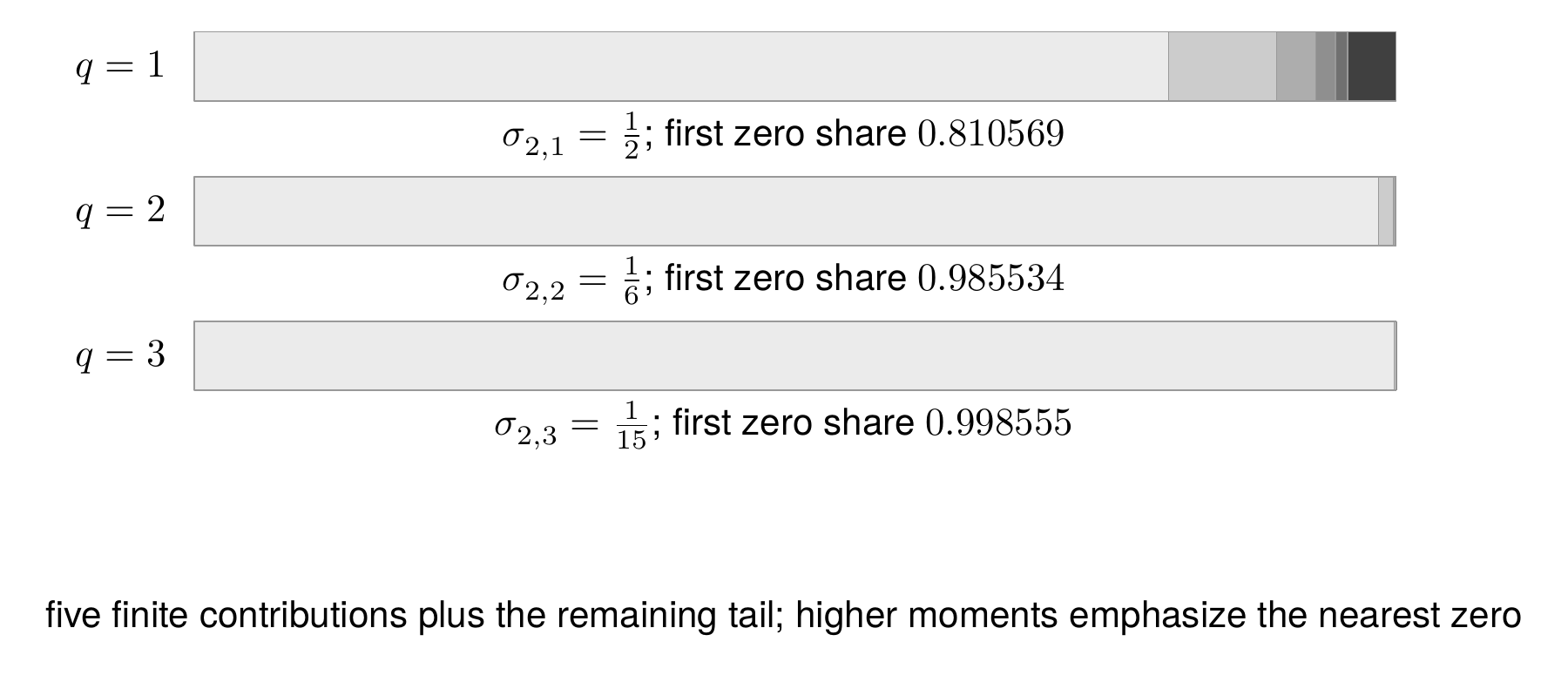
Reading the drawing
Each horizontal bar has five finite zero contributions followed by the remaining tail. The total is the exact rational moment labeled for that row. The table also transcribes the displayed decimal share of the nearest zero. As the inverse-power order increases, that nearest-zero share occupies more of the bar; the widths themselves are numerical visualizations.
Drawing labels and data 7 labels
Read the original labels as selectable text. Tables preserve grid relationships; other short labels are grouped compactly.
| Moment order | Exact total and displayed share |
|---|---|
| \(q=1\) | \(\sigma_{2,1}=\frac{1}{2}\); first zero share \(0.810569\) |
| \(q=2\) | \(\sigma_{2,2}=\frac{1}{6}\); first zero share \(0.985534\) |
| \(q=3\) | \(\sigma_{2,3}=\frac{1}{15}\); first zero share \(0.998555\) |
five finite contributions plus the remaining tail; higher moments emphasize the nearest zero
For order two,
The plate shows how successive inverse powers emphasize the nearest zero. Its shaded pieces are contributions from the first five positive reduced zeros, followed by the remaining tail. The total in each row is the exact rational moment.
The tangent is a sum of poles
Logarithmic differentiation also gives
away from poles. Summability of \(|\lambda|^{-1}\) permits the locally uniform partial-fraction expansion without added regularizing terms.
Read this as
A global analytic product theorem connects the infinite zero sum to a finite algebraic recurrence. The recurrence alone does not prove the product theorem.
Evidence note from the source edition
Displayed moments are checked against formal logarithm coefficients and exact order-two/order-four zeta values. Bar widths are numerical shares. General power sums use \(\lambda^{-q}\), not \(|\lambda|^{-q}\) when exceptional nonpositive zeros are present.