
For \(N=4\), write \(\omega=i\). To extract residue \(j\), evaluate the function at four rotated arguments and attach the phase \(i^{-j\ell}\):
A monomial \(a_mz^m\) is multiplied by the finite average of \(i^{(m-j)\ell}\). Matching phases all vote \(1\). Nonmatching phases cancel exactly.
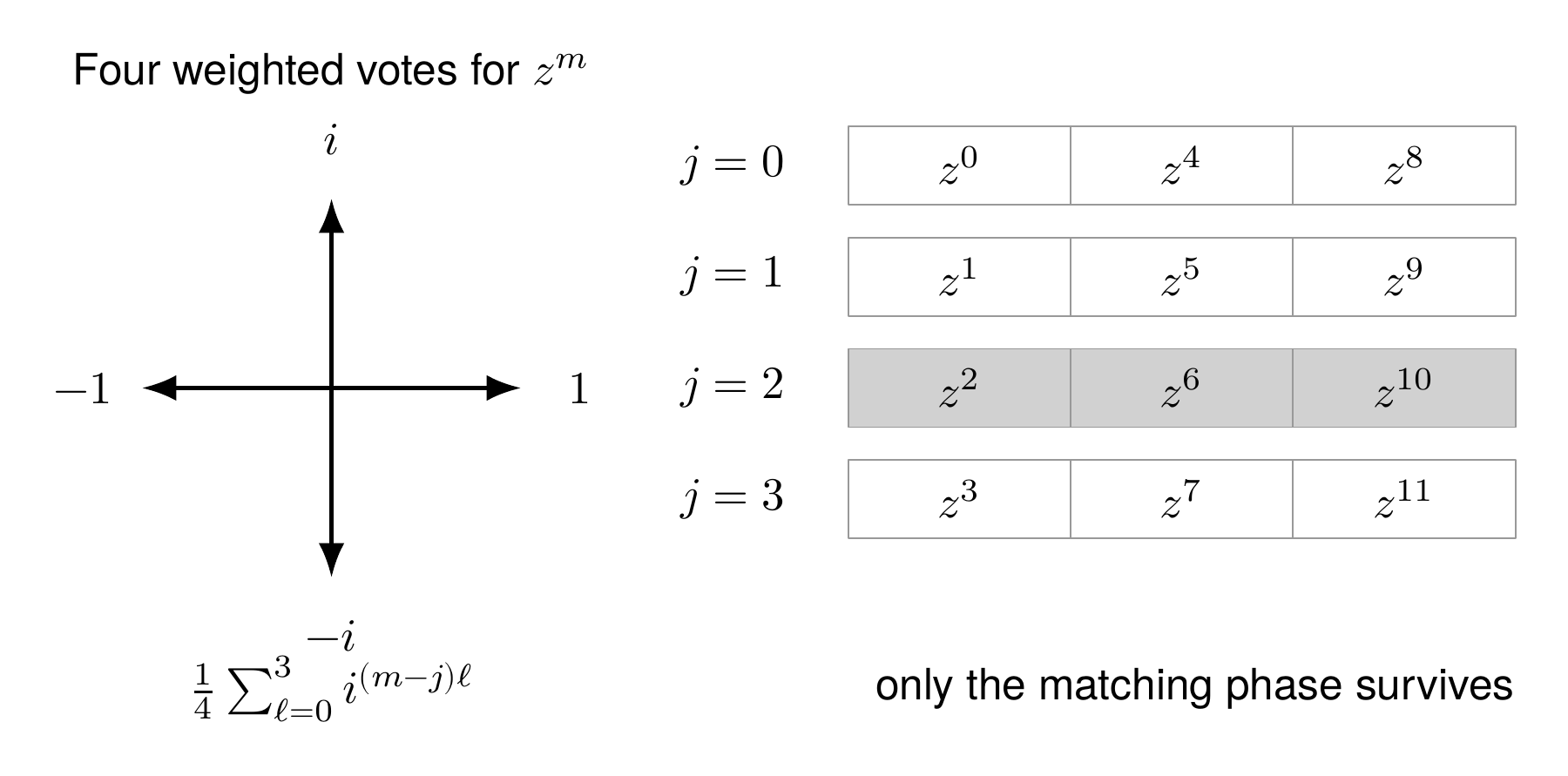
Reading the drawing
The left panel places the four complex phases on perpendicular arrows from a common origin. The finite average below them selects matching coefficient addresses. The right panel lists four residue lanes. Its shaded third row contains the monomials selected in the worked example; shading is also identified explicitly in the table.
Drawing labels and data 23 labels
Read the original labels as selectable text. Tables preserve grid relationships; other short labels are grouped compactly.
- Four weighted votes for \(z^m\)
\(\frac14\sum_{\ell=0}^3 i^{(m-j)\ell}\)
| Direction | Phase |
|---|---|
| Right | \(1\) |
| Up | \(i\) |
| Left | \(-1\) |
| Down | \(-i\) |
| Lane | First term | Second term | Third term | Highlight |
|---|---|---|---|---|
| \(j=0\) | \(z^{0}\) | \(z^{4}\) | \(z^{8}\) | |
| \(j=1\) | \(z^{1}\) | \(z^{5}\) | \(z^{9}\) | |
| \(j=2\) | \(z^{2}\) | \(z^{6}\) | \(z^{10}\) | Selected lane |
| \(j=3\) | \(z^{3}\) | \(z^{7}\) | \(z^{11}\) |
- only the matching phase survives
An example that can be checked coefficient by coefficient
Take \(F(z)=\sum_{m=0}^{12}(m+1)z^m\). Then
Applying the same selector again changes nothing. Applying a different selector gives zero. Summing the four selected polynomials returns the original \(F\).
Selection is also a symmetry condition
For the selected polynomial \(F_2\), rotation gives \(F_2(iz)=-F_2(z)\). More generally, a residue-\(j\) section satisfies \(F_j(\omega z)=\omega^jF_j(z)\). The phase label therefore describes both the coefficient addresses and the response to rotation.
Read this as
This is not an approximate Fourier fit. The finite root sum is exactly \(0\) or \(1\) on every coefficient.
Evidence note from the source edition
The checker compares the actual complex average with independent coefficient selection for this polynomial. The drawing shows the four complex phases, not a numerical convergence argument.