
Let \(r\) vary instead of fixing the reciprocal power. Since
the coefficient of \(w^n\) is a polynomial of degree \(n\) in \(r\). Bell polynomials collect the possible ways logarithmic terms contribute total degree \(n\).
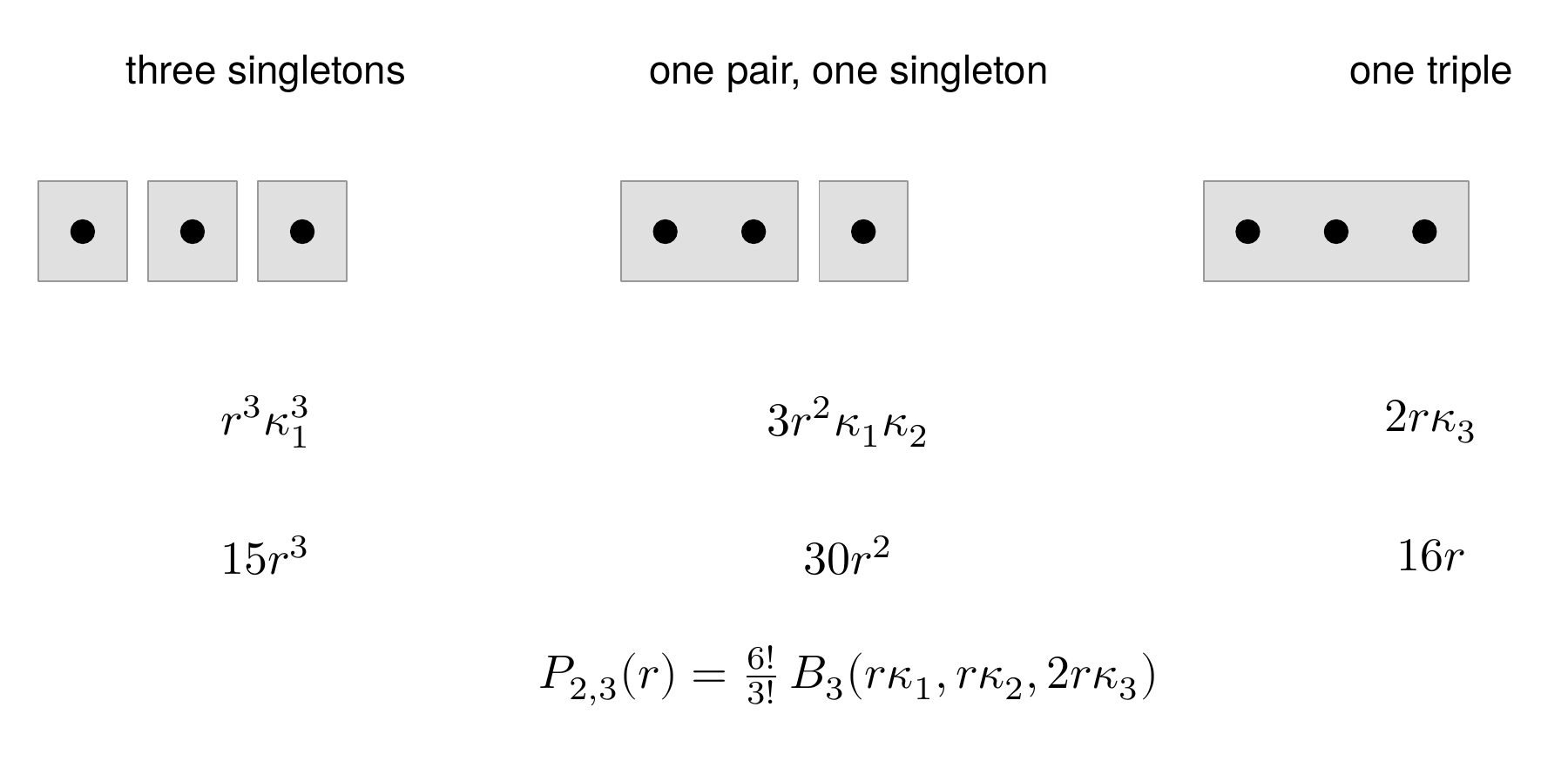
Reading the drawing
Each row names a partition type, gives its logarithmic contribution, and gives the resulting term after the plate’s factorial normalization. Three singleton pieces produce the cubic term, a pair and singleton produce the quadratic term, and a single triple produces the linear term. The Bell-polynomial identity underneath combines the three rows.
Drawing labels and data 10 labels
Read the original labels as selectable text. Tables preserve grid relationships; other short labels are grouped compactly.
| Partition type | Logarithmic term | Normalized contribution |
|---|---|---|
| three singletons | \(r^3\kappa_1^3\) | \(15r^3\) |
| one pair, one singleton | \(3r^2\kappa_1\kappa_2\) | \(30r^2\) |
| one triple | \(2r\kappa_3\) | \(16r\) |
For \(N=2\), the first three logarithmic coefficients are
The third Bell polynomial is \(B_3(x_1,x_2,x_3)=x_1^3+3x_1x_2+x_3\). Substituting \(x_1=r\kappa_1\), \(x_2=r\kappa_2\), \(x_3=2r\kappa_3\) and multiplying by \(6!/3!\) gives
At \(r=1\) this is \(61\). At \(r=2\) it is \(272\). At \(r=0\) it vanishes, as every positive-index reciprocal coefficient must.
The leading term has a simple source
Only \(n\) copies of the linear logarithmic term can contribute \(r^n w^n\). Therefore
Read this as
The polynomial parameter records how many logarithmic pieces are combined. It is not a numerical interpolation in the reciprocal order.
Evidence note from the source edition
The partition plate is a finite combinatorial expansion. The exact tests verify the leading coefficient and parameter polynomial through block index six for five orders.