
Selection separates a function additively. It does not make multiplication diagonal. A residue-\(i\) term multiplied by a residue-\(j\) term lands in residue \(i+j\pmod N\). For \(N=3\), use
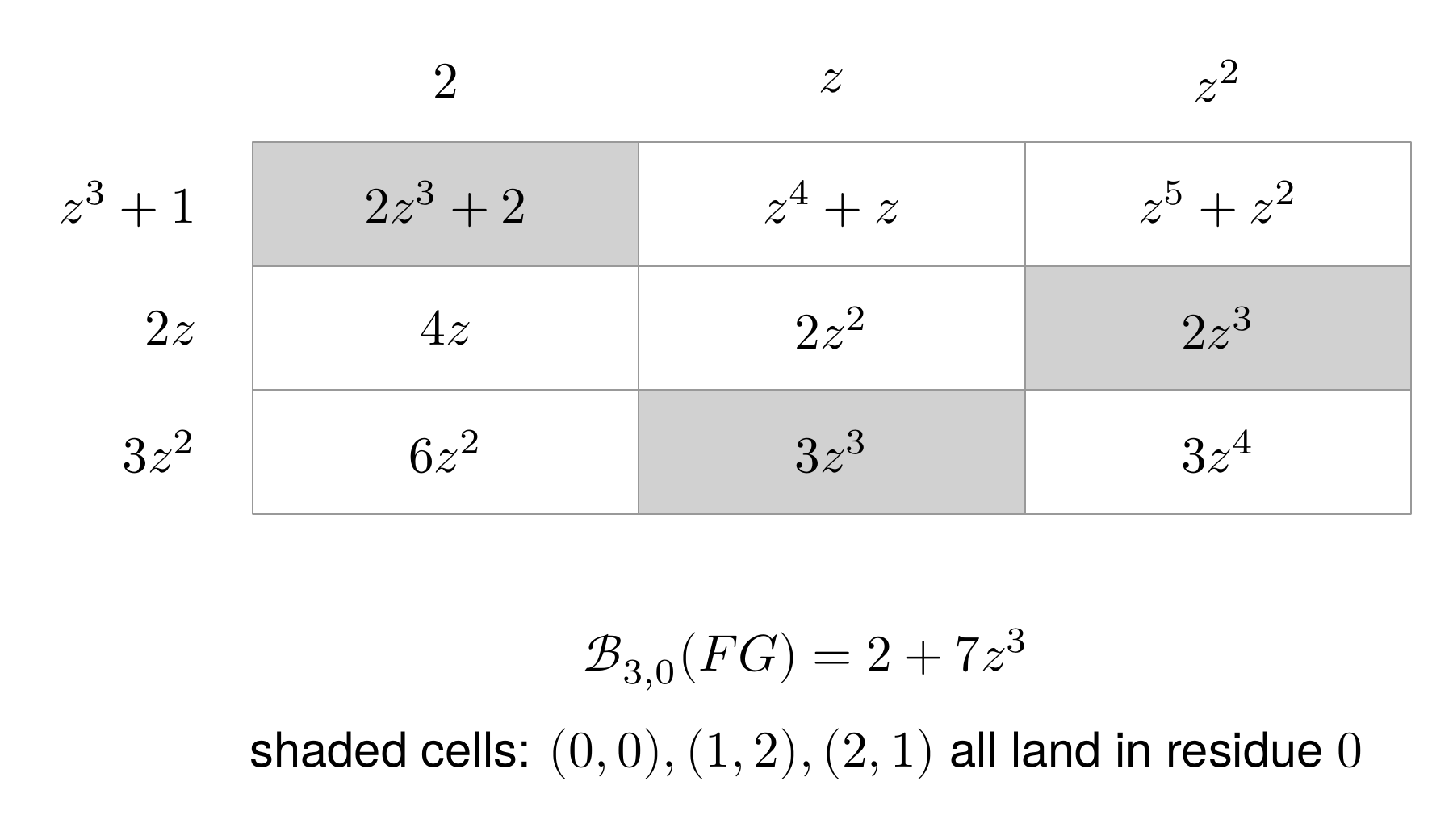
The table displays every product of their three selected sections.
Reading the drawing
Columns are the selected sections of the second polynomial and rows are those of the first. Each interior cell is their exact product. The top-left, middle-right, and bottom-middle cells are shaded: together they supply the residue-zero output. Reading only the top-left cell omits the two mixed contributions.
Drawing labels and data 17 labels
Read the original labels as selectable text. Tables preserve grid relationships; other short labels are grouped compactly.
| First section / second section | \(2\) | \(z\) | \(z^{2}\) |
|---|---|---|---|
| \(z^{3} + 1\) | \(2 z^{3} + 2\) | \(z^{4} + z\) | \(z^{5} + z^{2}\) |
| \(2 z\) | \(4 z\) | \(2 z^{2}\) | \(2 z^{3}\) |
| \(3 z^{2}\) | \(6 z^{2}\) | \(3 z^{3}\) | \(3 z^{4}\) |
\(\mathcal B_{3,0}(FG)=2+7z^3\)
shaded cells: \((0,0), (1,2), (2,1)\) all land in residue \(0\)
The shaded cells contribute to residue zero:
Keeping only the product of the residue-zero inputs would give \(2+2z^3\) and lose five units of the \(z^3\) coefficient. The mixed cells are part of the exact result.
The general rule
Every pair belongs to exactly one output residue. No term is discarded and no coefficient is estimated. This finite cyclic convolution is the algebra behind the later addition formulas and block-coefficient recurrences.
Read this as
A packet label tells you where an interaction lands, not that interactions with other packets vanish.
Evidence note from the source edition
All nine table entries and all three output sections are checked as exact polynomial identities. This is the scalar cyclic specialization used by the paper.