
One recurrence uses the denominator coefficients. Another uses its logarithm. With \(b_n(r)=P_{N,n}(r)/(Nn)!\), the shorter logarithmic form is
The negative superdiagonal in the Newton determinant is essential.
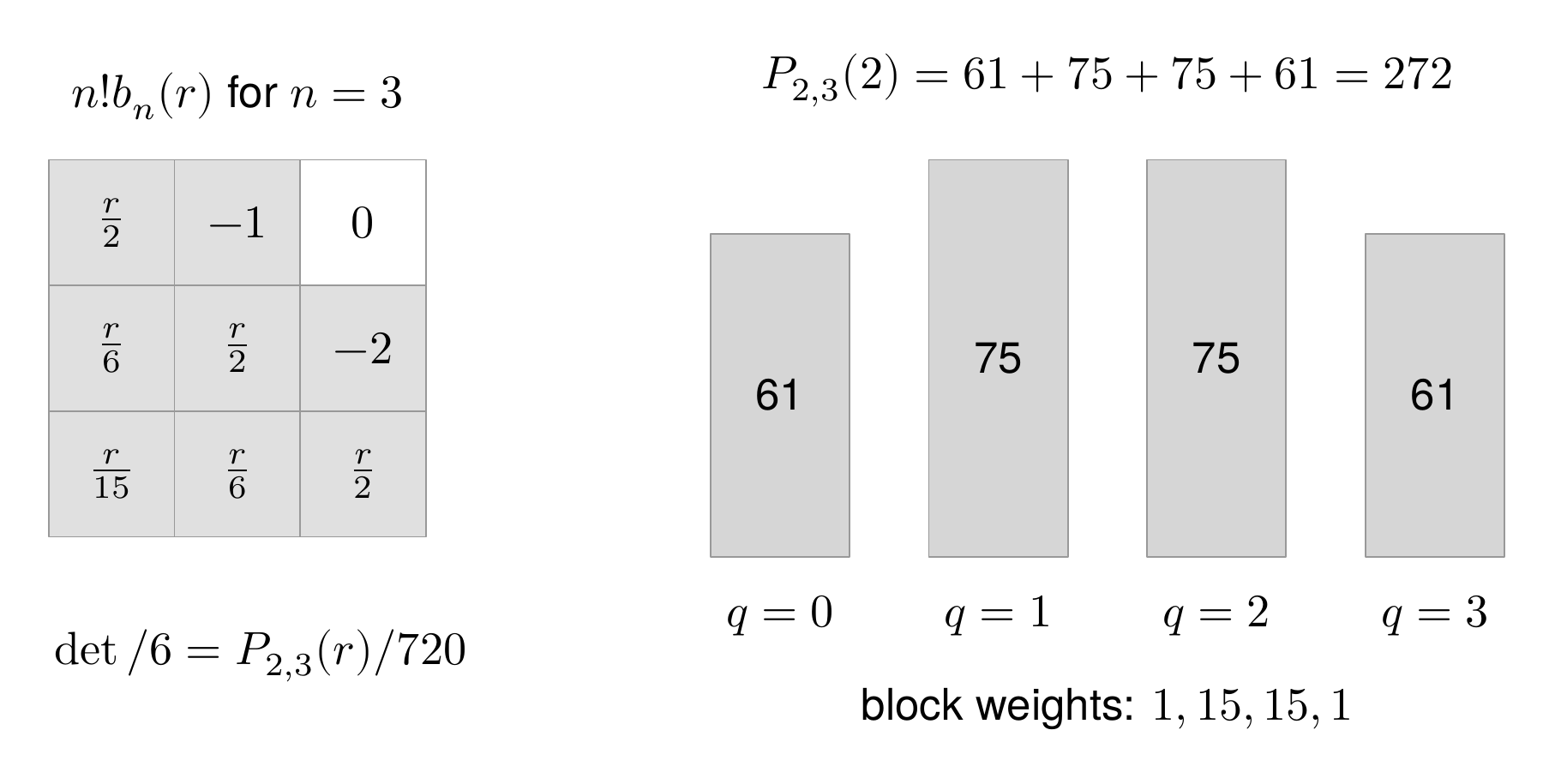
Reading the drawing
The left panel shows a three-by-three determinant with a negative superdiagonal. Its normalization is stated immediately below. The right panel has four contributions, indexed from zero to three, to the parameter-addition calculation. The middle contributions use the larger block binomial weights rather than ordinary binomial weights.
Drawing labels and data 21 labels
Read the original labels as selectable text. Tables preserve grid relationships; other short labels are grouped compactly.
| Row / column | Column 0 | Column 1 | Column 2 |
|---|---|---|---|
| Row 0 | \(\frac{r}{2}\) | \(-1\) | \(0\) |
| Row 1 | \(\frac{r}{6}\) | \(\frac{r}{2}\) | \(-2\) |
| Row 2 | \(\frac{r}{15}\) | \(\frac{r}{6}\) | \(\frac{r}{2}\) |
- \(\det /6=P_{2,3}(r)/720\)
| Block index | Contribution |
|---|---|
| \(q=0\) | 61 |
| \(q=1\) | 75 |
| \(q=2\) | 75 |
| \(q=3\) | 61 |
- \(P_{2,3}(2)=61+75+75+61=272\)
- block weights: \(1,15,15,1\)
The additive parameter law has block weights
Using the same logarithm, \(D_N^{-r}D_N^{-s}=D_N^{-(r+s)}\). Thus
For \(N=2,n=3,r=s=1\), the four weights are \(1,15,15,1\). The two middle terms are \(15\cdot1\cdot5\) and \(15\cdot5\cdot1\). Together with the endpoints, they give \(272\). Using \(\binom nq\) instead would be incorrect for these coefficients. That ordinary binomial law belongs to the separately normalized sequence \(n!P_{N,n}/(Nn)!\).
Read this as
Agreement of independent recurrences is a useful check precisely because their bookkeeping is different. Neither permits silently changing the factorial convention.
Evidence note from the source edition
The checker compares both recurrence routes and the determinant, then checks the parameter-addition identity symbolically. A deliberately incorrect ordinary-binomial substitution is rejected.