
The signed denominator and the normalized unsigned sections produce different reciprocal families. In order two,
Their first block-EGF coefficients make the difference visible.
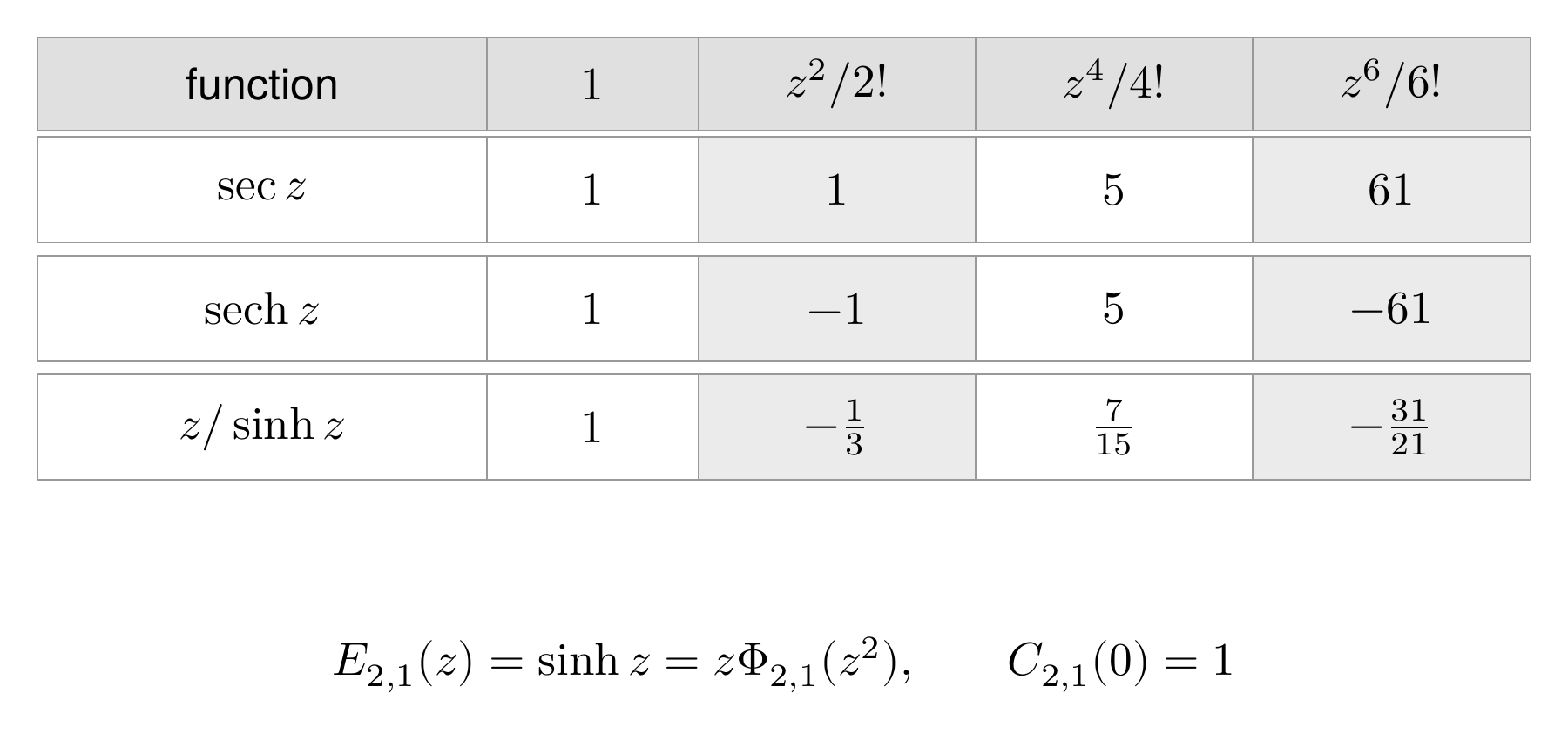
Reading the drawing
Read across each function row using the factorial-scaled monomials in the column headers. The rows differ in signs and rational values even though each normalized function has constant term one. The identity beneath the table records removal of the forced zero before forming the third reciprocal.
Drawing labels and data 21 labels
Read the original labels as selectable text. Tables preserve grid relationships; other short labels are grouped compactly.
| function | \(1\) | \(z^2/2!\) | \(z^4/4!\) | \(z^6/6!\) |
|---|---|---|---|---|
| \(\sec z\) | \(1\) | \(1\) | \(5\) | \(61\) |
| \(\operatorname{sech}z\) | \(1\) | \(-1\) | \(5\) | \(-61\) |
| \(z/\sinh z\) | \(1\) | \(- \frac{1}{3}\) | \(\frac{7}{15}\) | \(- \frac{31}{21}\) |
Remove the forced zero before taking a reciprocal
The section \(E_{N,j}\) begins with \(z^j/j!\). Define
Then \(C_{N,j}(z)=1/\Phi_{N,j}(z^N)\) has value \(1\) at the origin. For \(j>0\), the notation \((z^j/j!)/E_{N,j}(z)\) means this removable continuation. It does not mean evaluating an undefined \(0/0\) expression. For \(N=2,j=1\), the first nontrivial coefficient is \(-1/3\) in front of \(z^2/2!\), equivalently \(-z^2/6\). Dropping the numerator \(z\) would instead produce the pole of \(1/\sinh z\).
Read this as
A minus sign in the denominator series and removal of an initial zero are different operations. Their reciprocal coefficients should not be interchanged.
Evidence note from the source edition
All entries in the table are exact rationals computed from independent triangular inverses. The table explicitly uses block-EGF columns. Ordinary coefficients are obtained by dividing by the displayed factorials.