
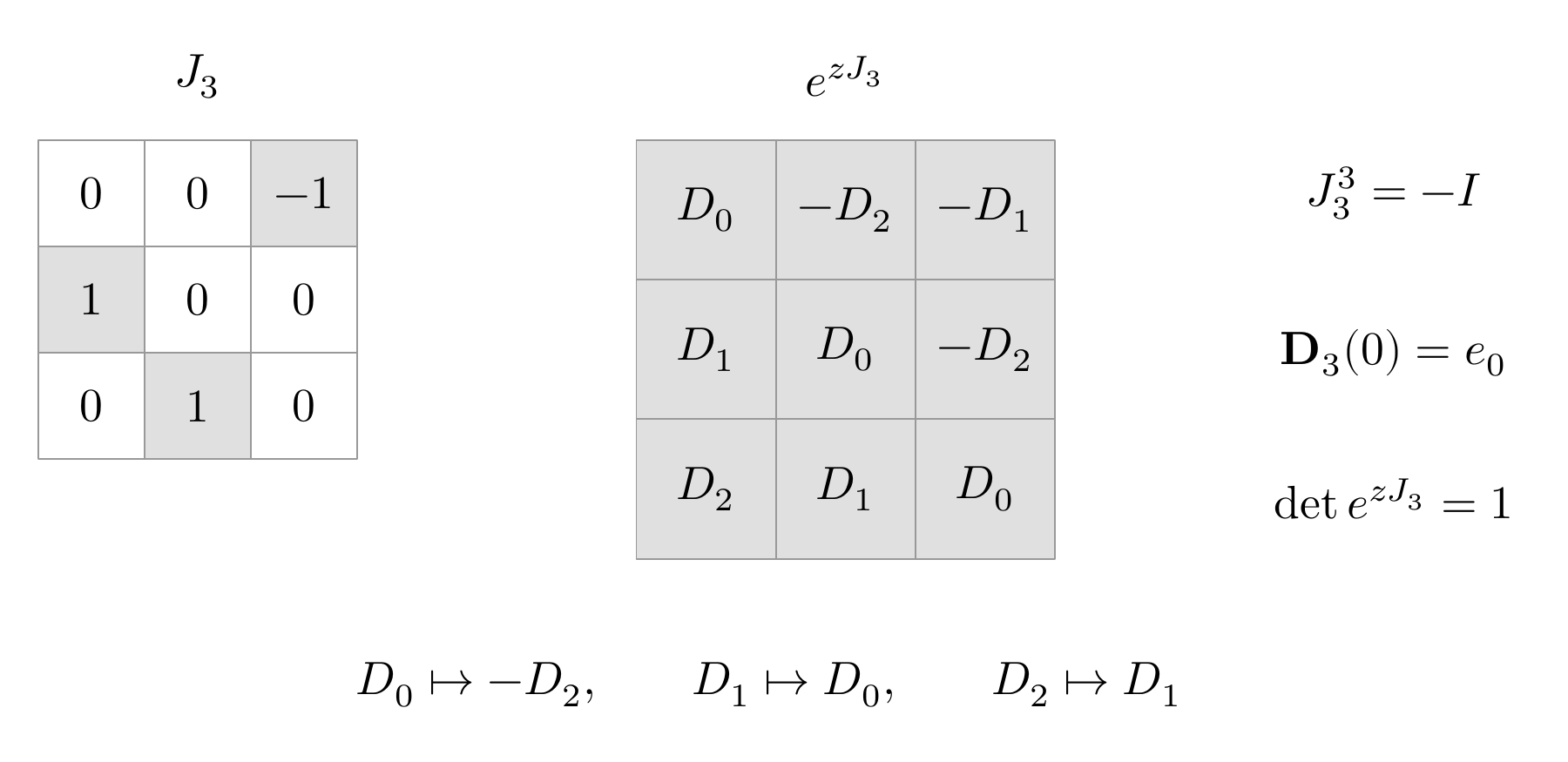
Let \(J_3e_0=e_1\), \(J_3e_1=e_2\), and \(J_3e_2=-e_0\). A complete turn changes sign, so \(J_3^3=-I\). The signed sections are the coordinates of \(e^{zJ_3}e_0\).
Reading the drawing
Read the two matrices by row and column in the ordered basis e₀, e₁, e₂. Columns describe inputs and rows describe outputs. The minus sign in the top-right corner closes the signed cycle. In the exponential matrix, each upper-triangular minus sign records a wrap across that edge. The derivative rules underneath use the abbreviated section names explained in the plate.
Drawing labels and data 24 labels
Read the original labels as selectable text. Tables preserve grid relationships; other short labels are grouped compactly.
| Row / column | Column 0 | Column 1 | Column 2 |
|---|---|---|---|
| Row 0 | \(0\) | \(0\) | \(-1\) |
| Row 1 | \(1\) | \(0\) | \(0\) |
| Row 2 | \(0\) | \(1\) | \(0\) |
| Row / column | Column 0 | Column 1 | Column 2 |
|---|---|---|---|
| Row 0 | \(D_{0}\) | \(- D_{2}\) | \(- D_{1}\) |
| Row 1 | \(D_{1}\) | \(D_{0}\) | \(- D_{2}\) |
| Row 2 | \(D_{2}\) | \(D_{1}\) | \(D_{0}\) |
Identities below the matrices
- \(J_3^3=-I\)
\(\mathbf D_3(0)=e_0\)
- \(\det e^{zJ_3}=1\)
Here \(D_j\) inside the matrix means \(D_{3,j}(z)\). For example,
Rows are output coordinates and columns are input coordinates. The upper-triangular minus signs record crossing the signed edge while moving from the column to the row. They are not arbitrary orientation choices.
Two checks connect the matrix and the scalar equation
The initial derivative matrix is the identity. Each initial jet \((y(0),y'(0),y''(0))\) therefore determines a unique linear combination. Also,
The roots of \(-1\) appearing later in the exponential sum are already the spectrum of this concrete matrix.
Read this as
The functions, their initial data, the addition law, and the exponent polygon come from one signed shift.
Evidence note from the source edition
The exact tests check every matrix-entry Taylor coefficient through degree 14 for \(N=1,\ldots,5\). The displayed determinant-one law is for \(N\ge2\). \(N=1\) is a separate boundary case.