
For \(1/\cos z\), the nearest poles are \(\rho=\pm\pi/2\). They contribute equally to even-degree coefficients. Including both poles gives
The factor two is orbit multiplicity, not an adjustable fitted constant.
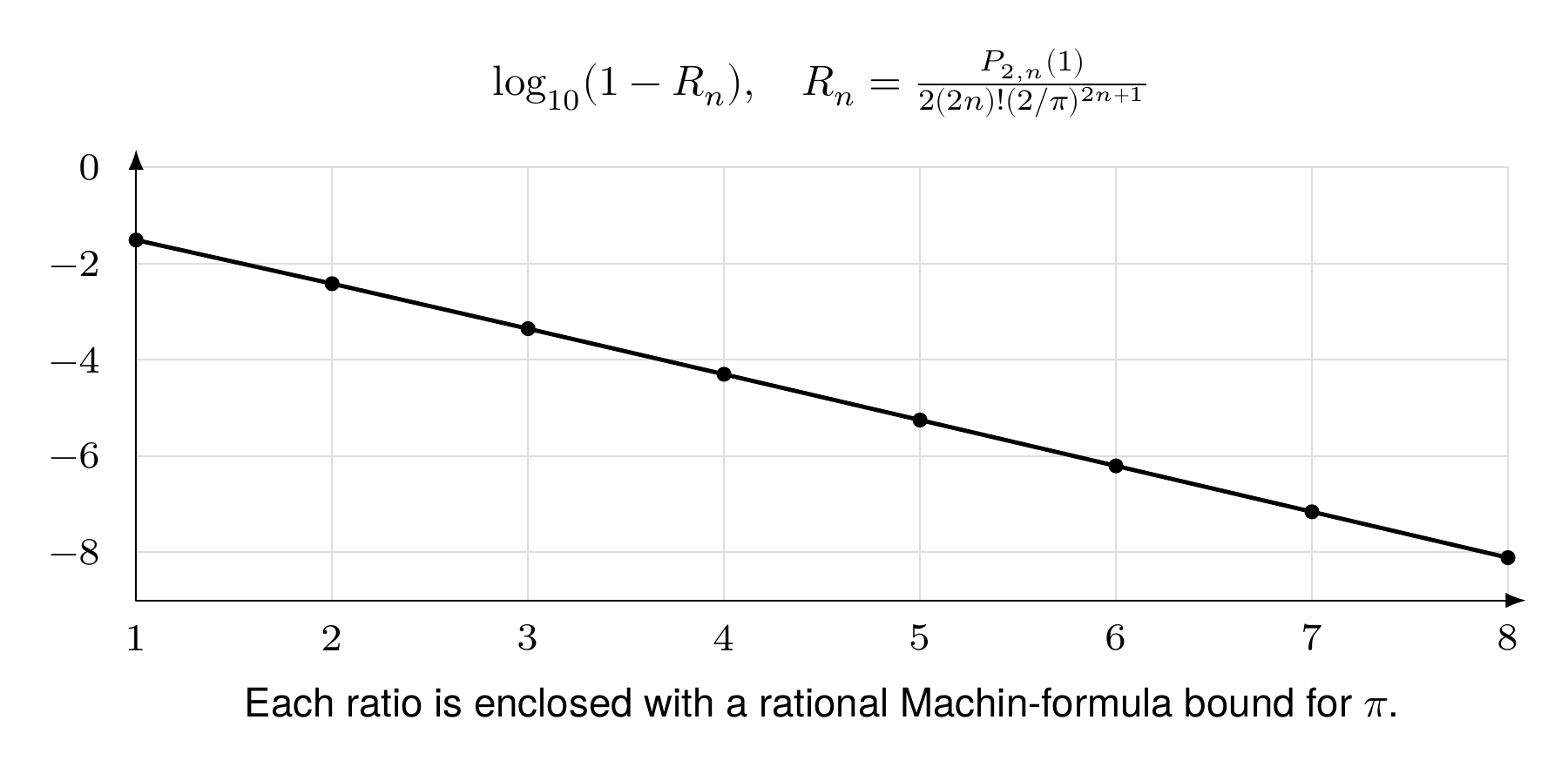
Reading the drawing
The horizontal ticks are the eight tested block indices. The vertical axis is the base-ten logarithm of one minus the enclosed coefficient ratio. The plotted values decrease as the approximation improves over this tested range. Rational bounds support these finite comparisons; the picture is not an additional all-index error theorem.
Drawing labels and data 15 labels
Read the original labels as selectable text. Tables preserve grid relationships; other short labels are grouped compactly.
Tested-index ticks
\(1\), \(2\), \(3\), \(4\), \(5\), \(6\), \(7\), \(8\)
Logarithmic-error ticks
\(-8\), \(-6\), \(-4\), \(-2\), \(0\)
Ratio and plotted quantity
Each ratio is enclosed with a rational Machin-formula bound for \(\pi\).
A finite quantitative check
For \(n=1,\ldots,8\), the exact integer coefficients and a rational enclosure for \(\pi\) bound the ratio \(R_n\) strictly between zero and one. In this tested range, \(1-R_n<3^{-(2n+1)}\). The plot displays the logarithm of the enclosed error, not an independently asserted all-\(n\) bound.
Higher reciprocal powers need more Laurent data
For positive integral order \(r\), a simple denominator zero becomes a pole of order \(r\). The highest Laurent term contributes a factor \(\binom{m+r-1}{r-1}\), but lower Laurent terms still contribute on the same exponential scale. Subtracting all principal parts is what leaves a holomorphic remainder controlled by the next zero radius.
Read this as
Nearest-zero geometry explains factorial-times-exponential growth. Multiplicity, reciprocal order, and lower principal parts determine its precise normalization.
Evidence note from the source edition
The ratio certificates use a rational Machin-formula enclosure for \(\pi\). The inherited general theorem retains simple nearest zeros, a gap to the next modulus, and positive integral reciprocal order. The plot does not remove those hypotheses.