
Order four gives a case with no asymptotic displacement at all. In normalized coordinates the positive radial locations are \(u=m+1/2\), while the reduced-zero locations are \(v=(m+1/2)^4\).
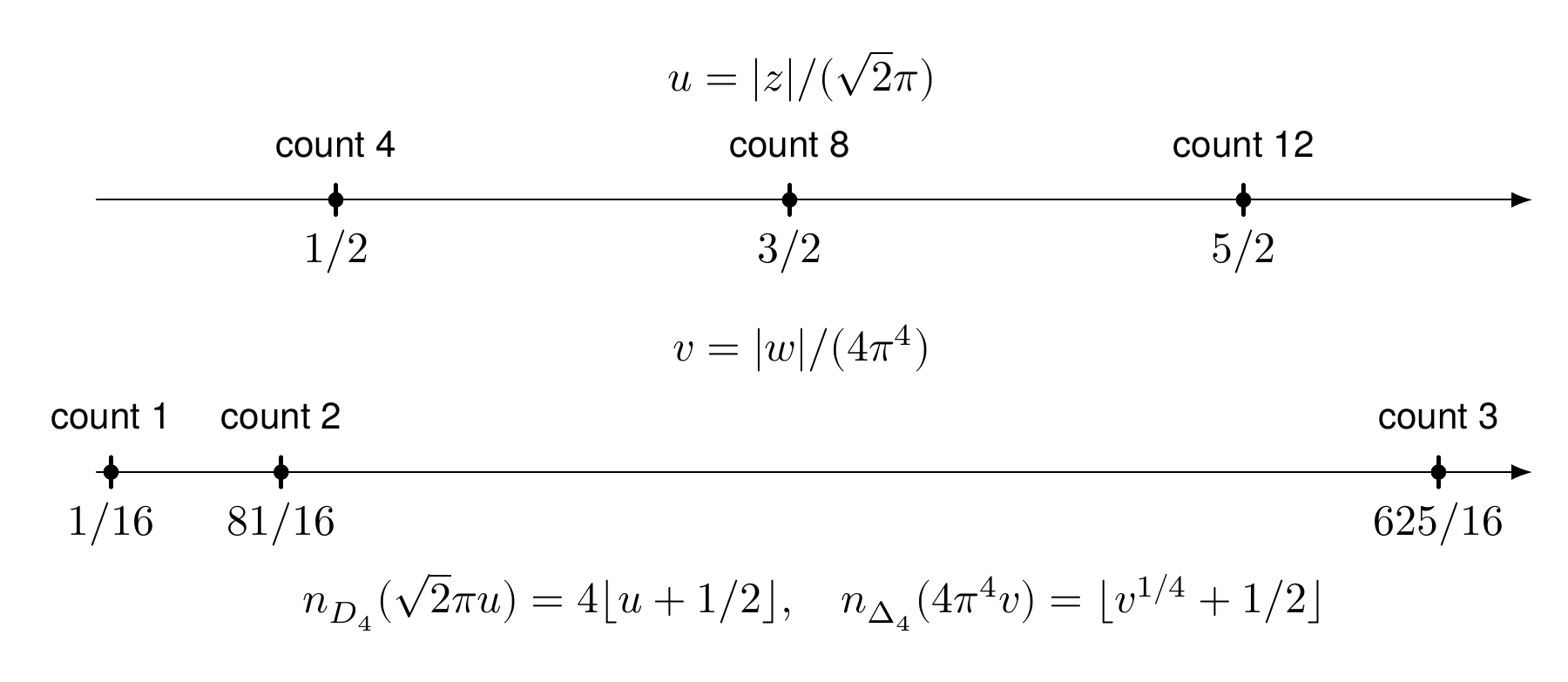
Reading the drawing
The upper row marks successive normalized radii and counts all four orbit members. The lower row marks their fourth powers and counts one reduced zero per orbit. The tables retain both the jump locations and the counts at those locations. The formulas include zeros on the disk boundary.
Drawing labels and data 15 labels
Read the original labels as selectable text. Tables preserve grid relationships; other short labels are grouped compactly.
| Radial location | Count at the jump |
|---|---|
| \(1/2\) | count 4 |
| \(3/2\) | count 8 |
| \(5/2\) | count 12 |
| Reduced location | Count at the jump |
|---|---|
| \(1/16\) | count 1 |
| \(81/16\) | count 2 |
| \(625/16\) | count 3 |
The two rows describe the same zero orbits. The upper row counts four zeros each time a new radius is reached. The lower row counts one reduced zero each time its fourth-power location is reached. Both formulas include zeros on the boundary of the disk.
Separate radius conversion from orbit multiplicity
In unscaled variables the general relation is
There are two operations here: replace the radius by its \(N\)th root and divide the count by \(N\). Forgetting either operation changes the leading constant. For this family the asymptotics are
The different powers agree with the entire-function orders \(1\) and \(1/N\).
Read this as
The reduced function has fewer repeated zeros and a different radius scale. Its counting law is not obtained by dividing a same-radius count alone.
Evidence note from the source edition
The exact order-four staircase formulas are tested at rational radii including jump points. The large-zero theorem for general \(N\) permits finitely many exceptions. These exact order-four identities do not justify discarding that boundary elsewhere.