
A formal unit series has a formal logarithm at the origin. To interpret that germ analytically, choose a simply connected zero-free region containing \(0\) and normalize the logarithm to vanish there.
Reading the drawing
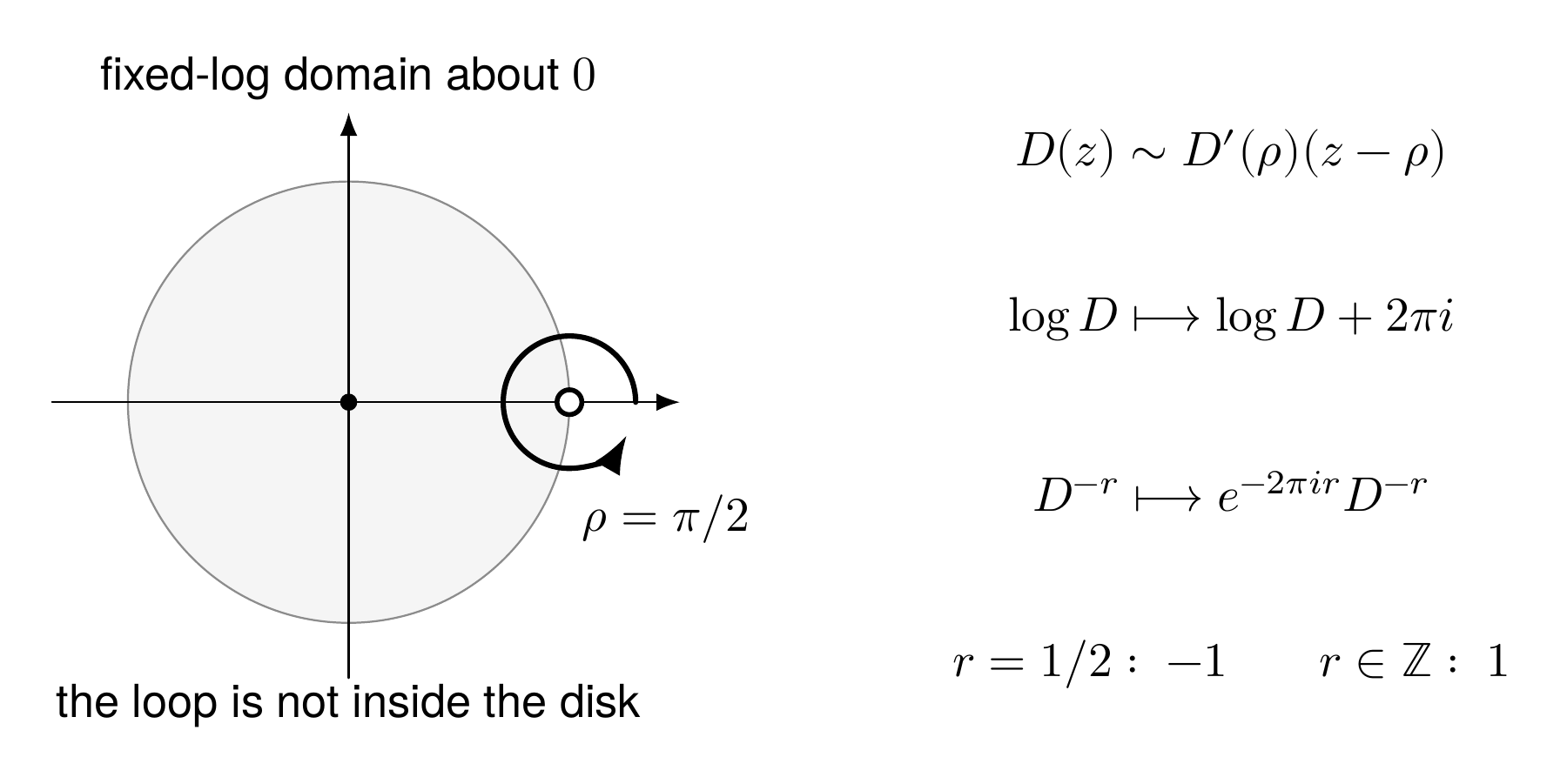
The shaded disk represents an admissible fixed-logarithm region around the origin. A separate loop encircles the marked simple zero outside that disk. The labels beneath the picture track the logarithm’s change and the resulting phase factor for the reciprocal power. This is a schematic domain picture, not a sampled proof of a winding-number statement.
Drawing labels and data 7 labels
Read the original labels as selectable text. Tables preserve grid relationships; other short labels are grouped compactly.
Admissible region
- fixed-log domain about \(0\)
Loop outside that region
- \(\rho=\pi/2\)
- the loop is not inside the disk
Local continuation rules
- \(D(z)\sim D^{\prime}(\rho)(z-\rho)\)
- \(\log D\longmapsto\log D+2\pi i\)
- \(D^{-r}\longmapsto e^{-2\pi i r}D^{-r}\)
Phase-factor examples
\(r=1/2:\ -1\qquad r\in\mathbb Z:\ 1\)
For \(D_2=\cos z\), the open disk \(|z|<\pi/2\) is an admissible domain. A small loop around the simple zero \(\rho=\pi/2\) is not contained in that disk. Analytic continuation around the zero changes the local logarithm by \(2\pi i\), and the power by \(e^{-2\pi ir}\).
Three different kinds of statement
A formal identity compares coefficients at the origin. A holomorphic identity for complex powers uses a common specified logarithm. A positive integer reciprocal power is globally meromorphic and needs no branch choice. These scopes cannot be exchanged without a further argument. For example, \(D^{-r}D^{-s}=D^{-(r+s)}\) is immediate using one fixed logarithm. Combining values built from unrelated branches can introduce additional phase factors.
Read this as
The branch choice is mathematical data. It is not a plotting convention that can be removed by drawing a cleaner curve.
Evidence note from the source edition
The domain picture is schematic. The phase change comes from the local simple-zero model and winding number, not from a sampled loop. Later nearest-pole asymptotics retain positive integral reciprocal order.