
The hypergeometric form is another way to organize the same coefficients. It does not introduce an extra function into the construction. Split a factorial into its residue classes and divide each factor by \(N\):
The parameter equal to \(1\) is omitted from \(A_{N,j}\) because the hypergeometric convention already supplies \((1)_n=n!\).
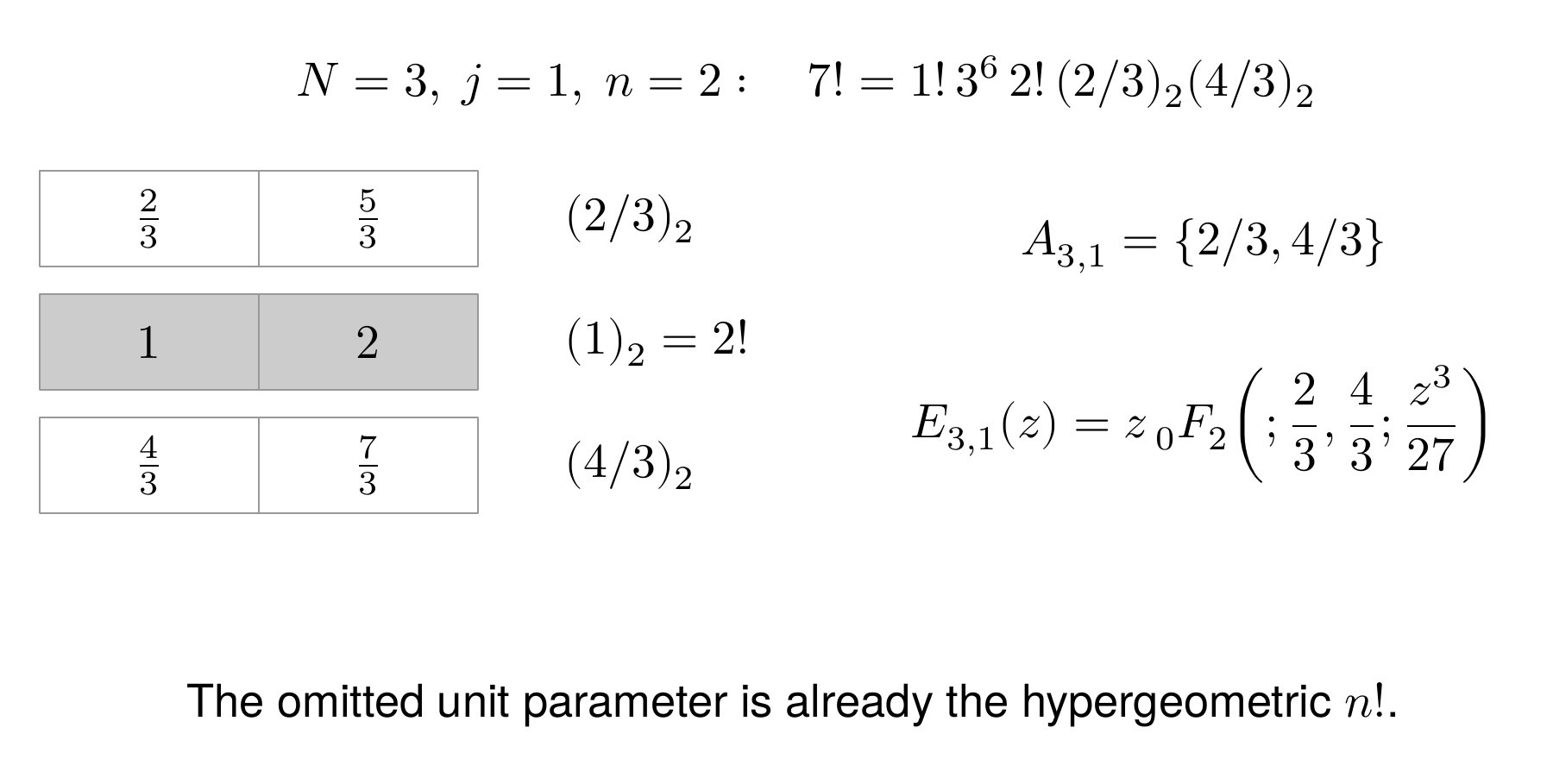
Reading the drawing
The rows separate the scaled factorial factors by residue. Their two entries multiply to the Pochhammer product in the last column. The middle row supplies the factorial already present in hypergeometric notation, so its unit parameter is omitted from the parameter set. The final formula retains both the initial monomial and the argument scaling.
Drawing labels and data 13 labels
Read the original labels as selectable text. Tables preserve grid relationships; other short labels are grouped compactly.
| First factor | Second factor | Product |
|---|---|---|
| \(\frac{2}{3}\) | \(\frac{5}{3}\) | \((2/3)_2\) |
| \(1\) | \(2\) | \((1)_2=2!\) |
| \(\frac{4}{3}\) | \(\frac{7}{3}\) | \((4/3)_2\) |
- \(A_{3,1}=\{2/3,4/3\}\)
The omitted unit parameter is already the hypergeometric \(n!\).
Check the displayed case
For \(N=3,j=1,n=2\), the six factors after the initial \(1!\) are \(2,3,4,5,6,7\). Dividing by three and grouping them gives the three rows of the plate. The middle row supplies \(2!\). The others supply \((2/3)_2\) and \((4/3)_2\). The right-hand side is exactly \(5040\). Consequently,
The prefactor \(z\) retains the forced zero at the origin. The hypergeometric argument \(z^3/27\) retains the scaling \(N^N\).
Read this as
Parameters, the omitted unit parameter, the prefactor, and the argument scaling all come from factorial bookkeeping.
Evidence note from the source edition
Five choices of \((N,j)\) are checked against the exact factorial identity for \(n=0,\ldots,7\). These finite checks support the example. The general analytic identification belongs to the inherited manuscript.