
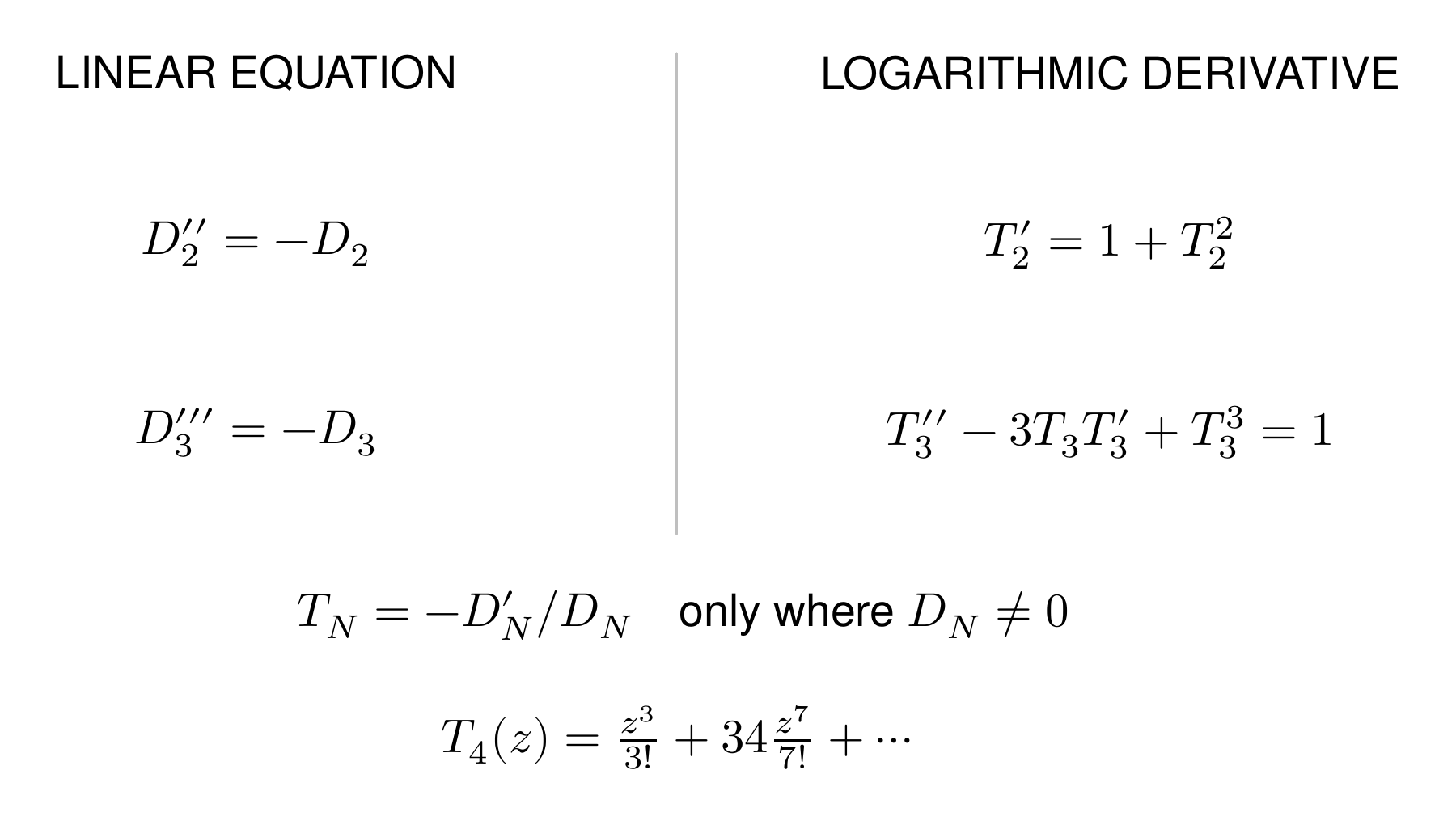
The transfer tangent is \(T_N=-D_N'/D_N\). It compresses the linear differential equation into a nonlinear scalar identity. This division is allowed only on the zero-free set of the denominator.
Reading the drawing
Read each row across: the denominator equation on the left becomes the corresponding nonlinear tangent equation on the right. The line below restricts logarithmic differentiation to the nonzero set of the denominator. The last line gives an order-four tangent series as a separate coefficient example.
Drawing labels and data 8 labels
Read the original labels as selectable text. Tables preserve grid relationships; other short labels are grouped compactly.
| LINEAR EQUATION | LOGARITHMIC DERIVATIVE |
|---|---|
| \(D_2^{\prime\prime}=-D_2\) | \(T_2^{\prime}=1+T_2^2\) |
| \(D_3^{\prime\prime\prime}=-D_3\) | \(T_3^{\prime\prime}-3T_3T_3^{\prime}+T_3^3=1\) |
The coefficients retain the reduced logarithmic information:
For order four, \(\kappa_{4,1}=1/24\) and \(\kappa_{4,2}=17/10080\). These give \(T_4(0)=1\) and \(T_4(1)=34\), explaining the last line of the plate.
A nonlinear equation with a precise origin
If \(D=e^g\) locally, then \(g'=-T\). Differentiating \(e^g\) three times gives \(D'''/D=-T''+3TT'-T^3\). Setting \(D'''/D=-1\) yields the cubic Riccati identity shown above. No additional nonlinear model has been assumed. The reciprocal family also satisfies \((D_N^{-r})'=rT_ND_N^{-r}\) on a fixed-log domain. The tangent has a pole at each zero of \(D_N\). Positive integer reciprocal powers also have poles there. General complex powers retain the stated branch convention.
Read this as
The nonlinear tangent equation is exact where division is legal. It is not a global regular differential equation across the zeros.
Evidence note from the source edition
The tests verify the tangent coefficient recurrence, the exact cubic ODE, and the symbolic Riccati reduction after clearing denominators. The order-one tangent is the separate constant function \(T_1=1\).